Aperçu en situation
 Envoyer
 Partager
 Détails de l'œuvre

 Télécharger
 Articles similaires
 Radiographie
 Diaporama
Night


 Lire la suite
Reproduction à l'huile faite à la main
Huile sur toile peinte à la main, avec cadre et dimensions personnalisés, réalisée sur commande par nos artistes. ( Commander l'impression Acheter l'image haute résolution)




P118B $10

P118H $10

P118W $10

P438Z $10

P508JH $12

P508YH $12

P805H $10

P805Z $10

P919BZ $10

P919G $10

P919XJ $10

P959ZH $10

P968JZ $12

W106C $8

W218G $10

W218JH $8

W218Y $10

W307PJ $10

W316G $10

W316PJ $8

W316Y $10

W398PJ $8

W4111J $10

W500HY $15

W500JH $15

W692G $12

W849H $8

W940BG $15

W953PJ $8




Choisissez parmi nos formats prédéfinis qui respectent les proportions originales de l’œuvre.

Vous pouvez saisir vos propres dimensions pour l'adapter à un cadre ou à un espace spécifique. Si la taille sélectionnée ne correspond pas aux proportions de l'image d'origine, nous recadrerons l'œuvre ou prolongerons la peinture avec des éléments peints à la main supplémentaires. Une maquette numérique vous sera envoyée pour approbation avant le début de la production.
Veuillez noter que l'aperçu à l'écran ne reflète pas le recadrage ou l'extension réels. Seule la maquette montrera fidèlement la composition finale.
Bien que des tailles personnalisées soient disponibles, nous vous recommandons de sélectionner une dimension dans la liste prédéfinie afin de préserver les proportions d'origine.
Après la commande, l’équipe OriginalUniqueArt.com contactera le client par e-mail pour recueillir ses instructions et lui fournira une maquette d’aperçu
Livraison dans le monde entier () en 3 à 4 semaines au lieu des 5 semaines habituelles. (30 août). Aucun compromis sur la qualité.

Livraison express gratuite dans le monde entier

Toile de lin de qualité supérieure

Assurance transport complète

Garantie de remboursement des droits de douane

Garantie de fidélité des couleurs

Politique de retour de 60 jours (uniquement en cas de défaut)

Garantie de remboursement à 100%

Offre de tarifs dégressifs
 L'option verre n'est disponible que pour les dimensions inférieures à 110 cm.

Night
Technique de reproduction
Format de la reproduction
-


Prix total
$ 300
A Visceral Encounter with Mortality
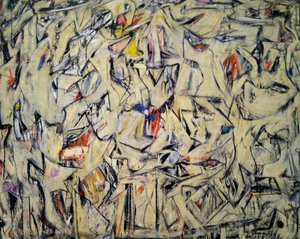
In the hauntingly rendered depths of Willem de Kooning’s 1948 masterpiece, “Night,” viewers are not merely observers but participants in a profound existential drama. The painting presents a striking, unsettling juxtaposition: a female face emerges from the shadows, only to be overlaid with the stark, skeletal imagery of a skull. This collision of beauty and decay establishes a central preoccupation that has defined much of de Kooning’s illustrious career. It is an image that refuses to offer comfort, instead forcing a confrontation with the fragility of life. The subject matter transcends simple portraiture, acting as a window into the human condition where the vitality of femininity battles against the encroaching darkness of mortality.
The emotional resonance of the piece is amplified by its place within the heart of Abstract Expressionism. Born from the profound disillusionment and psychological upheaval of the post-World War II era, "Night" embodies the movement's characteristic intensity. De Kooning abandons the safety of realism to prioritize raw feeling over precise form. There is a palpable sense of anxiety woven into every stroke, reflecting a period when artists were grappling with the trauma of global conflict and the terrifying uncertainties of a new atomic age. To stand before this work is to feel the weight of that historical tension, making it an essential piece for those who appreciate art that speaks to the deepest, often unspoken, layers of the human psyche.
The Language of Gesture and Texture
Technically, "Night" is a masterclass in the action painting style that would soon define the New York School. De Kooning utilized a bold, visceral palette—dominated by deep blacks, fiery reds, and jarring yellows—to create a sense of movement and instability. His technique relies heavily on thick impasto, where layers of oil paint are applied with such vigor that the canvas takes on a three-dimensional, sculptural quality. These heavy, deliberate strokes do not merely depict a scene; they record the physical and emotional energy of the artist himself. The texture is so dense that it creates a rhythmic, almost turbulent surface, mirroring the internal chaos of the subject matter.
Beyond the central figures, the composition is enriched by subtle, enigmatic elements that invite endless reinterpretation. A checkered pattern drifts through the background, adding a layer of geometric tension and depth that contrasts sharply with the organic, fluid forms of the face and skull. The presence of fragmented motifs—hints of a bird or perhaps a distant car—suggests a world in flux, where the boundaries between the subconscious and reality are perpetually blurred. For the discerning collector or interior designer, this painting offers more than just visual impact; it provides a sophisticated focal point that commands attention through its complexity, making it a timeless addition to any space dedicated to profound artistic expression.
Biographie de l'artiste
jeunesse et carrière
Willem de Kooning, un artiste expressionniste abstrait néerlandais-américain renommé, est né le 24 avril 1904 à Rotterdam, aux Pays-Bas. Ses parents, Leendert de Kooning et Cornelia Nobel, ont divorcé en 1907, et de Kooning a vécu avec son père avant de passer sous la tutelle de sa mère. Il quitte l'école en 1916 et devient apprenti dans un cabinet d'arts commerciaux.développement artistique
De Kooning a suivi des cours du soir à l’Académie des Beaux-Arts et des Sciences Techniques à Rotterdam de 1916 à 1924. En 1927, il s'installe à New York City, où il travaille comme peintre décorateur et commence à développer son style artistique unique.expressionnisme abstrait
Le travail de De Kooning a évolué vers l’expressionnisme abstrait dans les années 1950, caractérisé par des coups de pinceau audacieux et des couleurs vibrantes. Sa peinture Woman I (1950-1952) est une œuvre fondamentale de ce mouvement, combinant la figuration à l'improvisation et à l'intensité émotionnelle.œuvres notables et collections
* The Glazier (137 x 112 cm, huile sur toile) : une peinture sombre aux tons terreux inspirée des fresques de Boscoreale. * Door to the River (expressionnisme abstrait) : une peinture à large coup de pinceau rappelant son passé de peintre décorateur. * Standing Man (expressionnisme abstrait) : un exemple caractéristique du style expressionniste abstrait de De Kooning.musées et collections
* Musée Boijmans Van Beuningen, Rotterdam, aux Pays-Bas : présente une impressionnante collection de plus de 151 000 œuvres d'art. * Bibliothèque universitaire de Leiden, aux Pays-Bas : abrite un centre culturel important avec plus de 5 200 000 volumes et 1 000 000 de livres électroniques. L'héritage de Willem de Kooning continue d'inspirer les artistes et les amateurs d'art, consolidant ainsi sa place en tant que pionnier de l'expressionnisme abstrait.
Willem de Kooning
1904 - 1997 , Pays-Bas
L'essentiel de l'artiste
- Artistes Influents: ['Arshile Gorky']
- Date De Décès: 19 mars 1997
- Date De Naissance: 24 avril 1904
- Lieu De Naissance: Rotterdam, Pays-Bas
- Mouvement Artistique: Expressionnisme abstrait
- Nationalité: Néerlandais-Américain
- Nom Complet: Willem de Kooning
- Oeuvres Notables:
- Woman I
- The Glazier
- Excavation
Articles connexes

Expressionnisme Abstrait : Les 10 Chefs-d'Œuvre Incontournables pour Décorer avec Art et Histoire
Plongez au cœur de l'Expressionnisme Abstrait avec ! Découvrez les 10 œuvres majeures de Pollock, Rothko et De Kooning. Histoire, techniques & inspiration déco. Explorez la collection complète en ligne.

Goya : 25 Chefs-d'Œuvre Inoubliables d'un Maître de l'Âme
Plongez au cœur de l'œuvre inégalable de Goya ! Découvrez 25 chefs-d’œuvre emblématiques, des portraits saisissants aux scènes dramatiques. Explorez la vie et l'art du maître espagnol avec OriginalUniqueArt.com – reproductions d'art de qualité musée et inspirations déco.

Willem de Kooning : Abstraction, Geste et Évolution de la Peinture Américaine d'Après-Guerre
Explorez l'évolution artistique de Willem de Kooning et son rôle clé dans l'expressionnisme abstrait américain. Analyse approfondie, influences européennes et héritage durable pour les collectionneurs avertis.
Au-Delà de la Représentation : Exploration du Paysage Émotionnel de l'Expressionnisme Abstrait
Explorez l'univers fascinant de l'Expressionnisme Abstrait avec OriginalUniqueArt. Analyse approfondie des maîtres (Pollock, Rothko, De Kooning) et conseils d'experts pour collectionner ces œuvres emblématiques. Découvrez une sélection unique.

Kandinsky : Les 25 Œuvres Maîtresses d'un Pionnier de l'Art Abstrait | OriginalUniqueArt
Plongez dans l'univers vibrant de Kandinsky ! Découvrez les 25 œuvres majeures du pionnier de l'art abstrait. Explorez son expressionnisme, ses couleurs audacieuses et l'histoire fascinante derrière chaque tableau. Reproductions d'exception sur OriginalUniqueArt.com.