Aperçu en situation
 Partager
 Partager
 Détails
 Guide imprimable

 Télécharger
 Articles similaires
 Radiographie
 Voir le diaporama
 Statistiques
A Tree in Naples


 Afficher la suite
L’œuvre d'art présentée sur cette page est protégée par le droit d'auteur, ce qui signifie que nous ne pouvons légalement créer ou vendre de reproduction identique. Cette protection est appliquée en vertu d'accords internationaux tels que la Convention de Berne et par les lois nationales, notamment celles énoncées par le Loi américaine sur le droit d'auteur - Titre 17.
En tant qu'alternative respectueuse et légale, nous proposons des œuvres d'art personnalisées, peintes à la main et inspirées de l'original. Nos artistes talentueux et professionnels étudient avec soin le style, l'ambiance et l'essence artistique de l'œuvre originale pour créer une pièce nouvelle et unique qui évoque la même émotion — tout en restant une création originale en soi.
Cette méthode est pleinement conforme aux réglementations sur le droit d'auteur car elle ne repose pas sur la copie ou la duplication de l'œuvre protégée. Il s'agit plutôt d'une réinterprétation créative — une nouvelle peinture qui s'inspire de l'original sans pour autant lui être identique.
Reproduction à l'huile faite à la main
Huile sur toile peinte à la main, avec cadre et dimensions personnalisés, réalisée sur commande par nos artistes. ( Passer au format impression Passer au format image numérique)




P118B €10

P118H €10

P118W €10

P438Z €10

P508JH €12

P508YH €12

P805H €10

P805Z €10

P919BZ €10

P919G €10

P919XJ €10

P959ZH €10

P968JZ €12

W106C €8

W218G €10

W218JH €8

W218Y €10

W307PJ €10

W316G €10

W316PJ €8

W316Y €10

W398PJ €8

W4111J €10

W500HY €15

W500JH €15

W692G €12

W849H €8

W940BG €15

W953PJ €8




Choisissez parmi nos formats prédéfinis qui respectent les proportions originales de l’œuvre.

Saisissez la largeur et la hauteur souhaitées, pour s'adapter à votre cadre ou à votre mur. Cette œuvre est peinte à la main ; ainsi, pour un format de forme différente, l'artiste peut peindre un peu plus autour du tableau ou réduire légèrement les bords — c'est vous qui choisissez. Nous vous envoyons une maquette numérique pour approbation avant que la peinture ne commence. L'image présentée sur cette page ne reflète pas le résultat réel — seule la maquette le fait.
Après la commande, l’équipe OriginalUniqueArt.com contactera le client par e-mail pour recueillir ses instructions et lui fournira une maquette d’aperçu
Livraison dans le monde entier () en 3 à 4 semaines au lieu des 5 semaines habituelles. (22 octobre). Aucun compromis sur la qualité.

Livraison express gratuite dans le monde entier

Toile de lin de haute qualité

Assurance transport complète

Garantie de remboursement des droits de douane

Garantie de fidélité des couleurs

Garantie de retour de 100 jours (uniquement en cas de défaut)

Garantie de remboursement à 100%

Tarifs dégressifs sur quantité
 L'option verre n'est disponible que pour les dimensions inférieures à 110 cm.

A Tree in Naples
Technique de reproduction
Format de la reproduction
-


Prix total final
€ 263
A Tree in Naples: An Exploration of Nature's Essence Through Abstract Expressionism
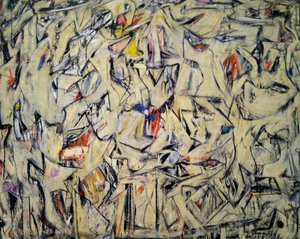
“A Tree in Naples,” created by Willem de Kooning in 1960, stands as a pivotal work within the realm of Abstract Expressionism—a movement that irrevocably altered the trajectory of American art history. More than just a depiction of foliage, this painting embodies De Kooning’s profound engagement with the natural world, translating its intangible qualities into a visual language characterized by bold gestures and vibrant hues.
De Kooning himself articulated his inspiration: “Just coming around roads, some place, and having the sensation of a piece of it, a piece of nature, like a fence, something on the road. And I really get very elated by again looking, by again seeing that the sky is blue, that the grass is green.” This simple statement reveals an artist deeply attuned to sensory experience—a desire to distill the essence of landscape into a form devoid of literal representation.
De Kooning's Technique: A Dance of Color and Gesture
Rejecting traditional artistic conventions, De Kooning employed a technique rooted in spontaneity and emotional expression. Vast brushstrokes dominate the canvas, conveying movement and dynamism—a deliberate departure from meticulous realism. Thick impasto creates textural richness, highlighting the physicality of the painting process itself. Visible marks and splatters contribute to its expressive character, mirroring the artist’s intuitive response to his subject matter.
Palette knives were utilized extensively in certain areas, further amplifying the texture and depth of the artwork. This method aligns perfectly with the core tenets of Abstract Expressionism—where conveying emotion transcends precise visual accuracy. The color palette is dominated by blues and reds, punctuated by whites and blacks, reflecting De Kooning’s fascination with capturing atmospheric conditions.
Historical Context: The New York School and Post-War Abstraction
"A Tree in Naples" emerged during the formative years of Abstract Expressionism—the first major American modern art movement following World War II. Artists like Jackson Pollock, Lee Krasner, and Franz Kline coalesced into “The New York School,” challenging established artistic norms and prioritizing subjective experience.
De Kooning’s work exemplifies this paradigm shift away from representational art toward a more personal and emotionally resonant aesthetic. The painting's stylistic choices—the expansive brushstrokes, the bold color palette—were directly influenced by fellow artists experimenting with similar approaches during this period.
Emotional Impact and Symbolism
Despite its lack of recognizable imagery, “A Tree in Naples” resonates deeply with viewers through its evocative emotional power. The interplay of color and line generates a palpable sense of vitality—a reflection of De Kooning’s fascination with capturing the fleeting beauty of nature.
Rather than portraying a specific tree, the painting seeks to convey *feeling*—the sensation of immersion in a landscape bathed in sunlight. It invites contemplation and interpretation, encouraging viewers to engage with the artwork on an emotional level. The simplification of visual vocabulary underscores De Kooning’s commitment to conveying profound ideas through abstract forms.
Ultimately, “A Tree in Naples” serves as a testament to De Kooning's artistic vision—a bold declaration that art can transcend literal depiction and communicate universal emotions.
Questions et réponses
À quel point les couleurs de «A Tree in Naples» de Willem de Kooning sont-elles harmonieuses ?
«A Tree in Naples» de Willem de Kooning présente une harmonie de couleurs Harmonie chromatique intense.
De quoi est fait « A Tree in Naples » ?
Le médium de «A Tree in Naples» de Willem de Kooning est Huile sur toile. Les reproductions visent à restituer l'aspect de cette technique.
L'œuvre « A Tree in Naples » est-elle libre de droits ?
Concernant les droits d'auteur, « A Tree in Naples » est dans le toujours protégé par le droit d'auteur.
Biographie de l'artiste
jeunesse et carrière
Willem de Kooning, un artiste expressionniste abstrait néerlandais-américain renommé, est né le 24 avril 1904 à Rotterdam, aux Pays-Bas. Ses parents, Leendert de Kooning et Cornelia Nobel, ont divorcé en 1907, et de Kooning a vécu avec son père avant de passer sous la tutelle de sa mère. Il quitte l'école en 1916 et devient apprenti dans un cabinet d'arts commerciaux.développement artistique
De Kooning a suivi des cours du soir à l’Académie des Beaux-Arts et des Sciences Techniques à Rotterdam de 1916 à 1924. En 1927, il s'installe à New York City, où il travaille comme peintre décorateur et commence à développer son style artistique unique.expressionnisme abstrait
Le travail de De Kooning a évolué vers l’expressionnisme abstrait dans les années 1950, caractérisé par des coups de pinceau audacieux et des couleurs vibrantes. Sa peinture Woman I (1950-1952) est une œuvre fondamentale de ce mouvement, combinant la figuration à l'improvisation et à l'intensité émotionnelle.œuvres notables et collections
* The Glazier (137 x 112 cm, huile sur toile) : une peinture sombre aux tons terreux inspirée des fresques de Boscoreale. * Door to the River (expressionnisme abstrait) : une peinture à large coup de pinceau rappelant son passé de peintre décorateur. * Standing Man (expressionnisme abstrait) : un exemple caractéristique du style expressionniste abstrait de De Kooning.musées et collections
* Musée Boijmans Van Beuningen, Rotterdam, aux Pays-Bas : présente une impressionnante collection de plus de 151 000 œuvres d'art. * Bibliothèque universitaire de Leiden, aux Pays-Bas : abrite un centre culturel important avec plus de 5 200 000 volumes et 1 000 000 de livres électroniques. L'héritage de Willem de Kooning continue d'inspirer les artistes et les amateurs d'art, consolidant ainsi sa place en tant que pionnier de l'expressionnisme abstrait.
Willem de Kooning
1904 - 1997 , Pays-Bas
En bref
- Artistes Influents: ['Arshile Gorky']
- Date De Décès: 19 mars 1997
- Date De Naissance: 24 avril 1904
- Lieu De Naissance: Rotterdam, Pays-Bas
- Mouvement Artistique: Expressionnisme abstrait
- Nationalité: Néerlandais-Américain
- Nom Complet: Willem de Kooning
- Oeuvres Notables:
- Woman I
- The Glazier
- Excavation
Articles connexes

Kandinsky : Les 25 Œuvres Maîtresses d'un Pionnier de l'Art Abstrait | OriginalUniqueArt
Plongez dans l'univers vibrant de Kandinsky ! Découvrez les 25 œuvres majeures du pionnier de l'art abstrait. Explorez son expressionnisme, ses couleurs audacieuses et l'histoire fascinante derrière chaque tableau. Reproductions d'exception sur OriginalUniqueArt.com.

Au-Delà de la Représentation : Exploration du Paysage Émotionnel de l'Expressionnisme Abstrait
Explorez l'univers fascinant de l'Expressionnisme Abstrait avec OriginalUniqueArt. Analyse approfondie des maîtres (Pollock, Rothko, De Kooning) et conseils d'experts pour collectionner ces œuvres emblématiques. Découvrez une sélection unique.

Expressionnisme Abstrait : Les 10 Chefs-d'Œuvre Incontournables pour Décorer avec Art et Histoire
Plongez au cœur de l'Expressionnisme Abstrait avec ! Découvrez les 10 œuvres majeures de Pollock, Rothko et De Kooning. Histoire, techniques & inspiration déco. Explorez la collection complète en ligne.

Willem de Kooning : Abstraction, Geste et Évolution de la Peinture Américaine d'Après-Guerre
Explorez l'évolution artistique de Willem de Kooning et son rôle clé dans l'expressionnisme abstrait américain. Analyse approfondie, influences européennes et héritage durable pour les collectionneurs avertis.

Goya : 25 Chefs-d'Œuvre Inoubliables d'un Maître de l'Âme
Plongez au cœur de l'œuvre inégalable de Goya ! Découvrez 25 chefs-d’œuvre emblématiques, des portraits saisissants aux scènes dramatiques. Explorez la vie et l'art du maître espagnol avec OriginalUniqueArt.com – reproductions d'art de qualité musée et inspirations déco.