

 Aperçu en situation
 Envoyer
 Partager
 Détails de l'œuvre
 Guide
Guide

 Télécharger l'image
 Articles similaires
 Radiographie
 Diaporama
 Statistiques
The Bar Parlour
 Oil
Oil- WallArt
- Impressionist Painting
 1922
1922- Modern
 104.0 x 158.0 cm
 Fitzwilliam College
 Lire la suite
Giclées et impressions d'art
Impressions giclées ou sur toile de qualité musée, avec une production rapide et des finitions au choix. ( Commander la reproduction peinte à la main Passer au format numérique)




P118B €10

P118H €10

P118W €10

P438Z €10

P508JH €12

P508YH €12

P805H €10

P805Z €10

P919BZ €10

P919G €10

P919XJ €10

P959ZH €10

P968JZ €12

W106C €8

W218G €10

W218JH €8

W218Y €10

W307PJ €10

W316G €10

W316PJ €8

W316Y €10

W398PJ €8

W4111J €10

W500HY €15

W500JH €15

W692G €12

W849H €8

W940BG €15

W953PJ €8




Choisissez parmi nos formats prédéfinis qui respectent les proportions originales de l’œuvre.

Saisissez la largeur et la hauteur souhaitées pour qu'elles s'adaptent à votre cadre ou à votre mur. Une impression peut être recadrée, mais jamais agrandie au-delà de l'image originale ; ainsi, un format de forme différente entraînera la perte d'une partie de l'image. Nous vous envoyons une maquette numérique pour approbation avant toute impression. L'image présentée sur cette page ne montre pas le recadrage réel — seule la maquette le permet.
Livraison dans le monde entier () en 2 semaines au lieu des 4/5 semaines habituelles. (28 octobre)

Livraison express gratuite dans le monde entier

Toile de lin de qualité supérieure

Assurance transport complète

Garantie de remboursement des droits de douane

Garantie de fidélité des couleurs

Politique de retour de 100 jours (uniquement en cas de défaut)

Garantie de remboursement à 100%

Offre de tarifs dégressifs
 L'option verre n'est disponible que pour les dimensions inférieures à 110 cm.

The Bar Parlour
Giclées et impressions d'art
Format de la reproduction
-


Prix total
€ 70
A Glimpse into London's Twilight: The Soul of Sickert's Bar Parlour
In the quiet, amber-hued corners of early twentieth-century London, Walter Richard Sickert found his most profound muses. The Bar Parlorp, painted in 1922, serves as a masterful window into a world that exists in the soft periphery of the bustling metropolis. This evocative piece captures a fleeting moment of repose within a dimly lit establishment, where the boundaries between public life and private intimacy begin to blur. Through his distinctive lens, Sickert does not merely document a scene; he invites the viewer to sit at the table, to feel the weight of the afternoon shadows, and to become a silent participant in this intimate tableau of everyday existence.
The composition is anchored by three figures who inhabit the space with a natural, unforced grace. Two women are seated at a table, their presence suggesting a shared confidence or perhaps a momentary respite from the world outside, while a man leans against the counter behind them, his posture embodying the weary yet watchful character of the urban dweller. There is a profound sense of theatricality in this arrangement—a nod to Sickert’s own early ambitions on the London stage. Every element, from the scattered bottles on the counter to the humble loaf of bread resting on the table, contributes to a narrative of domesticity found within the public sphere, creating a scene that feels both deeply personal and universally recognizable.
The Mastery of Impressionistic Light and Texture
Technically, The Bar Parlour is a triumph of late Impressionist sensibility. Sickert eschews the sharp, clinical lines of realism in favor of loose, expressive brushstrokes that prioritize atmosphere over anatomical precision. This technique allows the light to perform its own magic; rather than being a harsh, direct force, the illumination is soft and diffused, as if filtering through a haze of tobacco smoke and dust motes. The color palette is a sophisticated study in earth tones—deep ochres, warm umbers, and muted shadows—which coalesce to create an inviting, nostalgic warmth that wraps around the viewer like a heavy velvet curtain.
For the discerning collector or interior designer, this painting offers more than mere decoration; it provides a focal point of profound emotional depth. The texture of the paint itself adds a tactile dimension to the work, suggesting the weathered surfaces of the bar and the soft fabrics of the figures' attire. When rendered as a high-quality reproduction, the interplay of light and shadow retains its ability to transform a room, lending an air of sophisticated melancholy and timeless elegance to any curated space. It is a piece that does not demand attention through loudness, but rather commands it through a quiet, irresistible magnetism.
A Legacy of Shadows and Human Connection
To understand the emotional resonance of this work, one must consider Sickert’s unique position as an artist caught between German heritage and British urbanity. His fascination with the "marginalized" and the "unseen" is palpable here. There is no grand historical drama unfolding in The Bar Parlour; instead, the drama lies in the subtle psychological tension between the characters and the heavy, comforting stillness of their environment. It is a celebration of the mundane, elevated to the level of high art through sheer observational genius.
Owning or displaying a reproduction of this masterpiece allows one to bring a piece of London's historical soul into the modern home. It serves as a reminder of the beauty found in the quiet intervals of life—the moments of stillness amidst the chaos of progress. For those seeking to infuse their interiors with a sense of history, warmth, and intellectual depth, Sickert’s vision offers an unparalleled source of inspiration, bridging the gap between the fleeting present and the enduring past.
Questions et réponses
Quelle est la luminance de «The Bar Parlour» de Walter Richard Sickert ?
«The Bar Parlour» de Walter Richard Sickert présente une luminance de Dark. La luminance décrit la quantité de lumière que les couleurs semblent réfléchir.
Quel âge avait Walter Richard Sickert lors de la création de « The Bar Parlour » ?
Walter Richard Sickert avait 62 ans lors de la création de « The Bar Parlour » en 1922. L'âge est calculé à partir de l'année de naissance de l'artiste, 1860.
Quelle taille est recommandée pour "The Bar Parlour" dans un(e) Living Room ?
L'association recommandée pour «The Bar Parlour» de Walter Richard Sickert : une impression de Large dans un(e) Living Room.
Biographie de l'artiste
Premières années et formation
Walter Richard Sickert, peintre britannico-allemand, est né le 31 mai 1860 à Munich, dans le royaume de Bavière. Sa famille s'est installée en Angleterre en 1868, après l'annexion du Schleswig-Holstein par l'Allemagne. La formation précoce de Sickert a débuté par un bref passage d’acteur, suivi de son inscription à la Slade School en 1881.Développement artistique
Il est ensuite devenu l'élève de James Abbott McNeill Whistler, qui a considérablement influencé son œuvre. Les premières peintures de Sickert étaient de petites études tonales peintes "alla prima" directement d’après nature, suivant l’exemple de Whistler. Son approche évoluera vers un style plus personnel et distinctif.Œuvres notables et controverses
Ses premières œuvres majeures, datant de la fin des années 1880, représentaient des scènes dans les music-halls londoniens. L'une de ses peintures les plus connues, Katie Lawrence at Gatti’s, a suscité la controverse en raison de sa représentation d'une chanteuse de music-hall bien connue, jugée « laide et vulgaire » par les critiques. Cette œuvre témoigne de son intérêt pour le réalisme social et l'observation directe de la vie quotidienne.Association avec le Groupe de Camden Town
Sickert a été une influence importante sur les styles d’avant-garde britanniques au XXe siècle. Il a rejoint le New English Art Club en 1888, un groupe d'artistes réalistes influencés par l'art français, et est devenu plus tard membre du Groupe de Camden Town. Cette association marque une période clé dans son développement artistique, où il s’engage davantage dans les mouvements artistiques émergents.Héritage et influence
L'œuvre de Sickert peut être admirée dans divers musées, dont le Museum Kunstsalon Franke Schenk, qui présente des œuvres du XVIe au XXe siècle. Son héritage dépasse sa propre œuvre, influençant les styles d’avant-garde britannique au milieu et à la fin du XXe siècle. Il est reconnu pour son approche unique de la peinture, combinant réalisme social, observation directe et une sensibilité particulière aux ambiances intimes et urbaines.- Découvrez 'Gaieté Montparnasse' de Sickert, peinture envoûtante de 1906 capturant la vie bohème parisienne. Intimité et influence impressionniste à OriginalUniqueArt.com.
- Portrait introspectif de George Moore par Walter Sickert (1890). Découvrez l'ambiance mélancolique et les coups de pinceau expressifs de cette œuvre post-impressionniste.
Conclusion
Le travail pionnier de Walter Richard Sickert dans l’art d’avant-garde britannique a laissé une marque indélébile sur le monde de l'art. Son héritage continue d'inspirer et d'influencer les artistes, faisant de lui une figure cruciale dans l'histoire de l'art moderne.
Walter Richard Sickert
1860 - 1942 , Allemagne
L'essentiel de l'artiste
- Artistes Influents: ['James Abbott McNeill Whistler']
- Date De Décès: 22 janvier 1942
- Date De Naissance: 31 mai 1860
- Influence Sur Les Artistes: ['Camden Town Group']
- Lieu De Naissance: Munich, Allemagne
- Mouvement Artistique: Post-Impressionnisme
- Nationalité: Britannique (d'origine allemande)
- Nom Complet: Walter Richard Sickert
- Œuvres Notables:
- Katie Lawrence at Gatti’s
- Gaieté Montparnasse
Articles connexes

L'Impressionnisme et le Post-Impressionnisme : Une Évolution Artistique Française
Explorez l'évolution de l'impressionnisme et du post-impressionnisme : histoire, artistes clés (Monet, Van Gogh…), techniques et héritage. Un guide expert pour les passionnés d'art.

Impressionnisme : Top 10 des Œuvres Incontournables pour une Décoration Raffinée
Plongez dans l'univers vibrant de l'impressionnisme avec notre sélection des 10 œuvres les plus emblématiques : Monet, Renoir, Degas… Découvrez l'histoire et la magie de ces chefs-d'œuvre. Reproductions d'art de qualité muséale sur OriginalUniqueArt.com

Richard Hayley Lever: A Study in British Impressionism & Coastal Light
Explore the captivating world of Richard Hayley Lever (1876-1958), a master of Impressionism renowned for his vibrant coastal scenes. Discover his life, style & legacy with OriginalUniqueArt.
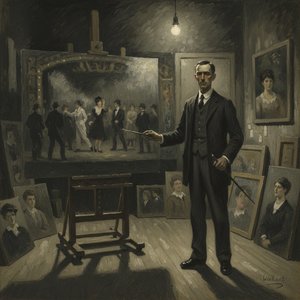
Walter Sickert: A Shadowy Realism & the Modern British Canvas
Explore the life & work of Walter Sickert, a pivotal British painter bridging Impressionism to Modernism. Discover his evocative scenes of London life, controversial legacy, and lasting influence on 20th-century art.
Les 25 Chefs-d'œuvre de la National Gallery : Art, Histoire & Décor d'Intérieur
Plongez au cœur des 25 chefs-d'œuvre de la National Gallery Londres : Van Gogh, Monet, Rembrandt… Découvrez l'histoire fascinante de ces tableaux célèbres et trouvez l'inspiration pour une décoration intérieure raffinée. Reproductions d'art de qualité muséale sur OriginalUniqueArt.com.


