

 Aperçu en situation
 Envoyer
 Partager
 Détails de l'œuvre

 Télécharger
 Articles similaires
 Radiographie
 Diaporama
Lamentation
 86.0 x 71.0 cm
 Musée Mayer van den Bergh
 Lire la suite
Acquérez une image numérique haute résolution et optimisée, d'une qualité bien supérieure à l'aperçu en ligne.
Chaque fichier est méticuleusement préparé par nos spécialistes internes à l'aide d'outils avancés et d'une retouche manuelle experte. Nous garantissons que chaque image possède une clarté exceptionnelle, une précision des couleurs irréprochable et un niveau de détail fin.
Le fichier final est livré par e-mail sous 72 heures, optimisé pour une utilisation immédiate dans des contextes professionnels, éditoriaux et d'impression. Il offre la même qualité de confiance que celle utilisée par les plus grands studios de création, éditeurs et galeries.
Image numérique
Téléchargez un fichier haute résolution pour votre usage personnel, l'impression et vos projets créatifs. ( Commander l'impression Commander la reproduction peinte à la main)
Inclus avec chaque commande d'image numérique
Livraison numérique experte, garantie.
En choisissant OriginalUniqueArt.com, vous n'obtenez pas seulement une simple image : vous recevez une œuvre numérique sublimée avec professionnalisme, conçue avec précision et accompagnée d'une garantie de satisfaction. Voici tout ce qui accompagne automatiquement votre commande :

Envoi rapide par e-mail
Votre fichier d'image numérique haute résolution vous sera envoyé par e-mail sous 72 heures après votre commande — prêt à un usage immédiat.

Fichier numérique optimisé par l'IA
Votre œuvre d'art bénéficie d'une optimisation professionnelle grâce à des outils d'IA avancés et une retouche manuelle, garantissant un niveau maximal de détail, de clarté et de fidélité chromatique.

Réexpédition gratuite à vie
Vous avez accidentellement supprimé ou perdu votre fichier ? Pas d'inquiétude — nous vous le renverrons gratuitement, quand vous le souhaitez.

Aucuns frais de douane — À jamais
Profitez de votre œuvre d'art instantanément sans frais de douane ni de livraison — les téléchargements numériques sont toujours exonérés de taxes.

Garantie de fidélité des couleurs
Nous garantissons que votre image numérique reproduit les couleurs de l'original aussi fidèlement que possible grâce à des outils professionnels et une gestion rigoureuse des couleurs.

Garantie satisfaction 60 jours
Si vous n'êtes pas satisfait de votre image numérique, nous la retoucherons ou vous rembourserons 100% sous 60 jours — sans poser de questions.

Garantie de remboursement à 100%
Pas satisfait ? Obtenez un remboursement intégral dans les 60 jours suivant la réception de votre fichier numérique — sans aucune question posée.

Réductions sur les commandes groupées
Achetez 3 images, économisez 10% - Achetez 5, économisez 15% - Achetez 10+, économisez 20%. Idéal pour les projets créatifs, les galeries et les agences.
Biographie de l'artiste
The Gentle Heir of Netherlandish Grandeur
In the golden, luminous era of Early Netherlandish painting, few names resonate with as much quiet dignity as Vrancke van der Stockt. While history often casts a brilliant, sometimes blinding light upon his mentor, the legendary Rogier van der Weyden, Van der Stockt emerged not merely as a shadow, but as a vital successor who carried the torch of Flemish emotional depth into a new generation. Born in Leuven before 1420, his life was woven into the very fabric of the Burgundian Netherlands, a period defined by unparalleled technical mastery and a profound spiritual intensity that sought to bridge the gap between the earthly and the divine.
Van der Stockt’s artistic journey began within the disciplined walls of his father’s workshop. Under the tutelage of Jan van der Stockt, he mastered the meticulous craftsmanship required by the era's high standards, learning to manipulate oil pigments to capture the subtle textures of velvet, the cold glint of metal, and the soft glow of skin. This foundational training provided him with the technical vocabulary that would later allow him to serve as a direct heir and popularizer of the Weyden style. His association with Rogier van der Weyden was perhaps the most defining chapter of his career; as an assistant and collaborator, he absorbed the master's ability to sculpt human grief and spiritual ecstasy onto wooden panels, yet he began to infuse these lessons with a uniquely restrained elegance.
A Legacy of Devotion and Civic Grace
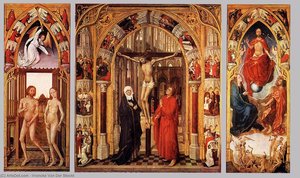
As his career matured, Van der Stockt’s work became characterized by a certain gentle sensitivity. Where Weyden might employ dramatic, sweeping gestures to convey agony, Van der Stockt often favored a more poised and graceful aesthetic. This is nowhere more evident than in his celebrated Triptych of the Redemption. In this monumental work, one finds a breathtaking narrative journey that guides the viewer through the sacred cycle of Christ's sacrifice. He possessed a miraculous ability to ground cosmic theological events in the recognizable human experience, populating his divine landscapes with tiny, meticulously rendered figures engaged in quiet, everyday activities—a technique that makes the sacred feel tangibly present and intimately reachable.
Beyond the confines of his studio, Van der Stockt was a man of significant civic importance. His life was marked by a profound engagement with the community of Leuven and Brussels, reflecting the high social standing of successful master painters in the 15th century. His achievements extended far beyond the easel:
- Mastery of the Guild: In 1445, he achieved the prestigious status of master within the Brussels Guild of St. Luke, a testament to his technical skill and professional standing.
- Civic Leadership: He served with distinction on the Leuven Town Council during several terms, including 1465, 1472, and 1475, demonstrating his influence in the political life of the city.
- Religious Stewardship: His leadership as the head of the Confraternity of St. Eloy between 1471 and 1473 highlighted his deep integration into the religious and social structures of his time.
- Official Recognition: Following the death of Rogier van der Weyden in 1464, Van der Stockt ascended to the position of the official painter of Leuven, a role that solidified his reputation as a premier artist of the region.
The Enduring Echo of a Master
Though the passage of centuries has left certain gaps in our biographical knowledge—a frustrating lacuna for modern art historians—the stylistic fingerprints of Vrancke van der Stockt remain indelible. His ability to balance the monumental with the minute, and the dramatic with the serene, ensures his place in the pantheon of the Northern Renaissance. He did not seek to eclipse the giants upon whose shoulders he stood; instead, he sought to refine their vision, offering a more tempered, graceful window into the soul of the late medieval world. Today, when we gaze upon his Lamentation or the intricate panels of his triptychs, we do not merely see a follower of Weyden, but a master in his own right, whose gentle hand helped define the very heartbeat of Netherlandish art.
vrancke van der stockt
1420 - 1495
En bref
- Artistic Movement Or Style: Early Netherlandish Painting
- Artists Or Movements Influenced By This Artist: ['Rogier van der Weyden']
- Artists Who Influenced This Artist: ['Rogier van der Weyden']
- Date Of Death: 14 June 1495
- Full Name: Vrancke van der Stockt
- Nationality: Dutch
- Notable Artworks:
- Triptych of the Redemption
- Lamentation
- Pietà
- Place Of Birth: Brussels, Belgium

