 Peinture à l'huile
 Tout sur SAINT PIERRE







































 Pour les œuvres ou reproductions dont un côté mesure plus de 105 cm (environ 41 pouces), le cadre sera expédié sous forme de kit démonté. Cette méthode garantit une livraison sécurisée et prévient tout dommage pendant le transport.


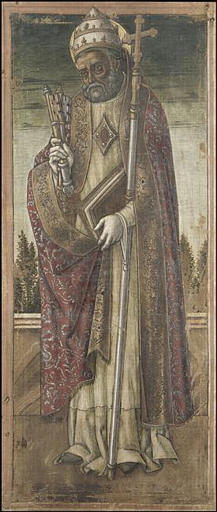
Identification of Saint Pierre by Vittore Crivelli
In this work, titled SAINT PIERRE, we encounter a significant example of the hand of Vittore Crivelli. This Italian Early Renaissance painter, who was born in Venice around 1440, brings a specific sense of gravity to the depiction of this religious figure. His approach reflects the transition of the era, moving through the stylistic shifts that defined the late fifteenth century.
Vittore Crivelli lived until 1501, a period during which his work helped shape the visual language of the Venetian school. In SAINT PIERRE, his characteristic attention to detail is evident, providing a sense of presence that is both quiet and authoritative. The subject is rendered with a focus on the dignity inherent to his role, captured through a style that balances the traditions of the past with the emerging naturalism of the Renaissance.
The Composition and Visual Elements
The figure is positioned centrally, though a subtle asymmetry lends a sense of natural movement to the pose. Saint Pierre faces the viewer directly, while his body is turned slightly to the left, creating a gentle tension in the stance. He holds the traditional attributes of his office: a book and the keys. In his right hand, he carries a tall crosier that extends vertically, providing a strong anchor for the entire composition.
Behind the figure, the landscape is rendered in muted tones, offering a quiet backdrop that does not compete with the subject. This setting provides a sense of space without requiring deep recession, keeping the focus entirely on the saint. The arrangement of the elements emphasizes his presence and authority through a balanced, formal structure.
Technique and Materials Used
The work is executed in tempera or oil paint on a wooden panel, a choice that allows for the meticulous brushwork seen throughout the composition. There is a deliberate variation in how the artist handles the surface to suggest different tactile qualities. The robes are rendered with a high level of detail, where the paint creates a sense of heavy, intricate fabric. In contrast, the skin of the figure is treated with a smoother texture, providing a subtle softness to the facial features.
The background landscape is handled with a different sensibility. It appears more simplified and lacks the dense texture found in the central figure, which helps to keep the focus on the subject. This approach creates a quiet depth, even where the spatial recession remains shallow. The application of color suggests a controlled use of glazes to achieve subtle shifts in tone, particularly in the garments and the skin.
Related Works by the Same Artist
To understand the breadth of this artist's hand, one might look toward the Musée du Petit Palais in Avignon, where several of his compositions reside. There, you will find Saint Michel, a work that shares a certain psychological depth with the figure of Saint Pierre. The collection in Avignon also holds La Vierge adorant l'Enfant, entre deux angelots musiciens and Saint Julien, offering a glimpse into his ability to handle religious subjects with a quiet, contemplative grace.
His reach extended beyond the immediate Venetian sphere, as seen in his commissions for significant religious sites. One notable example is St Louis of France, which was created for the Saint Louis Cathedral in Bordeaux between 1481 and 1502. This work demonstrates his capacity for managing large-scale devotional pieces and the intricate drapery that characterizes his approach to the human form.
- St Louis of France (1481-1502)
- Saint Michel
- Saint Julien
- La Vierge adorant l'Enfant, entre deux angelots musiciens
Where to See This Artwork Today
This depiction of Saint Pierre is held within the collection of the Musée du Petit Palais. Located in Avignon, France, the museum offers a quiet space to observe the work in its intended context. It is a significant part of the institution's holdings, which reflect the artistic history of the region.
The museum is also known as the Petit Palais Museum. As a city of Paris Museum of Fine Arts, it maintains a focused selection of works that allow for a close, personal encounter with the artist's hand. One may find this piece among other religious panels that have been preserved within these walls.
Questions et réponses
Est-ce que SAINT PIERRE est peint à la main ou est-ce une impression ?
Peint à la main : un peintre professionnel reproduit SAINT PIERRE à l'huile sur une toile en lin.
Quelle taille choisir pour SAINT PIERRE ?
Les tailles vont de 48.6 x 20.6 cm (€199) à 249.8 x 105.9 cm (€1070) ; le tableau sur cette page présente les principales étapes et leurs prix respectifs.
Quel est le délai de livraison ?
La livraison prend 4 à 5 semaines, avec une expédition express mondiale gratuite ; une option de production urgente est proposée sur cette page. Vous pouvez la retourner sous 100 jours pour un remboursement intégral, sans condition.
Où se trouve l'original de SAINT PIERRE ?
L'original fait partie de la collection du Musée du Petit Palais, à Avignon.
Quelle technique Vittorio Crivelli a-t-il utilisée pour SAINT PIERRE ?
Tempera On Panel
 Aperçu en situation

 Envoyer
 Partager
 Détails de l'œuvre
 Fiche pédagogique


 Télécharger l'image
 Articles similaires
 Radiographie
 Diaporama
 Questions et réponses

 Statistiques


