

 Aperçu en situation
 Envoyer
 Partager
 Détails de l'œuvre

 Télécharger
 Articles similaires
 Radiographie
 Diaporama
Screen


 Lire la suite
Reproduction à l'huile faite à la main
Huile sur toile peinte à la main, avec cadre et dimensions personnalisés, réalisée sur commande par nos artistes. ( Commander l'impression Acheter l'image haute résolution)




































Choisissez parmi nos formats prédéfinis qui respectent les proportions originales de l’œuvre.

Vous pouvez saisir vos propres dimensions pour l'adapter à un cadre ou à un espace spécifique. Si la taille sélectionnée ne correspond pas aux proportions de l'image d'origine, nous recadrerons l'œuvre ou prolongerons la peinture avec des éléments peints à la main supplémentaires. Une maquette numérique vous sera envoyée pour approbation avant le début de la production.
Veuillez noter que l'aperçu à l'écran ne reflète pas le recadrage ou l'extension réels. Seule la maquette montrera fidèlement la composition finale.
Bien que des tailles personnalisées soient disponibles, nous vous recommandons de sélectionner une dimension dans la liste prédéfinie afin de préserver les proportions d'origine.
Après la commande, l’équipe OriginalUniqueArt.com contactera le client par e-mail pour recueillir ses instructions et lui fournira une maquette d’aperçu
Livraison dans le monde entier () en 3 à 4 semaines au lieu des 5 semaines habituelles. (29 août). Aucun compromis sur la qualité.

Livraison express gratuite dans le monde entier

Toile de lin de qualité supérieure

Assurance transport complète

Garantie de remboursement des droits de douane

Garantie de fidélité des couleurs

Politique de retour de 60 jours (uniquement en cas de défaut)

Garantie de remboursement à 100%

Offre de tarifs dégressifs
 L'option verre n'est disponible que pour les dimensions inférieures à 110 cm.

Screen
Technique de reproduction
Format de la reproduction
-


Prix total
$ 300
Biographie de l'artiste
The Visionary Synthesis of Tsuda Sen
In the twilight of the Edo period, a time of profound transition for Japan, the works of Tsuda Sen emerged as a breathtaking bridge between ancient tradition and the encroaching modern world. Born into the disciplined atmosphere of a samurai family in Tokyo, Sen possessed a unique intellectual lineage that allowed him to look beyond the borders of his nation. While many of his contemporaries remained anchored in the established aesthetics of Japanese calligraphy, Sen was driven by an insatiable curiosity for the scientific and the structural. His early education, heavily influenced by his father’s foresight regarding Western knowledge, instilled in him a rare ability to observe the natural world through a lens of both botanical precision and artistic grace. This duality—the scientist's eye for detail and the artist's soul for expression—would become the hallmark of his enduring legacy.
The true brilliance of Sen’s career lies in his pioneering development of what is now recognized as Namban grammar, a revolutionary decorative art form. This was not merely an aesthetic choice but a profound linguistic experiment translated into visual media. By studying the rhythmic structures and geometric complexities of European grammatical forms, Sen sought to create a new visual language for Japan. He moved away from the fluid, often organic strokes of traditional ink wash toward a more structured, deliberate use of shapes and stylized lettering. This innovation allowed for a level of precision and complexity that could convey intricate ideas with a newfound elegance, effectively mimicking the structural logic of Western thought while maintaining a distinctly Japanese spirit.
A Legacy of Botanical Precision and Decorative Innovation
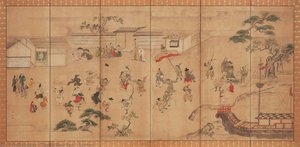
Beyond his linguistic experiments, Sen’s work was deeply rooted in the tangible beauty of the natural world. His training in botany at Tokyo Imperial University provided him with an unparalleled understanding of organic forms, which he seamlessly integrated into his decorative compositions. This scientific rigor breathed life into his screens and paintings, where every leaf, petal, and insect was rendered with a meticulousness that bordered on the hyper-realistic, yet always remained harmoniously balanced within his stylized frameworks. His ability to marry the rigid geometry of his Namban style with the delicate textures of nature created a tension that was both captivating and avant-garde for his era.
The historical significance of Tsuda Sen cannot be overstated, as he stood at the precipice of Japan's modernization. His collaborative efforts, most notably alongside his son, Tsuda Umeko, helped to forge a path where Eastern decorative traditions could dialogue with Western structural principles. Through his trade-themed screens and innovative use of geometric motifs, he prepared the Japanese visual consciousness for the globalized era that was to follow. Today, his work remains a testament to the power of cross-cultural synthesis, reminding us that true innovation often occurs at the intersection of disparate worlds, where the precision of science meets the boundless imagination of art.
tsuda dou-sen
1804 - 1856 , Japan
L'essentiel de l'artiste
- Artistic Movement Or Style: Namban-jin Xu-ekizu
- Date Of Birth: August 6, 1837
- Date Of Death: April 24, 1908
- Full Name: Tsuda Sen
- Nationality: Japanese
- Notable Artworks: ['Trade Screens']
- Place Of Birth: Tokyo, Japan

