Impressionism · 1890
Spring (Thomas Wilmer Dewing, 1890)
Thomas Wilmer Dewing (1851–1938) a réalisé Spring. Elle date de 1890. Il appartient au mouvement Impressionism. Réalisée en Oil On Canvas. Il est conservé au Smithsonian American Art Museum à Washington, D.C., États-Unis d'Amérique. Ses dimensions sont 52 × 88 cm.
- 1890
- Oil On Canvas
- 52 × 88 cm
- Smithsonian American Art Museum, Washington, D.C.

 Aperçu en situation

 Peinture à l'huile faite main
 Envoyer
 Partager
 Fiche pédagogique


 Télécharger l'image
 Articles similaires
 Radiographie
 Diaporama
 Questions et réponses

 Statistiques
Spring, en bref
- Titre
- Spring
- Artiste
- Thomas Wilmer Dewing (1851–1938)
- Lieu de naissance de l'artiste
- Boston, États-Unis
- Date
- 1890
- Technique
- Oil On Canvas
- Dimensions
- 52 × 88 cm
- Où le voir
- Smithsonian American Art Museum, Washington, D.C., États-Unis d'Amérique
- Mouvement
- Impressionism
- Période
- 19th Century
- Sujet
- pastoral scene, outdoor leisure, women in art, springtime, nature landscape, soft light
Que représente Spring ?
Identification of Spring by Thomas Dewing
Spring is an oil on canvas painting by the American artist Thomas Dewing. The work was executed in 1890. This specific piece measures 52 x 88 cm in size. It is currently held in the collection of the Hirshhorn Museum and Sculpture Garden located in the United States.
The artist, Thomas Dewing, was born in Boston, United States. His practice involved the use of oil paints to render figures within outdoor settings. This particular composition depicts a group of women situated in a field characterized by grass and trees. The scene includes figures in various positions, some seated on the ground and others standing, amidst a landscape that contains two birds.
The Composition and Visual Elements
The scene is organized within a lush field where a group of women is positioned amidst tall grass and surrounding trees. The arrangement of the figures creates a sense of depth across the landscape. Some women are standing upright while others are seated directly on the ground. These subjects are engaged in various activities, such as playing games or simply occupying the outdoor space. Two birds are visible within the composition, placed among the natural elements.
The spatial organization is divided into a foreground, a middle ground, and a background. In the foreground and middle ground, the figures interact within the greenery, while the background recedes toward distant, less distinct elements. The horizon line is emphasized by the horizontal expanse of the field. The lighting appears diffused, consistent with an overcast sky, which casts a soft light over the figures and the vegetation. This arrangement creates an atmosphere of movement and social interaction within the natural setting.
Technique and Artistic Style
The work is an oil painting on canvas executed in a loose, impressionistic style. The application of paint is visible throughout the surface, creating a textured, impasto-like quality particularly in the rendering of the grass and the sky. This technique emphasizes the physical presence of the medium. The composition is structured through a clear division of the foreground, middle ground, and background, establishing a sense of spatial depth. Predominantly horizontal lines define the landscape, emphasizing the expanse of the field and the flatness of the terrain.
Organic shapes constitute the primary forms within the scene, including the hills, the fields, and the human figures. The brushwork is spontaneous, utilizing broken color to capture the specific atmosphere of an overcast day. Lighting appears diffused across the landscape. The artist employs a muted color palette and soft, feathery brushstrokes to define the subjects and their surroundings. This approach prioritizes the immediate visual impression of the environment over precise, sharp detail.
Related Works by the Artist
The artist's body of work includes several notable compositions that explore similar themes of female figures in specific settings. The White Dress is identified as a key work within his oeuvre. Other significant pieces include Woman in Black: Portrait of Maria Oakey Dewing, which is an oil on panel, and Lady in Gold, painted in 1912. These works often feature the refined, aristocratic female figures that characterize his tonalist style.
Other compositions from his career include The Recitation, dated 1891, and Summer, also known as Moonrise, which was painted in 1893. These paintings contribute to a collection that includes various works held in museums and private collections across the United States, such as those found in the Freer Gallery of Art at the Smithsonian Institution.
Dans quel musée se trouve Spring ?
Smithsonian American Art Museum
Washington, D.C., États-Unis d'Amérique
Une Chronique de l'Identité Américaine Le Smithsonian American Art Museum, situé à Washington, D.C., constitue la toute première collection d'art américain du pays. En tant que pilier de la Smithsonian Institution, il abrite l'une des collections les plus vastes et les plus inclusives d'œuvres réalisées aux États-Unis. Ce trésor artistique représente un témoignage continu de l'expérience américaine, capturant avec finesse les aspirations, le caractère et l'imaginaire de la nation, de l'époque coloniale jusqu'à nos jours.


Images haute résolution de Spring

Domaine public : l'artiste est décédé en 1938.
Autres formats, recadrages et citations →Thomas Wilmer Dewing, Spring (1890), Smithsonian American Art Museum. Domaine public
Questions sur Spring, réponses
Dans quel musée se trouve l'original de « Spring » ?
Vous pouvez admirer l'original de « Spring » au Smithsonian American Art Museum, Washington, D.C., États-Unis d'Amérique.
En quelle année «Spring» de Thomas Wilmer Dewing a-t-il été créé ?
«Spring» date de 1890. Cette date inscrit l'œuvre dans la carrière de Thomas Wilmer Dewing ainsi que dans son époque.
Quelle technique a été utilisée pour «Spring» de Thomas Wilmer Dewing ?
« Spring » est réalisé en Oil On Canvas.
Quelles sont les dimensions réelles de «Spring» de Thomas Wilmer Dewing ?
«Spring» mesure 52 x 88 cm dans sa forme originale. Les dimensions originales constituent une référence utile lors du choix de la taille d'une reproduction.
Que représente « Spring » ?
Les thèmes présents dans «Spring» de Thomas Wilmer Dewing incluent pastoral scene, outdoor leisure, women in art, springtime, nature landscape, soft light, american art, impressionistic. Ensemble, ils résument le sujet de l'œuvre.
L'image de «Spring» de Thomas Wilmer Dewing peut-elle être librement reproduite ?
Concernant les droits d'auteur, « Spring » est dans le dans le domaine public - ses droits d'auteur sont tombés dans le domaine public.
À quel artiste est attribuée l'œuvre "Spring" ?
L'artiste à l'origine de « Spring » est Thomas Wilmer Dewing. L'œuvre est répertoriée sous le nom de Thomas Wilmer Dewing.
À quel mouvement artistique appartient « Spring » ?
Le mouvement associé à «Spring» de Thomas Wilmer Dewing est Impressionism. Cette classification situe l'œuvre parmi des artistes et des œuvres d'art apparentés.
À quelle période de la carrière de Thomas Wilmer Dewing se situe « Spring » ?
Au cours de la carrière de Thomas Wilmer Dewing, « Spring » s'inscrit dans la période Mature Period. Cette phase permet de le comparer aux autres œuvres de l'artiste.
À propos de l'artiste, Thomas Wilmer Dewing

1851–1938, États-Unis
Thomas Wilmer Dewing
Premières années et formationThomas Wilmer Dewing, peintre américain, est né le 4 mai 1851 à Boston, Massachusetts. Son parcours artistique a commencé par un apprentissage de lithographe, qui l'a ensuite conduit à l’Académie Julian prestigieuse à Paris, où il a étudié sous la direction de Gustave Boulanger et Jules Lefebvre à partir de 1887. Style artistique et œuvres notablesLe style artistique de Dewing se caractérise par ses peintures tonalistes, un genre profondément enraciné dans l'esthétisme anglais. Ses sujets préférés étaient les femmes aristocratiques, souvent représentées dans des environnements mélancoliques et oniriques, jouant de la musique ou s’engageant dans des activités introspectives.
À propos de Thomas Wilmer Dewing Œuvres notables de Thomas Wilmer Dewing
Autres œuvres de Thomas Wilmer Dewing
 La Dame en or1912
 La Récitation1891
 L'Esclave du Sorcier (Le Jeune Sorcier), (peinture)1877
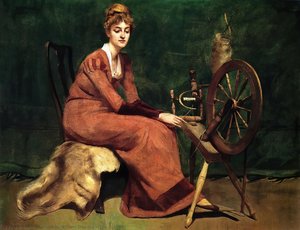 La Fileuse1880

Essais sur Spring
 Les 25 chefs-d'œuvre de Thomas Cole : l'âme de la nature sauvagePlongez dans les chefs-d'œuvre de Thomas Cole et la Hudson River School. Explorez sa collection sur OriginalUniqueArt.com.
 The Logic of the Landscape: Understanding Compositional Structure and DepthMaster landscape composition through the works of Patinir and Cézanne. Explore the logic of depth and perspective now.
 Artworks des îles Vierges des États-Unis des années 1890Découvrez les chefs-d'œuvre de Camille Pissarro et l'impressionnisme des années 1890. Explorez la collection complète sur OriginalUniqueArt…