

 Aperçu en situation
 Partager
 Partager
 Détails
 Guide imprimable

 Télécharger
 Articles similaires
 Radiographie
 Voir le diaporama
 Statistiques
Weda Cook


 Afficher la suite
Reproduction à l'huile faite à la main
Huile sur toile peinte à la main, avec cadre et dimensions personnalisés, réalisée sur commande par nos artistes. ( Passer au format impression Passer au format image numérique)




P118B €10

P118H €10

P118W €10

P438Z €10

P508JH €12

P508YH €12

P805H €10

P805Z €10

P919BZ €10

P919G €10

P919XJ €10

P959ZH €10

P968JZ €12

W106C €8

W218G €10

W218JH €8

W218Y €10

W307PJ €10

W316G €10

W316PJ €8

W316Y €10

W398PJ €8

W4111J €10

W500HY €15

W500JH €15

W692G €12

W849H €8

W940BG €15

W953PJ €8




Choisissez parmi nos formats prédéfinis qui respectent les proportions originales de l’œuvre.

Vous pouvez saisir vos propres dimensions pour l'adapter à un cadre ou à un espace spécifique. Si la taille sélectionnée ne correspond pas aux proportions de l'image d'origine, nous recadrerons l'œuvre ou prolongerons la peinture avec des éléments peints à la main supplémentaires. Une maquette numérique vous sera envoyée pour approbation avant le début de la production.
Veuillez noter que l'aperçu à l'écran ne reflète pas le recadrage ou l'extension réels. Seule la maquette montrera fidèlement la composition finale.
Bien que des tailles personnalisées soient disponibles, nous vous recommandons de sélectionner une dimension dans la liste prédéfinie afin de préserver les proportions d'origine.
Après la commande, l’équipe OriginalUniqueArt.com contactera le client par e-mail pour recueillir ses instructions et lui fournira une maquette d’aperçu
Livraison dans le monde entier () en 3 à 4 semaines au lieu des 5 semaines habituelles. (10 octobre). Aucun compromis sur la qualité.

Livraison express gratuite dans le monde entier

Toile de lin de haute qualité

Assurance transport complète

Garantie de remboursement des droits de douane

Garantie de fidélité des couleurs

Garantie de retour de 100 jours (uniquement en cas de défaut)

Garantie de remboursement à 100%

Tarifs dégressifs sur quantité
 L'option verre n'est disponible que pour les dimensions inférieures à 110 cm.

Weda Cook
Technique de reproduction
Format de la reproduction
-


Prix total final
€ 259
The Unflinching Gaze: Capturing Modernity in Thomas Eakins' Weda Cook
To stand before Thomas Eakins’ Weda Cook is not merely to observe a portrait; it is to confront a moment of profound, unvarnished reality. Painted in 1891, this oil on canvas transcends the simple act of likeness, offering instead a deep psychological study wrapped in the elegance of late Victorian fashion. Eakins, the master of American realism, possessed an almost scientific dedication to capturing the human form and spirit with breathtaking accuracy. The subject herself, Weda Cook, is rendered with a poise that seems both natural and meticulously composed. Her long hair cascades around her shoulders, framing a face that meets the viewer’s gaze with an intensity that refuses easy interpretation. It is this directness—this refusal to simply smile for posterity—that makes the painting such a compelling piece of art history.
Technique and The Art of Realism
Eakins' technical mastery in Weda Cook is evident in every visible brushstroke. He was a proponent of realism, eschewing the romantic flourishes that sometimes characterized his contemporaries for something far more grounded: truth. Observe the texture of the pink dress; Eakins has managed to convey the weight and drape of the fabric while simultaneously suggesting its delicate nature. The handling of light across her skin is masterful, giving her complexion a luminous quality that seems almost alive. This attention to detail—the subtle shading around the eyes, the precise rendering of the hair strands—speaks to an artist who studied anatomy as rigorously as he studied composition. For those interested in acquiring a reproduction, understanding this commitment to visible technique allows one to appreciate the painstaking effort required to translate such depth onto canvas.
Historical Echoes and Social Portraiture
The late 19th century was a period of immense social flux in America, and Eakins chronicled that change through his subjects. Weda Cook serves as a beautiful artifact from this era, capturing the societal expectations placed upon women while simultaneously celebrating their individual presence. The seriousness etched into her expression suggests a woman of substance, perhaps navigating the complex currents of turn-of-the-century society. Unlike idealized portraits meant solely for vanity, Eakins’ work feels engaged with the world around him—a testament to the dignity found in everyday American life. It invites us to consider not just who she was, but what it meant to be a woman of her standing during that transformative time.
Emotional Resonance and Interior Placement
Emotionally, the painting resonates with a quiet power. There is an undeniable gravity emanating from Weda Cook that draws the viewer in, compelling them to look closer, to decipher the meaning behind that steady gaze. For collectors or interior designers seeking art that anchors a space with intellectual weight, Weda Cook offers more than mere decoration; it offers conversation. Imagine this piece gracing a formal drawing-room or a sophisticated study—its presence would lend an air of cultivated history and thoughtful depth to the surroundings. It is a work that demands contemplation, rewarding the viewer with layers of observation upon every viewing.
Questions et réponses
Quel âge avait Thomas Eakins lors de la création de « Weda Cook » ?
Lorsque « Weda Cook » a été créé en 1891, Thomas Eakins — né(e) en 1844 — était âgé(e) de 47 ans.
«Weda Cook» de Thomas Eakins est-il une peinture, un dessin ou une estampe ?
« Weda Cook » est une œuvre de type WallArt.
Quel usage et quel espace sont recommandés pour «Weda Cook» de Thomas Eakins ?
«Weda Cook» de Thomas Eakins est recommandé pour Focal, idéalement dans une Lounge. L'usage et l'espace permettent de déterminer où placer une reproduction.
En quelle année "Weda Cook" a-t-il été réalisé ?
«Weda Cook» date de 1891. Cette date inscrit l'œuvre dans la carrière de Thomas Eakins ainsi que dans son époque.
Qui est l'artiste derrière « Weda Cook » ?
L'artiste à l'origine de « Weda Cook » est Thomas Eakins. L'œuvre est répertoriée sous le nom de Thomas Eakins.
Où puis-je acheter une impression de «Weda Cook» de Thomas Eakins ?
Pour obtenir un tirage de «Weda Cook» de Thomas Eakins, il vous suffit de le commander sur cette page : une impression d'art sur toile de coton ou sur papier canvas d'archive.
À quel style appartient « Weda Cook » ?
«Weda Cook» de Thomas Eakins appartient au mouvement American Realism. Ce mouvement apporte le contexte stylistique de l'œuvre.
Biographie de l'artiste
Une vie dédiée à la capture de la réalité
Thomas Cowperthwait Eakins, peintre américain réaliste, photographe, sculpteur et pédagogue en beaux-arts, a laissé une marque indélébile sur la toile de l'histoire de l'art américain. Né le 25 juillet 1844 à Philadelphie, en Pennsylvanie, sa vie fut un témoignage de son dévouement inébranlable à capturer l'essence de la réalité.Jeunesse et formation
La jeunesse d’Eakins fut marquée par un vif intérêt pour le dessin et les sciences. Il fréquenta Central High School puis étudia à la Pennsylvania Academy of the Fine Arts, où il perfectionna ses compétences en dessin et en anatomie. Son séjour en Europe, notamment sous la tutelle de Jean-Léon Gérôme à Paris, influença grandement son approche artistique.Une carrière définie par le réalisme
Le travail d’Eakins se caractérise par un réalisme implacable, une caractéristique qui le distinguait de ses contemporains. Ses portraits, au nombre de plusieurs centaines, offrent un aperçu poignant du tissu intellectuel et social de la fin du XIXe et du début du XXe siècle à Philadelphie. Parmi les œuvres notables, citons Max Schmitt en monocellulaire, qui ne se contente pas de démontrer la maîtrise d’Eakins dans la capture du mouvement, mais révèle également son vif intérêt pour la forme humaine.Enseignement et controverse
Le passage d'Eakins à l'Pennsylvania Academy of the Fine Arts fut marqué à la fois par l'influence et la controverse. Son approche pédagogique, qui mettait l’accent sur l’importance d’étudier le corps humain en direct, conduisait souvent à des frictions avec ses pairs. Cela, combiné à des scandales personnels, a entravé son succès et nui à sa réputation de son vivant.Héritage
Malgré les défis auxquels il a été confronté, Eakins est aujourd'hui célébré comme "le plus fort, le plus profond réaliste du XIXe et du début du XXe siècle dans l’art américain". Son œuvre se trouve dans divers musées, dont le Metropolitan Museum of Art, qui abrite plusieurs de ses œuvres notables.- Le champion en monocellulaire (Max Schmitt en monocellulaire) - une œuvre majeure qui témoigne de la maîtrise précoce d’Eakins dans la capture du mouvement.
- Thomas Eakins - explorez l'ensemble des œuvres d'Eakins sur OriginalUniqueArt, offrant un aperçu approfondi de son évolution artistique et de son style.
- Wikipédia : Thomas Eakins - plongez au cœur de l’entrée Wikipédia complète consacrée à Eakins, détaillant sa vie, ses influences et l'impact de son œuvre sur l'histoire de l'art américain.

Thomas Eakins
1844 - 1916 , États-Unis d'Amérique
En bref
- Artistes Influents: ['Jean-Léon Gérôme']
- Date De Décès: 25 juin 1916
- Date De Naissance: 25 juillet 1844
- Lieu De Naissance: Philadelphie, États-Unis
- Mouvement Artistique: Réalisme américain
- Nationalité: Américaine
- Nom Complet: Thomas Cowperthwait Eakins
- Œuvres Notables:
- Max Schmitt en monocellulaire
- La Clinique Gross
Articles similaires

Réalisme Américain : 10 Chefs-d'œuvre Incontournables pour une Déco Inspirée
Plongez au cœur du Réalisme Américain avec 10 chefs-d'œuvre d'Edward Hopper, Andrew Wyeth et plus. Découvrez l'histoire et les techniques de ces artistes emblématiques. Reproductions de tableaux de qualité musée sur OriginalUniqueArt.com !

Le Réalisme Américain du XXe siècle : Un commentaire social et artistique poignant
Explorez le Réalisme Américain du XXe siècle : de l'Ashcan School à Hopper. Analyse approfondie des artistes, techniques et l'impact social de ce mouvement artistique puissant. Découvrez son héritage sur OriginalUniqueArt.
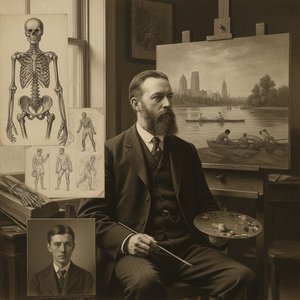
Thomas Eakins: Realism, Anatomy & the American Spirit – A Comprehensive Exploration of Life and Legacy
Explore the life & legacy of Thomas Eakins, a pivotal American Realist painter. Discover his groundbreaking techniques, anatomical precision, and iconic works like 'The Gross Clinic.' A comprehensive guide for art enthusiasts.

The Unvarnished Truth: A Cultural Journey Through the Soul of American Realism
Explore the profound beauty of American Realism. From the Ashcan School's urban grit to intimate portraits, discover how artists captured the authentic soul of a nation through unvarnished truth and masterful observation.

American Realism: Capturing the Raw Soul of a Nation Through the Lens of Art History
Explore the profound depth of American Realism. From the gritty Ashcan School to poignant social landscapes, discover how masters captured the raw soul of a nation through evocative oil paintings and timeless art history.


