

 Aperçu en situation
 Partager
 Partager
 Détails
 Guide imprimable

 Télécharger
 Articles similaires
 Radiographie
 Voir le diaporama
 Statistiques
The Crucifixion


 Afficher la suite
Reproduction à l'huile faite à la main
Huile sur toile peinte à la main, avec cadre et dimensions personnalisés, réalisée sur commande par nos artistes. ( Passer au format impression Passer au format image numérique)




P118B €10

P118H €10

P118W €10

P438Z €10

P508JH €12

P508YH €12

P805H €10

P805Z €10

P919BZ €10

P919G €10

P919XJ €10

P959ZH €10

P968JZ €12

W106C €8

W218G €10

W218JH €8

W218Y €10

W307PJ €10

W316G €10

W316PJ €8

W316Y €10

W398PJ €8

W4111J €10

W500HY €15

W500JH €15

W692G €12

W849H €8

W940BG €15

W953PJ €8




Choisissez parmi nos formats prédéfinis qui respectent les proportions originales de l’œuvre.

Saisissez la largeur et la hauteur souhaitées, pour s'adapter à votre cadre ou à votre mur. Cette œuvre est peinte à la main ; ainsi, pour un format de forme différente, l'artiste peut peindre un peu plus autour du tableau ou réduire légèrement les bords — c'est vous qui choisissez. Nous vous envoyons une maquette numérique pour approbation avant que la peinture ne commence. L'image présentée sur cette page ne reflète pas le résultat réel — seule la maquette le fait.
Après la commande, l’équipe OriginalUniqueArt.com contactera le client par e-mail pour recueillir ses instructions et lui fournira une maquette d’aperçu
Livraison dans le monde entier () en 3 à 4 semaines au lieu des 5 semaines habituelles. (23 octobre). Aucun compromis sur la qualité.

Livraison express gratuite dans le monde entier

Toile de lin de haute qualité

Assurance transport complète

Garantie de remboursement des droits de douane

Garantie de fidélité des couleurs

Garantie de retour de 100 jours (uniquement en cas de défaut)

Garantie de remboursement à 100%

Tarifs dégressifs sur quantité
 L'option verre n'est disponible que pour les dimensions inférieures à 110 cm.

The Crucifixion
Technique de reproduction
Format de la reproduction
-


Prix total final
€ 264
Thomas Eakins’ *The Crucifixion*: A Study in Stark Realism
Thomas Eakins' 1880 painting, *The Crucifixion*, isn’t the grand, overtly religious depiction one might expect. Instead, it presents a profoundly unsettling and remarkably intimate portrayal of Christ on the cross—a work that reveals the artist’s deeply rooted commitment to unflinching realism and his unique perspective on human suffering. Far from glorifying martyrdom, Eakins strips away any sentimentalism, offering instead a brutally honest depiction of death and decay, rendered with an almost clinical precision.
The painting immediately commands attention through its sheer scale—an imposing eight feet tall—placing the viewer directly within the scene. The composition is remarkably simple: a solitary figure, Christ, hangs suspended from the cross against a bleak, undefined landscape. There’s no dramatic sky, no crowd of mourners, no overt signs of grief. Instead, we are confronted with the stark reality of death – the pallor of the body, the rough texture of the wood, and the unsettling stillness of the scene. Eakins masterfully utilizes a muted palette of browns, grays, and ochres, further emphasizing the somber mood and the sense of isolation.
A Masterclass in Anatomical Detail and Observation
Eakins’ technical skill is undeniable. He was obsessed with accurate representation, honed through years of rigorous study and a deep understanding of human anatomy—a fascination evident in his portraits and medical illustrations. *The Crucifixion* showcases this expertise to its fullest extent. Every detail, from the subtle wrinkles on Christ's skin to the rough grain of the wood, is rendered with painstaking accuracy. This isn’t simply a depiction of a corpse; it’s an anatomical study—a testament to Eakins’ dedication to observing and faithfully recreating the physical world.
Interestingly, Eakins’ background as a student at Jefferson Medical College profoundly influenced his approach. He dissected cadavers extensively, gaining an unparalleled understanding of human musculature and skeletal structure. This knowledge is seamlessly integrated into the painting, lending it a remarkable sense of realism and immediacy. The way Christ's body hangs, the subtle tension in his limbs—all are informed by Eakins’ anatomical expertise.
Symbolism Beyond the Biblical Narrative
While rooted in Christian iconography, *The Crucifixion* transcends a simple retelling of the biblical story. It becomes a meditation on mortality, suffering, and the human condition. The lack of emotional expression—the absence of tears or lamentation—forces the viewer to confront the stark reality of death without sentimentality. Some art historians suggest that Eakins’ deliberate choice to omit traditional religious symbols reflects his own disillusionment with organized religion, prioritizing instead a direct engagement with the subject matter.
Furthermore, the painting's setting – an undefined landscape—can be interpreted as representing the universal experience of death. It is not tied to any specific location or time period, but rather speaks to the fundamental human condition. The figure’s face, obscured in shadow, invites contemplation and encourages viewers to project their own emotions and interpretations onto the scene.
Eakins' Legacy: A Realist Icon
Despite its unsettling nature, *The Crucifixion* is considered one of Eakins’ most significant works. It exemplifies his commitment to realism, his meticulous attention to detail, and his willingness to confront difficult subjects with unflinching honesty. It stands as a powerful reminder of the artist's unique vision—a vision that continues to resonate with viewers today.
Reproductions of *The Crucifixion* offer an exceptional opportunity to experience Eakins’ masterful technique and profound insights into the human condition. Whether displayed in a grand salon or a more intimate setting, this iconic painting remains a compelling testament to the power of realism and the enduring fascination with mortality.
Questions et réponses
Puis-je examiner « The Crucifixion » plus en détail ?
La vue X de «The Crucifixion» de Thomas Eakins se trouve sur la page Rayons X de l'œuvre : une exploration interactive de l'image à travers onze couches optiques.
Quelle est l'intensité des couleurs dans «The Crucifixion» de Thomas Eakins ?
«The Crucifixion» de Thomas Eakins présente une intensité de couleur Vivid.
Quand "The Crucifixion" a-t-il été créé, et à quel mouvement appartient-il ?
«The Crucifixion» de Thomas Eakins date de 1880 et appartient au mouvement Contemporary Realism.
Biographie de l'artiste
Une vie dédiée à la capture de la réalité
Thomas Cowperthwait Eakins, peintre américain réaliste, photographe, sculpteur et pédagogue en beaux-arts, a laissé une marque indélébile sur la toile de l'histoire de l'art américain. Né le 25 juillet 1844 à Philadelphie, en Pennsylvanie, sa vie fut un témoignage de son dévouement inébranlable à capturer l'essence de la réalité.Jeunesse et formation
La jeunesse d’Eakins fut marquée par un vif intérêt pour le dessin et les sciences. Il fréquenta Central High School puis étudia à la Pennsylvania Academy of the Fine Arts, où il perfectionna ses compétences en dessin et en anatomie. Son séjour en Europe, notamment sous la tutelle de Jean-Léon Gérôme à Paris, influença grandement son approche artistique.Une carrière définie par le réalisme
Le travail d’Eakins se caractérise par un réalisme implacable, une caractéristique qui le distinguait de ses contemporains. Ses portraits, au nombre de plusieurs centaines, offrent un aperçu poignant du tissu intellectuel et social de la fin du XIXe et du début du XXe siècle à Philadelphie. Parmi les œuvres notables, citons Max Schmitt en monocellulaire, qui ne se contente pas de démontrer la maîtrise d’Eakins dans la capture du mouvement, mais révèle également son vif intérêt pour la forme humaine.Enseignement et controverse
Le passage d'Eakins à l'Pennsylvania Academy of the Fine Arts fut marqué à la fois par l'influence et la controverse. Son approche pédagogique, qui mettait l’accent sur l’importance d’étudier le corps humain en direct, conduisait souvent à des frictions avec ses pairs. Cela, combiné à des scandales personnels, a entravé son succès et nui à sa réputation de son vivant.Héritage
Malgré les défis auxquels il a été confronté, Eakins est aujourd'hui célébré comme "le plus fort, le plus profond réaliste du XIXe et du début du XXe siècle dans l’art américain". Son œuvre se trouve dans divers musées, dont le Metropolitan Museum of Art, qui abrite plusieurs de ses œuvres notables.- Le champion en monocellulaire (Max Schmitt en monocellulaire) - une œuvre majeure qui témoigne de la maîtrise précoce d’Eakins dans la capture du mouvement.
- Thomas Eakins - explorez l'ensemble des œuvres d'Eakins sur OriginalUniqueArt, offrant un aperçu approfondi de son évolution artistique et de son style.
- Wikipédia : Thomas Eakins - plongez au cœur de l’entrée Wikipédia complète consacrée à Eakins, détaillant sa vie, ses influences et l'impact de son œuvre sur l'histoire de l'art américain.

Thomas Eakins
1844 - 1916 , États-Unis d'Amérique
En bref
- Artistes Influents: ['Jean-Léon Gérôme']
- Date De Décès: 25 juin 1916
- Date De Naissance: 25 juillet 1844
- Lieu De Naissance: Philadelphie, États-Unis
- Mouvement Artistique: Réalisme américain
- Nationalité: Américaine
- Nom Complet: Thomas Cowperthwait Eakins
- Œuvres Notables:
- Max Schmitt en monocellulaire
- La Clinique Gross
Articles connexes

Réalisme Américain : 10 Chefs-d'œuvre Incontournables pour une Déco Inspirée
Plongez au cœur du Réalisme Américain avec 10 chefs-d'œuvre d'Edward Hopper, Andrew Wyeth et plus. Découvrez l'histoire et les techniques de ces artistes emblématiques. Reproductions de tableaux de qualité musée sur OriginalUniqueArt.com !
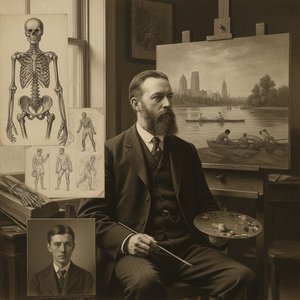
Thomas Eakins: Realism, Anatomy & the American Spirit – A Comprehensive Exploration of Life and Legacy
Explore the life & legacy of Thomas Eakins, a pivotal American Realist painter. Discover his groundbreaking techniques, anatomical precision, and iconic works like 'The Gross Clinic.' A comprehensive guide for art enthusiasts.
Realism in Art: A Professional Guide to Authentic Detail and Lifelike Masterpieces for Large-Scale Interior Projects
Master the use of Realism in professional interiors. This expert guide explores 19th-century masterpieces, offering procurement managers and designers technical insights into selecting authentic, hand-painted oil reproductions for high-end hotel and corporate projects.

Échos de la Société : Explorer l'Héritage Durable du Réalisme Social dans l'Art
Explorez l'héritage durable du réalisme social dans l'art ! Découvrez Courbet, Manet, Sekoto et bien d'autres artistes engagés. Analyse approfondie et reproductions haute qualité sur OriginalUniqueArt.

10 chefs-d'œuvre du Réalisme Romantique qui capturent l'âme humaine
Plongez dans l'émotion du Réalisme Romantique. Explorez 10 chefs-d'œuvre iconiques, de Constable à Homer, mêlant vérité et passion. Trouvez l'inspiration pour votre décor avec nos reproductions de qualité musée sur OriginalUniqueArt.com. Découvrez toute la collection en ligne.


