Passer au format impression
 Lire la suite







































 Pour les œuvres ou reproductions dont un côté mesure plus de 105 cm (environ 41 pouces), le cadre sera expédié sous forme de kit démonté. Cette méthode garantit une livraison sécurisée et prévient tout dommage pendant le transport.


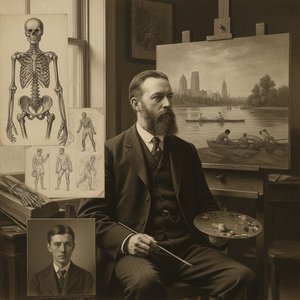
Thomas Eakins : Un pionnier du réalisme anatomique
Thomas Cowperthwait Eakins (1844–1916) s'impose comme une figure monumentale de l'art américain, un peintre d'un réalisme sans concession qui consacra sa vie à capturer l'essence même de l'expérience humaine. Il ne se contentait pas de vouloir représenter le monde ; il cherchait à le disséquer, à en comprendre l'anatomie, tant physique que psychologique, pour ensuite le reconstruire sur la toile avec une honnêteté qui frisait souvent la provocation. Le parcours d'Eakins ne fut pas celui d'un succès immédiat, mais plutôt celui d'une lente ascension faite de dévouement, de controverses et, finalement, d'une reconnaissance durable en tant que peintre peut-être le plus profond du réalisme américain des XIXe et début du XXe siècles. Sa Philadelphie n'était pas une cité de paysages grandioses ou d'idéaux romantiques ; c'était un monde de médecins, de rameurs, de chasseurs et d'individus ordinaires — autant de sujets qu'il rendait avec une précision presque scientifique. Son éducation favorisa à la fois une curiosité intellectuelle et une fascination pour la forme humaine. Il étudia l'anatomie avec diligence au Haverford College, disséquant méticuleusement des cadavres pour acquérir une connaissance directe de la musculature et de la structure squelettique — une pratique jugée peu orthodoxe pour l'époque, mais cruciale pour sa vision artistique. Cet engagement envers l'exactitude anatomique allait devenir la marque de fabrique de son œuvre, imprégnant ses portraits et ses études de figures d'un niveau de détail sans précédent. Il absorba l'influence de Rembrandt et de Michel-Ange, des artistes qui privilégiaient la capture des subtilités de l'expression et de la forme humaines, façonnant ainsi son approche de la peinture avant même de commencer sa formation formelle à la Pennsylvania Academy of Fine Arts.« La Chanteuse de concert » : Une étude d'observation et de précision
« La Chanteuse de concert », achevé en 1892, illustre parfaitement le style distinctif d'Eakins — un portrait imprégné d'une observation méticuleuse et d'une maîtrise technique absolue. Le tableau représente Weda Cook (1867–1937), une soprano célèbre pour ses prouesses vocales, saisie en pleine performance sur scène. Contra Unlike les portraits traditionnels qui cherchaient à idéaliser le sujet, Eakins s'efforça de dépeindre Cook avec un réalisme implacable, capturant non seulement son apparence physique, mais aussi la tension palpable et la concentration intense de son effort artistique. Il parvint à cet exploit remarquable grâce à un processus laborieux, passant des heures à esquisser les mouvements et les expressions faciales de Cook, analysant la mécanique de sa voix de chant et rendant méticuleusement chaque nuance de sa posture et de sa musculature. Pour ce faire, Eakiente utilisa une technique caractérisée par le glacis superposé — l'application de fines couches de couleur sur plusieurs strates pour construire la profondeur tonale et la luminosité. Cette méthode lui permit de capturer les jeux subtils d'ombre et de lumière sur la peau de Cook, transmettant une impression de présence presque tangible. La composition est délibérément sobre, se concentrant uniquement sur la chanteuse elle-même devant un arrière-plan simple composé de marches de scène — un choix intentionnel conçu pour aiguiser l'attention du spectateur sur sa forme et son expression. Notablement, Eakins a intégré un petit détail qui en dit long sur sa philosophie artistique : il a gravé les premières mesures de « O Mio Sussurro » de Felix Mendelssohn directement dans le cadre du tableau, symbolisant son dévouement à capturer non seulement la ressemblance visuelle, mais aussi l'essence même de la performance de Cook — l'acte même du chant. Au-delà de sa brillance technique, « La Chanteuse de concert » résonne d'une profonde signification symbolique. Le portrait d'Eakins représente bien plus qu'une simple représentation d'une musicienne ; il incarne la quête de l'excellence artistique et la concentration inébranlable nécessaire pour atteindre la maîtrise. Le rendu anatomique méticuleux de l'artiste souligne sa conviction que l'art doit tendre vers une représentation honnête de la réalité humaine — une conviction ancrée dans sa formation scientifique et nourrie par le désir de transcender la simple beauté superficielle. En fin de compte, le tableau évoque un sentiment de contemplation tranquille et d'admiration pour le dévouement de Cook, invitant les spectateurs à réfléchir au pouvoir transformateur de l'effort artistique et à l'héritage durable de Thomas Eakins en tant que l'un des peintres réalistes les plus influents d'Amérique.Questions et réponses
En quelle année et dans quel mouvement "La Chanteuse de concert" a-t-elle été réalisée ?
«La Chanteuse de concert» a été réalisé en 1890, au sein du mouvement Réalisme contemporain.
Qui est l'auteur de « La Chanteuse de concert » et de quel mouvement artistique est-il issu ?
« La Chanteuse de concert » a été créé par Thomas Eakins dans le style Réalisme contemporain. L'artiste et le mouvement définissent la tradition de l'œuvre.
L'image de «La Chanteuse de concert» de Thomas Eakins peut-elle être librement reproduite ?
«La Chanteuse de concert» de Thomas Eakins est dans le dans le domaine public - ses droits d'auteur sont tombés dans le domaine public. Ce statut régit les modalités de reproduction de l'image de l'œuvre.
 Aperçu en situation
 Envoyer
 Partager
 Détails de l'œuvre
 Guide
Guide

 Télécharger l'image
 Articles similaires
 Radiographie
 Diaporama
 Q&A
Q&A Statistiques