Aperçu en situation
 Partager
 Partager
 Détails
 Guide imprimable

 Télécharger
 Articles similaires
 Radiographie
 Voir le diaporama
 Statistiques
Landscape VII


 Afficher la suite
L’œuvre d'art présentée sur cette page est protégée par le droit d'auteur, ce qui signifie que nous ne pouvons légalement créer ou vendre de reproduction identique. Cette protection est appliquée en vertu d'accords internationaux tels que la Convention de Berne et par les lois nationales, notamment celles énoncées par le Loi américaine sur le droit d'auteur - Titre 17.
En tant qu'alternative respectueuse et légale, nous proposons des œuvres d'art personnalisées, peintes à la main et inspirées de l'original. Nos artistes talentueux et professionnels étudient avec soin le style, l'ambiance et l'essence artistique de l'œuvre originale pour créer une pièce nouvelle et unique qui évoque la même émotion — tout en restant une création originale en soi.
Cette méthode est pleinement conforme aux réglementations sur le droit d'auteur car elle ne repose pas sur la copie ou la duplication de l'œuvre protégée. Il s'agit plutôt d'une réinterprétation créative — une nouvelle peinture qui s'inspire de l'original sans pour autant lui être identique.
Reproduction à l'huile faite à la main
Huile sur toile peinte à la main, avec cadre et dimensions personnalisés, réalisée sur commande par nos artistes. ( Passer au format impression Passer au format image numérique)




P118B €10

P118H €10

P118W €10

P438Z €10

P508JH €12

P508YH €12

P805H €10

P805Z €10

P919BZ €10

P919G €10

P919XJ €10

P959ZH €10

P968JZ €12

W106C €8

W218G €10

W218JH €8

W218Y €10

W307PJ €10

W316G €10

W316PJ €8

W316Y €10

W398PJ €8

W4111J €10

W500HY €15

W500JH €15

W692G €12

W849H €8

W940BG €15

W953PJ €8




Choisissez parmi nos formats prédéfinis qui respectent les proportions originales de l’œuvre.

Saisissez la largeur et la hauteur souhaitées, pour s'adapter à votre cadre ou à votre mur. Cette œuvre est peinte à la main ; ainsi, pour un format de forme différente, l'artiste peut peindre un peu plus autour du tableau ou réduire légèrement les bords — c'est vous qui choisissez. Nous vous envoyons une maquette numérique pour approbation avant que la peinture ne commence. L'image présentée sur cette page ne reflète pas le résultat réel — seule la maquette le fait.
Après la commande, l’équipe OriginalUniqueArt.com contactera le client par e-mail pour recueillir ses instructions et lui fournira une maquette d’aperçu
Livraison dans le monde entier () en 3 à 4 semaines au lieu des 5 semaines habituelles. (23 octobre). Aucun compromis sur la qualité.

Livraison express gratuite dans le monde entier

Toile de lin de haute qualité

Assurance transport complète

Garantie de remboursement des droits de douane

Garantie de fidélité des couleurs

Garantie de retour de 100 jours (uniquement en cas de défaut)

Garantie de remboursement à 100%

Tarifs dégressifs sur quantité
 L'option verre n'est disponible que pour les dimensions inférieures à 110 cm.

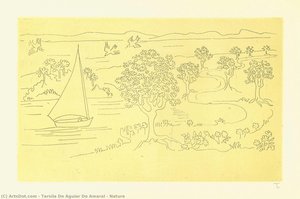
Landscape VII
Technique de reproduction
Format de la reproduction
-


Prix total final
€ 264
A Dreamscape of Brazilian Serenity
In the quiet corners of art history, few works capture the essence of pastoral tranquility as tenderly as Tarsila do Amaral’s Landscape VII. Created in 1971, toward the twilight of the artist's illustrious career, this piece serves as a window into a world where time seems to slow down. The painting presents a breathtakingly serene landscape, depicting a small, nestled village cradled by rolling hills and the gentle presence of water. It is an invitation to step away from the chaos of modernity and enter a realm of soft light and rhythmic simplicity. Through her masterful use of pastel shades—delicate pinks, ethereal blues, and lush greens—Amaral crafts a dreamlike atmosphere that feels both intimately familiar and otherworldly.
The composition is a masterclass in balanced, horizontal layering. The viewer’s eye is led through a series of soft bands: a verdant foreground suggesting cool water or thick vegetation, a central stage featuring quaint architecture and a striking rock formation, and finally, a background of pink-hued hills that melt into the horizon. There is a charming, almost naive quality to the perspective; by eschewing harsh linear recession in favor of a flatter, more two-dimensional arrangement, the artist emphasizes the decorative beauty of the scene. This approach allows the shapes—the rounded contours of the hills and the organic forms of the trees—to dance across the canvas with a rhythmic, folk-art grace.
Technique and the Texture of Memory
To behold Landscape VII is to witness the tactile power of oil on canvas. Amaral employs a technique characterized by visible, expressive brushstrokes that lend the work a vibrant, living energy. The application of paint is particularly noteworthy in the central rock formation and the surfaces of the buildings, where thick impasto creates a physical texture you can almost feel with your eyes. This ruggedness provides a beautiful counterpoint to the soft, diffused lighting that permeates the scene, suggesting the gentle glow of an overcast afternoon. Every stroke feels intentional, contributing to a surface that is as much about the physical presence of the medium as it is about the subject matter itself.
For the discerning collector or interior designer, this piece offers a unique opportunity to introduce a sense of calm and sophisticated nostalgia into a space. The artwork does not merely decorate a wall; it transforms an environment. Its soft palette and organic shapes make it an ideal centerpiece for rooms designed for relaxation, such as a master suite or a quiet reading nook. Because the style leans toward the Antropofagia movement's roots while embracing a more mature, simplified aesthetic, it bridges the gap between avant-garde history and timeless decorative elegance.
A Legacy of Peace and Identity
Beyond its visual splendor, Landscape VII carries a profound symbolic weight. As a pivotal figure in Brazilian Modernism, Tarsila do Amaral spent her life distilling the soul of her nation into bold, innovative forms. In this later work, that mission evolves into an exploration of harmony and peace. The village scene acts as a symbol of a life lived in equilibrium with nature, where human habitation and the earth exist in a seamless, unconflicted embrace. It evokes a sense of nostalgia for a simpler era, making it deeply resonant for anyone seeking to surround themselves with art that promotes emotional well-being.
Owning a high-quality reproduction of this masterpiece allows one to possess a fragment of Brazilian cultural identity. Whether you are an art historian captivated by her evolution from Cubist influences to folk-inspired simplicity, or a decorator looking for a piece that breathes tranquility into a contemporary setting, Landscape VII stands as a testament to the enduring power of the landscape to soothe the human spirit. It is more than a painting; it is a quiet sanctuary captured in pigment.
Questions et réponses
Quelle émotion l'œuvre Modernism «Landscape VII» dégage-t-elle ?
Au sein du mouvement Modernism, « Landscape VII » est empreint d'un ton Tranquil.
Comment puis-je obtenir une impression de «Landscape VII» de Tarsila do Amaral ?
Pour obtenir une impression de «Landscape VII» de Tarsila do Amaral, il vous suffit de la commander sur sa page Impression d'art fine : une impression d'art sur toile de coton ou sur papier canvas d'archive.
Comment le style de « Landscape VII » s'inscrit-il dans l'époque de son créateur ?
Dans «Landscape VII» de Tarsila do Amaral, le mouvement Modernism rencontre l'époque Époque moderne.
Biographie de l'artiste
Premières années et formation
Tarsila de Aguiar do Amaral, plus connue sous le nom de Tarsila, est née le 1er septembre 1886 à Capivari, au Brésil. Issue d'une famille aisée de producteurs de café, elle a grandi dans un environnement qui encourageait ses aspirations artistiques. Sa formation initiale s’est faite auprès de Pedro Alexandrino Borges avant qu’elle ne parte étudier à Paris en 1920. Elle s'inscrit à l'Académie Julian puis à l'Académie Moderne, où elle est influencée par Fernand Léger, Albert Gleizes et André Lhote.Contribution au modernisme brésilien
Tarsila est considérée comme une figure de proue du modernisme brésilien. Son œuvre a joué un rôle essentiel dans la définition de l'identité artistique du pays. Membre du *Grupo dos Cinco*, aux côtés d’Anita Malfatti, Menotti Del Picchia, Mário de Andrade et Oswald de Andrade, elle a profondément influencé le mouvement artistique moderne au Brésil.Œuvre majeure et mouvements esthétiques
* Abaporu (1928), une peinture célèbre, a inspiré le manifeste *Antropófago* d'Oswald de Andrade, pierre angulaire du mouvement esthétique de l’anthropophagie. * A Negra (1923), une œuvre précoce, témoigne du style naissant de Tarsila. * Morro da Favela, une pièce qui reflète son engagement avec les thèmes brésiliens.Évolution artistique et influences
Après ses études à Paris, Tarsila est revenue au Brésil où elle a été profondément influencée par la nouvelle vague moderniste. Elle intègre le *Grupo dos Cinco*, un collectif influent de peintres et d'écrivains associés au modernisme brésilien. Sa production est particulièrement foisonnante entre 1923 et 1929, bien que son succès ait été limité en raison de l’attrait du public pour le surréalisme. Elle participe au Salon des Vrais Indépendants en 1928 et 1929. Son œuvre évolue vers un style particulier et coloré, mêlant sa culture brésilienne aux techniques apprises à Paris. Elle explore l'imagination et la rêverie dans ses toiles.Héritage et reconnaissance
Tarsila a laissé un héritage important au-delà de ses 230 peintures, des centaines de dessins, d’illustrations, de gravures, de fresques et de cinq sculptures. Elle a contribué à faire avancer le modernisme en Amérique latine et a développé un style unique pour le Brésil. Son influence s'étend aux artistes latino-américains qui ont été inspirés par son exemple à utiliser des sujets brésiliens indigènes et à développer leur propre style. Le cratère Amaral sur Mercure porte son nom. Des expositions rétrospectives de son œuvre ont eu lieu à Paris, notamment à la Maison de l'Amérique latine en 2006 et au Musée du Luxembourg en 2024-2025. Selon Paulo Herkenhoff, directeur du Musée des Beaux-Arts de Rio de Janeiro, elle est le « baromètre de la société brésilienne des premières décennies du XXe siècle ».Liste d'œuvres
- Chapèu azul, 1922 – Coleção Simão Mendel Guss
- Autorretrato (Manteau rouge), 1923, huile sur toile, 73 × 60 cm – Musée national des Beaux-Arts
- A Negra, 1923 – Musée d'Art contemporain de l'université de São Paulo
- Caipirinha, 1923 – Collection privée
- Rio de Janeiro, 1923 – Fundação Cultural Ema Gordon Klabin
- Carnaval em Madureira, 1924, huile sur toile, 76 × 65 cm – Pinacothèque de l'État de São Paulo
- A Cuca, 1924 – Musée de Grenoble
- A Feira I

Tarsila do Amaral
1886 - 1973 , Brésil
En bref
- Artistes Influents:
- Fernand Léger
- Albert Gleizes
- André Lhote
- Date De Décès: 17 janvier 1973
- Date De Naissance: 1er septembre 1886
- Influences Artistiques: Antropofagia, Grupo dos Cinco
- Lieu De Naissance: Cachoeira do Sul, Brésil
- Mouvement Artistique: Modernisme brésilien
- Nationalité: Brésilienne
- Nom Complet: Tarsila do Amaral
- Oeuvres Notables:
- Abaporu (1928)
- A Negra (1923)
- Morro da Favela
Articles connexes

Les 10 Chefs-d'œuvre du Paysage Romantique : Artistes et Décor d'Intérieur
Plongez dans l'émotion du Romantisme avec les 10 plus beaux paysages de Friedrich, Turner & Delacroix. Découvrez leur histoire et trouvez l'inspiration déco idéale sur OriginalUniqueArt.com !
Benedito Calixto: A Brazilian Modernist's Landscape of Memory & National Identity
Explore the captivating world of Benedito Calixto, a pivotal Brazilian Modernist painter. Discover his iconic landscapes, the story behind the famous Bandeirante portrait, and his lasting impact on Brazilian national identity. Learn more at OriginalUniqueArt.

Constable : Les 25 Chefs-d'Œuvre du Maître Anglais | OriginalUniqueArt
Plongez dans l'univers de John Constable avec les 25 œuvres incontournables du maître anglais. Découvrez l'histoire, la technique et l'émotion derrière ses paysages romantiques. Reproductions de qualité muséale sur OriginalUniqueArt.com.

Évocations de lieux : Un voyage historique à travers l'art du paysage
Explorez l'histoire fascinante de la peinture de paysage à travers les chefs-d'œuvre du Romantisme. Découvrez Friedrich, Turner et Aivazovski et laissez-vous inspirer par la beauté sauvage et le sublime. Reproduction d'art de qualité chez OriginalUniqueArt.

The Subtleties of Pastel: A Comprehensive Exploration of Technique, History & Emotional Resonance
Explore the captivating world of pastel art! Discover its rich history, Impressionistic masters like Degas, emotional power & unique techniques. Find museum-quality reproductions at OriginalUniqueArt.