

 Aperçu en situation
 Partager
 Partager
 Détails
 Guide imprimable

 Télécharger
 Articles similaires
 Radiographie
 Voir le diaporama
 Statistiques
Landscape with Water Mill
 Acrylic On Canvas
- WallArt
- Romantic Landscape
 1803
1803 71.0 x 91.0 cm
 Manchester Art Gallery
 Afficher la suite
Reproduction à l'huile faite à la main
Huile sur toile peinte à la main, avec cadre et dimensions personnalisés, réalisée sur commande par nos artistes. ( Passer au format impression Passer au format image numérique)




P118B $10

P118H $10

P118W $10

P438Z $10

P508JH $12

P508YH $12

P805H $10

P805Z $10

P919BZ $10

P919G $10

P919XJ $10

P959ZH $10

P968JZ $12

W106C $8

W218G $10

W218JH $8

W218Y $10

W307PJ $10

W316G $10

W316PJ $8

W316Y $10

W398PJ $8

W4111J $10

W500HY $15

W500JH $15

W692G $12

W849H $8

W940BG $15

W953PJ $8




Choisissez parmi nos formats prédéfinis qui respectent les proportions originales de l’œuvre.

Vous pouvez saisir vos propres dimensions pour l'adapter à un cadre ou à un espace spécifique. Si la taille sélectionnée ne correspond pas aux proportions de l'image d'origine, nous recadrerons l'œuvre ou prolongerons la peinture avec des éléments peints à la main supplémentaires. Une maquette numérique vous sera envoyée pour approbation avant le début de la production.
Veuillez noter que l'aperçu à l'écran ne reflète pas le recadrage ou l'extension réels. Seule la maquette montrera fidèlement la composition finale.
Bien que des tailles personnalisées soient disponibles, nous vous recommandons de sélectionner une dimension dans la liste prédéfinie afin de préserver les proportions d'origine.
Après la commande, l’équipe OriginalUniqueArt.com contactera le client par e-mail pour recueillir ses instructions et lui fournira une maquette d’aperçu
Livraison dans le monde entier () en 3 à 4 semaines au lieu des 5 semaines habituelles. (25 septembre). Aucun compromis sur la qualité.

Livraison express gratuite dans le monde entier

Toile de lin de haute qualité

Assurance transport complète

Garantie de remboursement des droits de douane

Garantie de fidélité des couleurs

Garantie de retour de 100 jours (uniquement en cas de défaut)

Garantie de remboursement à 100%

Tarifs dégressifs sur quantité
 L'option verre n'est disponible que pour les dimensions inférieures à 110 cm.

Landscape with Water Mill
Technique de reproduction
Format de la reproduction
-


Prix total final
$ 300
A Serene Vision of Rural England: Augustus Wall Callcott’s ‘Landscape with Water Mill’
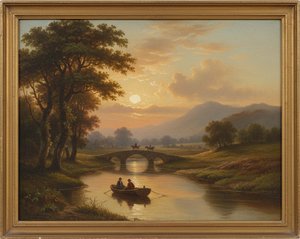
Augustus Wall Callcott's “Landscape with Water Mill,” painted in 1803, is more than just a picturesque depiction of the English countryside; it’s a carefully constructed evocation of Romantic ideals and a subtle meditation on humanity’s relationship to nature. Housed within the esteemed Manchester Art Gallery, this work offers a glimpse into a world where tranquility reigns supreme, yet hints at an underlying drama – a quiet storm brewing in the sky mirroring perhaps the complexities of human experience.
The scene unfolds with remarkable clarity and detail. A modest water mill, constructed from weathered stone and topped with a charming thatched roof, dominates the foreground. Its wooden wheel, perpetually turning, represents not just mechanical industry but also the relentless passage of time. The river flowing alongside is rendered with a delicate touch, reflecting the overcast sky above – a subtle indication of an impending change. The artist’s brushwork is loose and expressive, capturing the movement of water and foliage with a captivating sense of dynamism. Notice how Callcott utilizes varying shades of green to create depth and texture within the surrounding trees, suggesting a dense, vibrant woodland.
Romanticism and the Sublime
“Landscape with Water Mill” firmly resides within the Romantic tradition, a movement that prioritized emotion, imagination, and the beauty of nature over strict academic rules. Callcott’s work embodies this shift by emphasizing atmosphere and feeling rather than precise representation. The dramatic clouds in the sky are not merely decorative; they contribute to the painting's overall sense of drama and the sublime – that awe-inspiring experience when confronted with something vast and powerful, like a storm or a grand landscape.
The inclusion of figures—a solitary man standing by the riverbank and another seated in contemplation—adds an element of human scale to the scene. These individuals are not imposing rulers but rather humble observers, inviting us to share their moment of quiet reflection amidst the grandeur of nature. They serve as a reminder of our own smallness within the vastness of the world.
Technical Details and Artistic Influence
Callcott’s technique is characterized by his masterful use of light and shadow. He skillfully employs atmospheric perspective, creating a sense of distance by subtly diminishing the colors and details of objects in the background. The muted palette—dominated by earthy tones—contributes to the painting's overall mood of serenity and contemplation. It’s evident that Callcott was influenced by artists like Thomas Gainsborough and John Constable, both masters of capturing the beauty of the English countryside with a sensitive eye for detail and an appreciation for light.
The signature “A.W. Callcott” in the lower right corner confirms the artist's identity and adds to the painting’s historical significance. The image itself, likely reproduced from an original source, further emphasizes its status as a treasured work of art.
Symbolism and Emotional Resonance
Beyond its aesthetic qualities, “Landscape with Water Mill” carries symbolic weight. The water mill represents both progress and tradition – the harnessing of natural power for human benefit. The river symbolizes life’s flow, while the solitary figures suggest themes of introspection and connection to nature. The impending storm hints at uncertainty and change, reminding us that even in moments of tranquility, disruption is always possible.
Ultimately, this painting invites viewers to pause, reflect, and appreciate the simple beauty of the natural world. It’s a testament to Callcott's skill as an artist and his ability to capture not just a landscape but also the emotions it evokes – a serene vision of rural England that continues to resonate with audiences today.
Biographie de l'artiste
Premières années et formation
Sir Augustus Wall Callcott, un peintre de paysage anglais renommé, est né le 20 février 1779 dans les gravières de Kensington, un village à la périphérie ouest de Londres. Sa jeunesse fut marquée par une passion pour la musique, ce qui l'amena à chanter dans la chorale de l'abbaye de Westminster pendant plusieurs années. Plus tard, il devint étudiant à la Royal Academy, où il entama sa carrière artistique en tant que portraitiste sous la tutelle de John Hoppner.Ascension vers la notoriété
La préférence de Callcott pour la peinture de paysage se fit rapidement sentir et, après 1804, il n'exposa exclusivement des paysages. Son habileté, son design élégant et sa tonalité charmante conduisirent à une progression constante de sa réputation. En 1806, il fut élu associé de la Royal Academy et, en 1810, devint académicien à part entière.Œuvres notables et expositions
Parmi ses œuvres les plus remarquables figurent :- L'entrée du bassin de Londres (1816)
- L'embouchure de la Tyne (1818)
- Une mer calme sur la Medway (1820)
- Rochester (1824)
- Raphaël et la fornarina (1837) – un exemple rare de ses peintures de figures, que l'on peut trouver au musée du sud de Kensington (collection Sheepshanks), aujourd’hui faisant partie du V&A.
Héritage et vie ultérieure
Callcott reçut une chevalerie en 1837 à l'occasion de l'accession au trône de la reine Victoria. Il succéda à William Seguier comme conservateur des tableaux de la reine en 1843. Callcott décéda le 25 novembre 1844 et fut enterré au cimetière de Kensal Green. Découvrez davantage d'œuvres de Sir Augustus Wall Callcott sur OriginalUniqueArt.com : Explorez davantage sur Wikipédia :
Sir Augustus Wall Callcott
1779 - 1844 , Royaume-Uni
En bref
- Date De Décès: 25 novembre 1844
- Date De Naissance: 20 février 1779
- Lieu De Naissance: Kensington, Royaume-Uni
- Nationalité: Britannique
- Nom Complet: Sir Augustus Wall Callcott
- Style Artistique: Paysage anglais
- Œuvres Notables:
- The Entrance to the Pool of London
- The Mouth of the Tyne
- A Dead Calm on the Medway
- Rochester
- Raffaelle and the Fornarina
Articles similaires

Évocations de lieux : Un voyage historique à travers l'art du paysage
Explorez l'histoire fascinante de la peinture de paysage à travers les chefs-d'œuvre du Romantisme. Découvrez Friedrich, Turner et Aivazovski et laissez-vous inspirer par la beauté sauvage et le sublime. Reproduction d'art de qualité chez OriginalUniqueArt.
Sir Augustus Wall Callcott: A Life Painted with Light & Atmosphere
Explore the life & art of Sir Augustus Wall Callcott, a celebrated British landscape painter known for his serene scenes and elegant compositions. Discover his Romantic influences & lasting legacy at OriginalUniqueArt.
John Varley I: Intimate Observation & the British Romantic Landscape
Explore the serene landscapes of John Varley I, a key figure in British Romanticism. Discover his unique watercolour style, collaboration with William Blake & lasting artistic legacy. Learn about collecting Varley's work.

Les 10 Chefs-d'œuvre du Paysage Romantique : Artistes et Décor d'Intérieur
Plongez dans l'émotion du Romantisme avec les 10 plus beaux paysages de Friedrich, Turner & Delacroix. Découvrez leur histoire et trouvez l'inspiration déco idéale sur OriginalUniqueArt.com !

Constable : Les 25 Chefs-d'Œuvre du Maître Anglais | OriginalUniqueArt
Plongez dans l'univers de John Constable avec les 25 œuvres incontournables du maître anglais. Découvrez l'histoire, la technique et l'émotion derrière ses paysages romantiques. Reproductions de qualité muséale sur OriginalUniqueArt.com.

