

 Aperçu en situation
 Partager
 Partager
 Détails
 Guide imprimable

 Télécharger
 Articles similaires
 Radiographie
 Voir le diaporama
 Statistiques
Sandal


 Afficher la suite
L’œuvre d'art présentée sur cette page est protégée par le droit d'auteur, ce qui signifie que nous ne pouvons légalement créer ou vendre de reproduction identique. Cette protection est appliquée en vertu d'accords internationaux tels que la Convention de Berne et par les lois nationales, notamment celles énoncées par le Loi américaine sur le droit d'auteur - Titre 17.
Cette méthode est pleinement conforme aux réglementations sur le droit d'auteur car elle ne repose pas sur la copie ou la duplication de l'œuvre protégée. Il s'agit plutôt d'une réinterprétation créative — une nouvelle peinture qui s'inspire de l'original sans pour autant lui être identique.
Giclées et impressions d'art
Impressions giclées ou sur toile de qualité musée, avec une production rapide et des finitions au choix. ( Acheter la peinture faite à la main Passer au format image numérique)




P118B €10

P118H €10

P118W €10

P438Z €10

P508JH €12

P508YH €12

P805H €10

P805Z €10

P919BZ €10

P919G €10

P919XJ €10

P959ZH €10

P968JZ €12

W106C €8

W218G €10

W218JH €8

W218Y €10

W307PJ €10

W316G €10

W316PJ €8

W316Y €10

W398PJ €8

W4111J €10

W500HY €15

W500JH €15

W692G €12

W849H €8

W940BG €15

W953PJ €8




Choisissez parmi nos formats prédéfinis qui respectent les proportions originales de l’œuvre.

Vous pouvez saisir vos propres dimensions pour vous adapter à un cadre ou à un espace spécifique. Si la taille sélectionnée ne correspond pas aux proportions de l'image originale, nous recadrerons l'œuvre ou étendrons l'image avec une bordure en miroir ou une couleur unie. Une maquette numérique vous sera envoyée pour approbation avant le début de la production.
Veuillez noter que l'aperçu à l'écran ne reflète pas le recadrage ou l'extension réelle. Seule la maquette montrera avec précision la composition finale.
Bien que des tailles personnalisées soient disponibles, nous vous recommandons de choisir une dimension dans la liste prédéfinie afin de préserver les proportions originales.
Livraison dans le monde entier () en 2 semaines au lieu des 4/5 semaines habituelles. (11 octobre)

Livraison express gratuite dans le monde entier

Toile de lin de haute qualité

Assurance transport complète

Garantie de remboursement des droits de douane

Garantie de fidélité des couleurs

Garantie de retour de 100 jours (uniquement en cas de défaut)

Garantie de remboursement à 100%

Tarifs dégressifs sur quantité
 L'option verre n'est disponible que pour les dimensions inférieures à 110 cm.

Sandal
Giclées et impressions d'art
Format de la reproduction
-


Prix total final
€ 69
Salvatore Ferragamo’s “Sandal”: A Step Into Hollywood Glamour
The image before you isn't merely a painting of shoes; it’s a portal into the heart of 1930s Hollywood, a whisper of luxury and innovation captured in vibrant color. Salvatore Ferragamo’s "Sandal," created in 1938, is more than just footwear—it’s a testament to the designer's audacious vision and his profound understanding of how objects could shape perception and embody dreams. The painting itself explodes with energy; a riot of red, yellow, blue, green, and orange coalesce into a dynamic composition that immediately draws the eye. The shoes aren’t static; they seem poised for movement, suggesting a life lived in dazzling lights and unforgettable evenings.
Ferragamo's genius lay not just in crafting beautiful shoes but in transforming them into statements of personality. This particular sandal was originally commissioned for Judy Garland, a starlet whose image became synonymous with the era’s glamour. The choice of colors—bold and unapologetically bright—reflects the spirit of the time: a celebration of optimism and exuberance following the austerity of the Depression. The open design, exposing the foot, wasn't simply practical; it was deliberately sensual, hinting at the allure and freedom associated with Hollywood stardom.
The Architect of Elegance: Ferragamo’s Legacy
Salvatore Ferragamo’s story is one of remarkable resilience and creative reinvention. Born in 1898 in Bonito, Italy, to a family of modest means, he initially found work in a shoe factory in Boston. However, his innate talent and eye for design quickly propelled him into the world of bespoke footwear, catering to the elite clientele of Santa Barbara, California, and then, crucially, to the stars of Hollywood. His early years were marked by hardship – financial struggles and personal challenges – yet he persevered, establishing a reputation for unparalleled craftsmanship and innovative designs.
Ferragamo’s approach was revolutionary. He didn't just build shoes; he engineered them. His meticulous attention to detail, combined with an understanding of human anatomy (he studied the feet of dancers to create more comfortable footwear), set him apart. He pioneered techniques like the platform heel – a daring departure from convention that would become his signature—and utilized exotic materials and intricate embellishments, cementing his place as a true visionary. The fact that he was commissioned by Judy Garland speaks volumes about his influence and the trust placed in his artistry.
A Window into the Past: Historical Context
The creation of "Sandal" occurred during a pivotal moment in history – the rise of Hollywood’s Golden Age. The 1930s were an era defined by extravagance, glamour, and escapism. Film became a dominant form of entertainment, shaping fashion trends and influencing social attitudes. Ferragamo recognized this cultural shift and skillfully incorporated it into his designs. The vibrant colors and bold silhouettes of "Sandal" perfectly capture the spirit of the decade – a time when shoes were not just functional objects but powerful symbols of status, style, and aspiration.
Interestingly, research reveals that the creation of this particular sandal was influenced by wartime rationing in America. The scarcity of steel for the heel shank led Ferragamo to creatively utilize cork and lightweight wood, demonstrating his ingenuity and resourcefulness. This anecdote adds another layer of intrigue to the artwork, highlighting its historical significance beyond mere aesthetic appeal.
Symbolism and Emotional Resonance
Beyond its technical brilliance, “Sandal” resonates with a powerful sense of nostalgia and romanticism. The image evokes memories of bygone eras – of red-carpet premieres, dazzling parties, and the intoxicating allure of Hollywood. The shoes themselves symbolize freedom, confidence, and the pursuit of dreams. They represent a desire to step into a world of glamour and excitement, embodying the spirit of adventure and self-expression.
This reproduction captures not only the visual details of Ferragamo’s original design but also its underlying emotional essence. It's an invitation to immerse yourself in the world of 1930s Hollywood, a reminder that even the simplest objects can hold profound meaning and transport us to another time and place. It is a piece perfect for collectors seeking a tangible connection to a legendary designer and a captivating era.
Questions et réponses
Où puis-je acheter une reproduction peinte à la main de «Sandal» de Salvatore Ferragamo ?
Les reproductions peintes à la main de «Sandal» de Salvatore Ferragamo sont disponibles sur ce site web : une reproduction à l'huile peinte à la main sur toile de lin, en passant commande via cette page.
L'image de «Sandal» de Salvatore Ferragamo peut-elle être librement reproduite ?
Le statut des droits d'auteur pour «Sandal» de Salvatore Ferragamo : l'œuvre est dans le toujours protégé par le droit d'auteur. Cela détermine si les reproductions de l'image peuvent être réalisées librement.
Quel âge avait Salvatore Ferragamo lors de la création de « Sandal » ?
Lorsque « Sandal » a été créé en 1938, Salvatore Ferragamo — né(e) en 1898 — était âgé(e) de 40 ans.
Où puis-je trouver des œuvres d'art similaires à «Sandal» de Salvatore Ferragamo ?
La page Œuvres similaires de «Sandal» de Salvatore Ferragamo présente des œuvres similaires.
Quelle est l'intensité des couleurs dans «Sandal» de Salvatore Ferragamo ?
Les couleurs de «Sandal» de Salvatore Ferragamo présentent une intensité Monochromatic.
À quel artiste est attribuée l'œuvre "Sandal" ?
L'artiste à l'origine de « Sandal » est Salvatore Ferragamo. L'œuvre est répertoriée sous le nom de Salvatore Ferragamo.
En quelle année «Sandal» de Salvatore Ferragamo a-t-il été créé ?
«Sandal» date de 1938. Cette date inscrit l'œuvre dans la carrière de Salvatore Ferragamo ainsi que dans son époque.
Biographie de l'artiste
Un héritage forgé dans le cuir : La vie et la vision de Salvatore Ferragamo
Salvatore Ferragamo, un nom synonyme d'élégance, d'innovation et de l'âge d'or du glamour hollywoodien, est né dans l'humilité en 1898 à Bonito, en Italie. Loin du monde scintillant qu'il allait finir par définir, la jeunesse de Salvatore était imprégnée de simplicité rurale ; pourtant, c'est ici que son extraordinaire voyage a commencé. Onzième d'une fratrie de quatorze enfants, il manifesta une fascination innée pour la cordonnerie, passant des heures interminables à observer le artisan local — un métier initialement découragé par son père qui le considérait comme une profession de faible rang social. Cependant, la passion du jeune Salvatore s'avéra inébranlable ; à seulement neuf ans, il confectionna sa première paire de chaussures pour la première communion de sa sœur, témoignage de son talent naissant et de sa détermination. Cet acte ne fut pas simplement la création d'une chaussure ; ce fut le forgeage d'un destin. Il marqua la naissance d'une vision artistique qui allait remodeler le paysage de la mode.De Boston à Hollywood : Une ascension transatlantique
Poussé par l'ambition, Ferragamo émigra en Amérique en 1915, rejoignant ses frères à Boston avant de graviter vers l'industrie cinématographique florissante de la Californie. Ce mouvement s'avéra décisif. Il établit d'abord un atelier de réparation, mais reconnut rapidement un besoin non satisfait : des chaussures d'une exécution exquise, adaptées aux exigences du grand écran. Les stars d'Hollywood — Lillian Gish, Mary Pickford et bientôt tant d'autres — devinrent sa clientèle fidèle. Ferragamo ne se contentait pas de fabriquer des chaussures ; il façonnait des illusions, sublimant les personnages à l'écran qui captivaient une nation entière. Il comprit le pouvoir de la narration visuelle et la manière dont la chaussure pouvait contribuer au récit d'un personnage. Cette compréhension le poussa à étudier l'anatomie à l'Université de Californie du Sud, convaincu que le véritable confort et l'élégance découlaient d'une compréhension profonde de la structure du pied. Son utilisation innovante de semelles en acier pour le soutien de la voûte plantaire révolutionna la construction de la chaussure, privilégiant à la fois l'esthétique et le bien-être — une marque de fabrique de sa philosophie de design.Le retour aux sources : Renaissance florentine et épanouissement artistique
En 1927, Ferragamo retourna dans sa patrie, s'installant à Florence, une ville imprégnée de traditions artistiques et artisanales. Il y établit un atelier qui devint rapidement un laboratoire d'innovation. Malgré les difficultés financières durant la Grande Dépression, menant à une faillite en 1933, il persévéra, porté par une foi inébranlable en sa vision. En réétablissant son entreprise en 1938 au sein de l'historique Palazzo Spini Feroni, Ferragamo entama une période de créativité prolifique. Il expérimenta sans crainte des matériaux non conventionnels — le liège, la peau de poisson, et même le métal — repoussant les limites du possible dans la cordonnerie. Cette volonté de défier les conventions devint sa signature. Ses créations n'étaient pas de simples objets fonctionnels ; elles étaient des œuvres d'art sculpturales, reflétant une profonde appréciation de l'histoire et un esprit audacieux de modernité. L'emblématique semelle compensée, née de la pénurie de matériaux pendant la guerre, témoigne de sa débrouillardise et de son ingéniosité, lui valant le prestigieux prix Neiman Marcus en 1947.Une empreinte durable : Héritage et influence
L'impact de Salvatore Ferragamo s'étend bien au-delà du domaine de la chaussure. Il fonda Salvatore Ferragamo S.p.A., un empire du luxe qui continue de prospérer aujourd'hui, exploitant des centaines de boutiques à travers le monde. Bien que célébré pour ses créations destinées aux icônes d'Hollywood comme Marilyn Monroe — il créa son célèbre talon aiguille — et Audrey Hepburn, son influence résonne dans la mode contemporaine. Son engagement envers le confort anatomique, les matériaux innovants et les formes sculpturales a ouvert la voie à des générations de designers. Le Musée Ferragamo à Florence sert de tribut vivant à son héritage, exposant non seulement ses modèles de chaussures révolutionnaires, mais aussi ses intérêts artistiques plus larges, incluant des collections telles que La Collezione Bonello (Malte) et la Collection Palumbo-Fossati (Venise). Son travail transcende la simple mode ; c'est une célébration de l'art, de l'innovation et du pouvoir durable de l'artisanat italien. Bien qu'il se soit éteint en 1960, l'esprit de Salvatore Ferragamo continue d'inspirer, nous rappelant que le vrai style ne réside pas seulement dans ce que nous portons, mais dans l'histoire qu'il raconte.Œuvres et collections notables
- Pollicino : Une sculpture de chaussure Pop Art vibrante, mettant en avant des couleurs audacieuses et un design ludique.
- Sandale (1952) : Un exemple emblématique d'artisanat luxueux et de design géométrique, incarnant l'élégance de l'époque.
- Prototipo di sandalo (1938) : Une magnifique chaussure antique démontrant une broderie complexe et un savoir-faire artisanal.
- <La Collezione Bonello (Malte) : Une collection soigneusement sélectionnée présentant des œuvres de maîtres tels que Le Caravage et Alberto Morrocco, reflétant l'appréciation de Ferragamo pour les beaux-arts.
- <La Collection Palumbo-Fossati (Venise, Italie) : Un assemblage renommé de peintures européennes s'étendant sur plusieurs siècles, soulignant les intérêts culturels plus vastes de Ferragamo.

Salvatore Ferragamo
1898 - 1960 , Italie
En bref
- Artistic Movement Or Style: Baroque
- Artists Or Movements Influenced By This Artist: ['Christian Dior']
- Artists Who Influenced This Artist: ['Luca Giordano']
- Date Of Birth: 5 juin 1898
- Date Of Death: 7 août 1960
- Full Name: Salvatore Ferragamo
- Nationality: Italien
- Notable Artworks:
- Pollicino
- Sandal (1952)
- Prototipo di sandalo (1938)
- Place Of Birth: Bonito, Italie
Articles similaires

Draped Narratives: Fashion as Symbol & Subject in Historical Art
Explore the fascinating history of fashion as a symbol of power & status in art! Discover masterpieces from Gainsborough to Tissot and learn how clothing shaped societal narratives. Find museum-quality reproductions at OriginalUniqueArt.

The Lens of Luxury: A Visual Journey Through the Evolution and Artistry of Fashion Photography
Embark on a visual journey through the evolution of fashion photography. Discover how masters like Gianfranco Ferré blended geometry, surrealism, and texture to redefine high-fashion art for collectors and connoisseurs of luxury imagery.
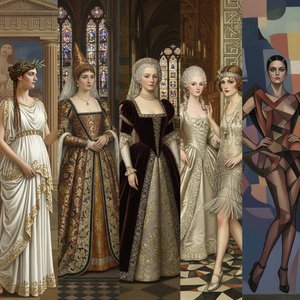
Style Through the Ages: Iconic Artworks That Defined the Evolution of Fashion Design
Explore the breathtaking intersection of fine art and high fashion. Discover how iconic masterpieces from Art Deco to Impressionism have shaped the world of luxury couture and timeless design in this curated visual journey.

Gianfranco Ferré: Deconstructing Haute Couture – A Legacy of Architectural Form
Explore the revolutionary world of Gianfranco Ferré, 'the architect of fashion.' Discover his architectural approach to haute couture, iconic Dior designs, and lasting influence on luxury style. A deep dive for collectors & enthusiasts.

Échos du Temps : Nostalgie, Technique et Signification Culturelle dans la Peinture Vintage
Explorez la nostalgie en peinture vintage : des analyses d'experts sur Hopper, Katz et Wesselmann aux conseils pour collectionner l'art moderne. Découvrez comment ces œuvres captivent et inspirent.


