
 Aperçu en situation
 Envoyer
 Partager
 Détails de l'œuvre
 Guide
Guide

 Télécharger l'image
 Articles similaires
 Radiographie
 Diaporama
 Q&A
Q&A Statistiques
Sandal


 Lire la suite
L’œuvre d'art présentée sur cette page est protégée par le droit d'auteur, ce qui signifie que nous ne pouvons légalement créer ou vendre de reproduction identique. Cette protection est appliquée en vertu d'accords internationaux tels que la Convention de Berne et par les lois nationales, notamment celles énoncées par le Loi américaine sur le droit d'auteur - Titre 17.
Cette méthode est pleinement conforme aux réglementations sur le droit d'auteur car elle ne repose pas sur la copie ou la duplication de l'œuvre protégée. Il s'agit plutôt d'une réinterprétation créative — une nouvelle peinture qui s'inspire de l'original sans pour autant lui être identique.
Giclées et impressions d'art
Impressions giclées ou sur toile de qualité musée, avec une production rapide et des finitions au choix. ( Commander la reproduction peinte à la main Passer au format numérique)




P118B €10

P118H €10

P118W €10

P438Z €10

P508JH €12

P508YH €12

P805H €10

P805Z €10

P919BZ €10

P919G €10

P919XJ €10

P959ZH €10

P968JZ €12

W106C €8

W218G €10

W218JH €8

W218Y €10

W307PJ €10

W316G €10

W316PJ €8

W316Y €10

W398PJ €8

W4111J €10

W500HY €15

W500JH €15

W692G €12

W849H €8

W940BG €15

W953PJ €8




Choisissez parmi nos formats prédéfinis qui respectent les proportions originales de l’œuvre.

Saisissez la largeur et la hauteur souhaitées pour qu'elles s'adaptent à votre cadre ou à votre mur. Une impression peut être recadrée, mais jamais agrandie au-delà de l'image originale ; ainsi, un format de forme différente entraînera la perte d'une partie de l'image. Nous vous envoyons une maquette numérique pour approbation avant toute impression. L'image présentée sur cette page ne montre pas le recadrage réel — seule la maquette le permet.
Livraison dans le monde entier () en 2 semaines au lieu des 4/5 semaines habituelles. (29 octobre)

Livraison express gratuite dans le monde entier

Toile de lin de qualité supérieure

Assurance transport complète

Garantie de remboursement des droits de douane

Garantie de fidélité des couleurs

Politique de retour de 100 jours (uniquement en cas de défaut)

Garantie de remboursement à 100%

Offre de tarifs dégressifs
 L'option verre n'est disponible que pour les dimensions inférieures à 110 cm.

Sandal
Giclées et impressions d'art
Format de la reproduction
-


Prix total
€ 71
A Whisper of Leather and Dreams: Unpacking Ferragamo's Iconic Sandal
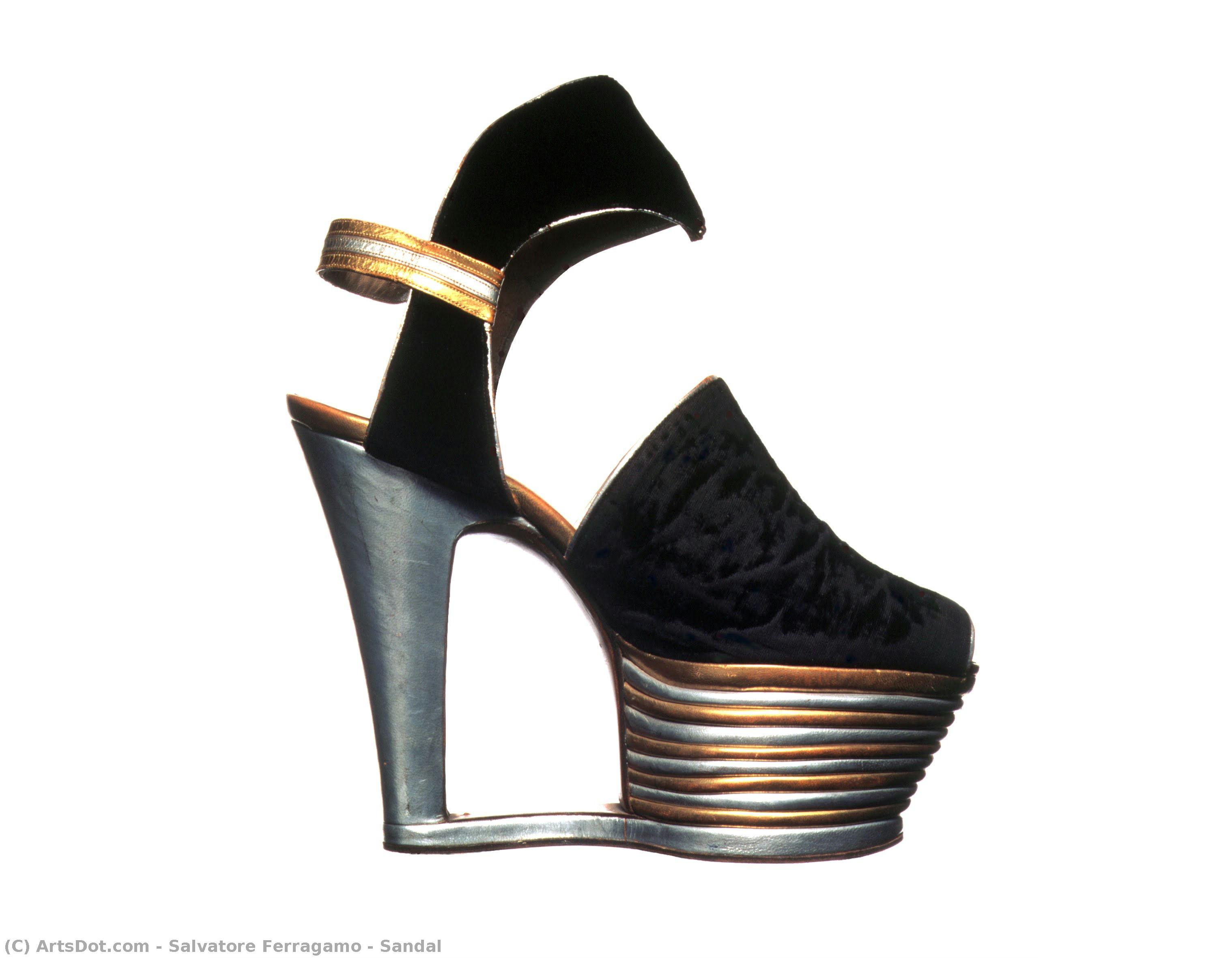
The image before us—a meticulously rendered photograph of Salvatore Ferragamo’s 1940 “Sandal”—isn’t merely a depiction of footwear; it’s a portal to an era defined by Hollywood extravagance, Italian artistry, and the audacious vision of a man who redefined luxury. This isn't simply a shoe; it’s a testament to meticulous craftsmanship, a symbol of daring design, and a poignant reflection of a bygone glamour. The stark black background immediately draws attention to the intricate details of the sandal itself – a study in elegant restraint and subtle power.
Ferragamo’s journey began not amidst the glittering lights of Tinseltown, but in the humble workshops of rural Italy. His early life, marked by hardship and a deliberate rejection of his family's traditional shoemaking expectations, instilled within him an unwavering determination to forge his own path. This foundational experience profoundly shaped his approach to design – a deep understanding of materials, a respect for construction, and a refusal to simply replicate existing forms. The “Sandal,” born from this ethos, embodies these principles perfectly.
The Architecture of Elegance: Form and Technique
Examining the photograph reveals a masterful interplay of form and technique. The sandal’s silhouette is immediately striking – a sleek, almost architectural structure that defies the conventional notions of footwear. The high heel, a bold statement in itself, isn't merely for height; it’s an integral element of the design, adding a sense of poised confidence to the wearer. The velvet upper, rendered with exquisite detail, speaks volumes about the quality of materials and the precision of the stitching. Notice the subtle curve of the toe, the delicate shaping of the straps – each element meticulously considered to enhance both aesthetics and comfort.
The use of silver kidskin trim adds a layer of luxurious texture and visual interest, contrasting beautifully with the deep black velvet. The wooden heel and sole, grounded in traditional shoemaking techniques, provide stability and durability while maintaining an air of understated sophistication. The photograph’s lighting is deliberately soft and even, highlighting the textures and reflective surfaces of the materials without creating harsh shadows. This diffused illumination emphasizes the sandal's tactile quality, inviting the viewer to almost reach out and feel its supple leather.
A Symbol of Transformation: History and Context
The “Sandal” is more than just a beautiful shoe; it’s a pivotal artifact in the history of fashion. Salvatore Ferragamo's early work with Hollywood stars—including Joan Crawford, Greta Garbo, and Marlene Dietrich—established him as the go-to designer for those seeking footwear that was both stylish and comfortable. His innovative designs, particularly the platform heel introduced in the late 1930s, revolutionized the industry and set a new standard for luxury footwear.
The sandal itself represents a deliberate departure from the restrictive styles of the time. It’s a symbol of liberation—a rejection of convention and an embrace of individual expression. Ferragamo's designs were often imbued with a sense of theatricality, reflecting the glamour and excitement of the Hollywood era. The “Sandal” perfectly encapsulates this spirit, suggesting a woman who is confident, stylish, and unafraid to make a statement.
Echoes of Glamour: Emotional Resonance
Looking at this photograph evokes a powerful sense of nostalgia—a longing for the golden age of Hollywood. The sandal’s elegant lines, luxurious materials, and subtle details transport us back to a time when fashion was an art form, and style was synonymous with glamour. It speaks to a desire for sophistication, refinement, and timeless beauty. The piece isn't simply decorative; it carries within it the legacy of a visionary designer who dared to challenge conventions and redefine luxury.
Questions et réponses
Dans quelle pièce recommanderiez-vous d'exposer «Sandal» de Salvatore Ferragamo ?
Une reproduction de « Sandal » s'intègre parfaitement dans une Living Room.
Quelle pièce s'accorde avec les couleurs de «Sandal» de Salvatore Ferragamo ?
Avec sa palette Pastels, «Sandal» de Salvatore Ferragamo est recommandé pour une Living Room. Ses couleurs justifient d'ailleurs cette suggestion.
Existe-t-il une fiche informative sur «Sandal» de Salvatore Ferragamo destinée aux étudiants ?
La page Fiche pédagogique de «Sandal» de Salvatore Ferragamo propose une fiche pédagogique imprimable en deux volets : l'œuvre accompagnée de sa fiche d'identité, une frise chronologique la situant dans la vie de l'artiste, d'autres œuvres de l'artiste, la palette de couleurs mesurée, ainsi que des citations prêtes à être copiées en quatre styles différents.
Biographie de l'artiste
Un héritage forgé dans le cuir : La vie et la vision de Salvatore Ferragamo
Salvatore Ferragamo, un nom synonyme d'élégance, d'innovation et de l'âge d'or du glamour hollywoodien, est né dans l'humilité en 1898 à Bonito, en Italie. Loin du monde scintillant qu'il allait finir par définir, la jeunesse de Salvatore était imprégnée de simplicité rurale ; pourtant, c'est ici que son extraordinaire voyage a commencé. Onzième d'une fratrie de quatorze enfants, il manifesta une fascination innée pour la cordonnerie, passant des heures interminables à observer le artisan local — un métier initialement découragé par son père qui le considérait comme une profession de faible rang social. Cependant, la passion du jeune Salvatore s'avéra inébranlable ; à seulement neuf ans, il confectionna sa première paire de chaussures pour la première communion de sa sœur, témoignage de son talent naissant et de sa détermination. Cet acte ne fut pas simplement la création d'une chaussure ; ce fut le forgeage d'un destin. Il marqua la naissance d'une vision artistique qui allait remodeler le paysage de la mode.De Boston à Hollywood : Une ascension transatlantique
Poussé par l'ambition, Ferragamo émigra en Amérique en 1915, rejoignant ses frères à Boston avant de graviter vers l'industrie cinématographique florissante de la Californie. Ce mouvement s'avéra décisif. Il établit d'abord un atelier de réparation, mais reconnut rapidement un besoin non satisfait : des chaussures d'une exécution exquise, adaptées aux exigences du grand écran. Les stars d'Hollywood — Lillian Gish, Mary Pickford et bientôt tant d'autres — devinrent sa clientèle fidèle. Ferragamo ne se contentait pas de fabriquer des chaussures ; il façonnait des illusions, sublimant les personnages à l'écran qui captivaient une nation entière. Il comprit le pouvoir de la narration visuelle et la manière dont la chaussure pouvait contribuer au récit d'un personnage. Cette compréhension le poussa à étudier l'anatomie à l'Université de Californie du Sud, convaincu que le véritable confort et l'élégance découlaient d'une compréhension profonde de la structure du pied. Son utilisation innovante de semelles en acier pour le soutien de la voûte plantaire révolutionna la construction de la chaussure, privilégiant à la fois l'esthétique et le bien-être — une marque de fabrique de sa philosophie de design.Le retour aux sources : Renaissance florentine et épanouissement artistique
En 1927, Ferragamo retourna dans sa patrie, s'installant à Florence, une ville imprégnée de traditions artistiques et artisanales. Il y établit un atelier qui devint rapidement un laboratoire d'innovation. Malgré les difficultés financières durant la Grande Dépression, menant à une faillite en 1933, il persévéra, porté par une foi inébranlable en sa vision. En réétablissant son entreprise en 1938 au sein de l'historique Palazzo Spini Feroni, Ferragamo entama une période de créativité prolifique. Il expérimenta sans crainte des matériaux non conventionnels — le liège, la peau de poisson, et même le métal — repoussant les limites du possible dans la cordonnerie. Cette volonté de défier les conventions devint sa signature. Ses créations n'étaient pas de simples objets fonctionnels ; elles étaient des œuvres d'art sculpturales, reflétant une profonde appréciation de l'histoire et un esprit audacieux de modernité. L'emblématique semelle compensée, née de la pénurie de matériaux pendant la guerre, témoigne de sa débrouillardise et de son ingéniosité, lui valant le prestigieux prix Neiman Marcus en 1947.Une empreinte durable : Héritage et influence
L'impact de Salvatore Ferragamo s'étend bien au-delà du domaine de la chaussure. Il fonda Salvatore Ferragamo S.p.A., un empire du luxe qui continue de prospérer aujourd'hui, exploitant des centaines de boutiques à travers le monde. Bien que célébré pour ses créations destinées aux icônes d'Hollywood comme Marilyn Monroe — il créa son célèbre talon aiguille — et Audrey Hepburn, son influence résonne dans la mode contemporaine. Son engagement envers le confort anatomique, les matériaux innovants et les formes sculpturales a ouvert la voie à des générations de designers. Le Musée Ferragamo à Florence sert de tribut vivant à son héritage, exposant non seulement ses modèles de chaussures révolutionnaires, mais aussi ses intérêts artistiques plus larges, incluant des collections telles que La Collezione Bonello (Malte) et la Collection Palumbo-Fossati (Venise). Son travail transcende la simple mode ; c'est une célébration de l'art, de l'innovation et du pouvoir durable de l'artisanat italien. Bien qu'il se soit éteint en 1960, l'esprit de Salvatore Ferragamo continue d'inspirer, nous rappelant que le vrai style ne réside pas seulement dans ce que nous portons, mais dans l'histoire qu'il raconte.Œuvres et collections notables
- Pollicino : Une sculpture de chaussure Pop Art vibrante, mettant en avant des couleurs audacieuses et un design ludique.
- Sandale (1952) : Un exemple emblématique d'artisanat luxueux et de design géométrique, incarnant l'élégance de l'époque.
- Prototipo di sandalo (1938) : Une magnifique chaussure antique démontrant une broderie complexe et un savoir-faire artisanal.
- <La Collezione Bonello (Malte) : Une collection soigneusement sélectionnée présentant des œuvres de maîtres tels que Le Caravage et Alberto Morrocco, reflétant l'appréciation de Ferragamo pour les beaux-arts.
- <La Collection Palumbo-Fossati (Venise, Italie) : Un assemblage renommé de peintures européennes s'étendant sur plusieurs siècles, soulignant les intérêts culturels plus vastes de Ferragamo.

Salvatore Ferragamo
1898 - 1960 , Italie
L'essentiel de l'artiste
- Artistic Movement Or Style: Baroque
- Artists Or Movements Influenced By This Artist: ['Christian Dior']
- Artists Who Influenced This Artist: ['Luca Giordano']
- Date Of Birth: 5 juin 1898
- Date Of Death: 7 août 1960
- Full Name: Salvatore Ferragamo
- Nationality: Italien
- Notable Artworks:
- Pollicino
- Sandal (1952)
- Prototipo di sandalo (1938)
- Place Of Birth: Bonito, Italie
Articles connexes

Échos d'époques révolues : Thèmes et techniques dans les collections d'art vintage
Explorez l'univers fascinant de l'art vintage ! Découvrez les thèmes et techniques des mouvements clés comme l'Art Déco et le Cubisme. Conseils d'experts pour collectionner et apprécier ces chefs-d'œuvre intemporels.

Échos du Temps : Nostalgie, Technique et Signification Culturelle dans la Peinture Vintage
Explorez la nostalgie en peinture vintage : des analyses d'experts sur Hopper, Katz et Wesselmann aux conseils pour collectionner l'art moderne. Découvrez comment ces œuvres captivent et inspirent.

Echoes of Time: Exploring the Enduring Appeal of Vintage Artwork
Explore the captivating world of vintage art! Discover its history, enduring appeal, & how to build your own collection. Expert advice, custom reproductions & museum-quality prints at OriginalUniqueArt.

Les 10 Chefs-d'œuvre des Années 40 : Art, Histoire et Décor Intérieur
Plongez dans l'art des années 40 : découvrez 10 chefs-d'œuvre emblématiques de Pollock, Kahlo et autres. Explorez l'histoire, les techniques & trouvez l'inspiration déco sur OriginalUniqueArt.com.

Echoes of Time: Exploring the Enduring Appeal & Historical Context of Vintage Art Prints
Explore the captivating world of vintage art prints! Discover their history, collecting tips & enduring appeal. Expert insights on chromolithography and building a legacy collection with OriginalUniqueArt.


