Aperçu en situation
 Partager
 Partager
 Détails
 Guide imprimable

 Télécharger
 Articles similaires
 Radiographie
 Voir le diaporama
 Statistiques
Self-portrait


 Afficher la suite
Giclées et impressions d'art
Impressions giclées ou sur toile de qualité musée, avec une production rapide et des finitions au choix. ( Acheter la peinture faite à la main Passer au format image numérique)




P118B $10

P118H $10

P118W $10

P438Z $10

P508JH $12

P508YH $12

P805H $10

P805Z $10

P919BZ $10

P919G $10

P919XJ $10

P959ZH $10

P968JZ $12

W106C $8

W218G $10

W218JH $8

W218Y $10

W307PJ $10

W316G $10

W316PJ $8

W316Y $10

W398PJ $8

W4111J $10

W500HY $15

W500JH $15

W692G $12

W849H $8

W940BG $15

W953PJ $8




Choisissez parmi nos formats prédéfinis qui respectent les proportions originales de l’œuvre.

Vous pouvez saisir vos propres dimensions pour vous adapter à un cadre ou à un espace spécifique. Si la taille sélectionnée ne correspond pas aux proportions de l'image originale, nous recadrerons l'œuvre ou étendrons l'image avec une bordure en miroir ou une couleur unie. Une maquette numérique vous sera envoyée pour approbation avant le début de la production.
Veuillez noter que l'aperçu à l'écran ne reflète pas le recadrage ou l'extension réelle. Seule la maquette montrera avec précision la composition finale.
Bien que des tailles personnalisées soient disponibles, nous vous recommandons de choisir une dimension dans la liste prédéfinie afin de préserver les proportions originales.
Livraison dans le monde entier () en 2 semaines au lieu des 4/5 semaines habituelles. (25 septembre)

Livraison express gratuite dans le monde entier

Toile de lin de haute qualité

Assurance transport complète

Garantie de remboursement des droits de douane

Garantie de fidélité des couleurs

Garantie de retour de 100 jours (uniquement en cas de défaut)

Garantie de remboursement à 100%

Tarifs dégressifs sur quantité
 L'option verre n'est disponible que pour les dimensions inférieures à 110 cm.

Self-portrait
Giclées et impressions d'art
Format de la reproduction
-


Prix total final
$ 80
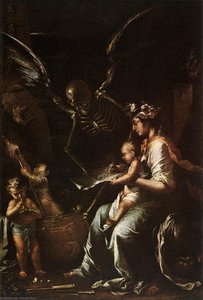
A Baroque Meditation on Identity
In the turbulent landscape of the seventeenth century, few figures captured the spirit of rebellion and intellectual depth quite like Salvator Rosa. His Self-Portrait, completed around 1645, is far more than a mere record of his physical likeness; it is a profound window into the Baroque soul. As the viewer encounters this masterpiece, they are met with a gaze that is both piercing and introspective, pulling them into a world where the boundaries between the artist’s persona and the weight of philosophical thought begin to blur. The portrait presents Rosa in a moment of quiet, heavy contemplation, seated amidst an ethereal, twilight landscape that seems to pulse with the uncertainty of the era.
The composition is masterfully orchestrated to evoke a sense of intimacy and gravity. By utilizing a tight focus on the subject's face and upper torso, Rosa directs our attention toward the psychological terrain of his own mind. The lighting is quintessentially Baroque, employing a dramatic chiaroscuro that carves the features of his face out of the surrounding darkness. This interplay of light and shadow does not merely provide depth; it creates a sense of movement within the stillness, highlighting the rugged textures of his hair and beard while casting much of the background into an indistinct, mysterious gloom. For the collector or designer, this piece offers a commanding presence, acting as a focal point that commands respect and invites long periods of silent study.
Symbolism and the Scholar's Spirit
Every element within this portrait serves a higher narrative purpose, weaving together the artist’s personal identity with the grander intellectual currents of his time. A laurel wreath encircles his head, a classical symbol of victory and poetic achievement that aligns Rosa with the great thinkers of antiquity, such as Plato. This choice suggests that his true triumph lies not in worldly fame, but in the mastery of thought and the pursuit of wisdom. The painting is often interpreted as a personification of philosophy itself—a meditation on silence, wisdom, and the inevitable march of mortality.
The texture of the work further enhances its symbolic weight. Through a deliberate use of impasto, Rosa applied thick layers of oil paint to create a tactile richness, particularly in the wild, untamed strands of his beard. This technique lends a sense of dynamism and raw energy to the figure, mirroring the artist's own reputation as a provocateur and a rebel. The color palette, dominated by somber ochres, deep browns, and muted reds, reinforces a mood of melancholy and gravity, making it an ideal selection for spaces designed for reflection, such as private libraries, study halls, or sophisticated, moody interior galleries.
A Legacy of Rebellion and Beauty
To possess a reproduction of this work is to hold a piece of history marked by defiance. Created during a period of intense religious and political upheaval in Naples, the portrait reflects Rosa’s engagement with the existential questions of his age. He was an artist who refused to be tethered to a single movement, blending the naturalism of Ribera with a romanticized, almost wild approach to landscape that would influence generations of artists well into the nineteenth century. The emotional impact of the piece lies in this very tension—the struggle between the individual and the infinite.
For those seeking to infuse their surroundings with character and historical depth, this Self-Portrait offers an unparalleled opportunity. It is a work that transcends decoration, providing a conversation piece that speaks of intellectual curiosity and the enduring power of the human spirit. Whether placed in a contemporary setting to provide a striking contrast or within a classical room to enhance its traditional elegance, Rosa’s vision remains as potent and captivating today as it was in 1645.
Biographie de l'artiste
La Jeunesse et la Formation
Salvator Rosa, peintre baroque italien, poète et graveur, est né à Arenella, près de Naples, soit le 20 juin, soit le 21 juillet 1615. Sa mère, Giulia Greca Rosa, était issue d'une famille grecque sicilienne. Malgré les aspirations de son père à ce qu’il devienne avocat ou prêtre, Salvator manifesta très tôt une préférence pour les arts.L'Ascension Artistique
La carrière artistique de Salvator Rosa se caractérisa par un style non conventionnel et extravagant qui le distinguait de ses contemporains. Il fut actif à Naples, Rome et Florence, son œuvre étant influencée par le naturalisme de Ribera et le classicisme de Poussin. Cependant, il refusa d'être lié à un style ou un mouvement particulier.- Pythagore émergeant des enfers (Kimbell Art Museum, Fort Worth, États-Unis), l’une de ses œuvres les plus célèbres, illustre son mélange unique de thèmes philosophiques et artistiques.
- Le Baptême de l'eunuque (Chrysler Museum of Art, Norfolk, États-Unis) témoigne de sa capacité à insuffler un drame intense même dans des récits bibliques mineurs.
Influences et Héritage
L’œuvre de Salvator Rosa eut une influence significative sur le développement de l'art baroque. Son impact se retrouve dans les œuvres d'artistes ultérieurs, tels que Luca Giordano, qui continuaient à repousser les limites de l'expression artistique. Liens importants : Profil de Salvator Rosa sur OriginalUniqueArt Wikipédia: Salvatore RosaUn Artiste Rebelle et Innovant
Rosa était un artiste profondément rebelle, défiant les conventions artistiques de son époque. Ses paysages sombres et sauvages, souvent peuplés de figures marginales, étaient une rupture avec les vues classiques et idéalisées de Claude Lorrain. Il est considéré comme un précurseur du romantisme, anticipant l'accent mis sur la puissance brute de la nature et l'exploration des émotions intenses. Son œuvre a connu un regain d’intérêt à la fin du XXe siècle, bien qu’il ne soit pas classé parmi les plus grands peintres baroques par les historiens de l'art contemporains, il est reconnu comme un peintre de paysages innovant et un pionnier du mouvement romantique.Conclusion
La vie et l'œuvre de Salvator Rosa continuent de fasciner les amateurs d’art et les historiens. Son style non conventionnel et sa rébellion constante contre les normes de son temps ont consolidé sa place dans l'histoire de l'art baroque. En tant que peintre, poète et graveur, il demeure une figure énigmatique, et son œuvre continue d'inspirer de nouvelles générations d’artistes et d’amateurs d’art. Musées : Kimbell Art Museum, Chrysler Museum of Art
Salvator Rosa
1615 - 1673 , Italie
En bref
- Artistic Movement Or Style: Baroque
- Artists Or Movements Influenced By This Artist:
- Luca Giordano
- Romantisme
- Artists Who Influenced This Artist:
- Ribera
- Poussin
- Date Of Birth: 20 juin ou 21 juillet 1615
- Date Of Death: 15 mars 1673
- Full Name: Salvator Rosa
- Nationality: Italien
- Notable Artworks:
- Pythagore sortant des enfers
- Le baptême de l'eunuque
- Place Of Birth (City And Country): Arénèlle, Italie
Articles similaires
Simon Vouet: A Baroque Master's Journey from Italian Influence to French Classicism
Explore the life & art of Simon Vouet, a pivotal French Baroque painter who introduced Italian styles to France. Discover his masterpieces and lasting influence on 17th-century art.

Salvator Rosa: A Baroque Rebel's Vision of Landscape, Allegory & the Human Condition
Explore the captivating world of Salvator Rosa, a rebellious Baroque master. Discover his dramatic landscapes, allegorical paintings & lasting influence on Romanticism. Hand-painted reproductions available at OriginalUniqueArt.

Drama and Light: A Definitive Guide to the Italian Baroque Masterpieces and the Revolution of Chiaroscuro
Explore the dramatic world of Italian Baroque art. Discover how masters like Caravaggio used chiaroscuro and tenebrism to revolutionize painting through light, shadow, and profound realism. A definitive guide for history lovers and art collectors.

Les 10 Chefs-d'œuvre Baroques qui ont Révolutionné l'Art |
Plongez au cœur du baroque avec les 10 chefs-d'œuvre de Caravaggio, Rembrandt et Rubens. Découvrez l'histoire fascinante de ces artistes et leurs tableaux célèbres. Reproductions d'art de qualité muséale sur – Explorez la collection !
Decoding Baroque Grandeur: A Guide to the Drama and Emotion of 17th-Century Art
Explore the breathtaking drama of 17th-century Baroque art. Our expert guide decodes the use of chiaroscuro, emotional intensity, and historical grandeur to help you appreciate and curate timeless masterpieces for your collection.