Aperçu en situation
 Envoyer
 Partager
 Détails de l'œuvre
 Guide
Guide

 Télécharger l'image
 Articles similaires
 Radiographie
 Diaporama
 Q&A
Q&A Statistiques
Self-Portrait

- 99.0 x 79.0 cm


 Lire la suite
Giclées et impressions d'art
Impressions giclées ou sur toile de qualité musée, avec une production rapide et des finitions au choix. ( Commander la reproduction peinte à la main Passer au format numérique)




P118B €10

P118H €10

P118W €10

P438Z €10

P508JH €12

P508YH €12

P805H €10

P805Z €10

P919BZ €10

P919G €10

P919XJ €10

P959ZH €10

P968JZ €12

W106C €8

W218G €10

W218JH €8

W218Y €10

W307PJ €10

W316G €10

W316PJ €8

W316Y €10

W398PJ €8

W4111J €10

W500HY €15

W500JH €15

W692G €12

W849H €8

W940BG €15

W953PJ €8




Choisissez parmi nos formats prédéfinis qui respectent les proportions originales de l’œuvre.

Saisissez la largeur et la hauteur souhaitées pour qu'elles s'adaptent à votre cadre ou à votre mur. Une impression peut être recadrée, mais jamais agrandie au-delà de l'image originale ; ainsi, un format de forme différente entraînera la perte d'une partie de l'image. Nous vous envoyons une maquette numérique pour approbation avant toute impression. L'image présentée sur cette page ne montre pas le recadrage réel — seule la maquette le permet.
Livraison dans le monde entier () en 2 semaines au lieu des 4/5 semaines habituelles. (1 novembre)

Livraison express gratuite dans le monde entier

Toile de lin de qualité supérieure

Assurance transport complète

Garantie de remboursement des droits de douane

Garantie de fidélité des couleurs

Politique de retour de 100 jours (uniquement en cas de défaut)

Garantie de remboursement à 100%

Offre de tarifs dégressifs
 L'option verre n'est disponible que pour les dimensions inférieures à 110 cm.

Self-Portrait
Giclées et impressions d'art
Format de la reproduction
-


Prix total
€ 71
Salvator Rosa’s Self-Portrait: A Window into Baroque Thought
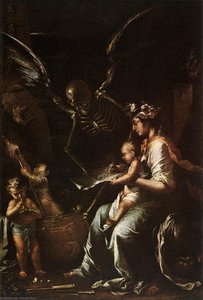
Salvator Rosa’s “Self-Portrait,” painted circa 1645, stands as a testament to the burgeoning spirit of philosophical inquiry within the Baroque period. More than just a likeness of the artist himself—Francesco Maria Rosa—the painting delves into themes of contemplation and intellectual pursuit, reflecting Rosa's profound engagement with humanist ideals prevalent during his time.
- Subject Matter: The central figure is depicted in a studio setting, meticulously engaged in sketching or writing on a spherical object – likely a globe. This deliberate choice isn’t merely decorative; it symbolizes Rosa’s ambition to map out the universe of knowledge and understanding, mirroring the broader intellectual currents of the era.
- Style & Technique: Executed in oil paint on canvas, Rosa employs a masterful blend of chiaroscuro—the dramatic interplay of light and shadow—characteristic of Baroque art. This technique amplifies the emotional impact of the portrait, highlighting Rosa’s face and hand as points of focus against a dark, indistinct background.
- Historical Context: Painted during Rosa’s formative years, “Self-Portrait” aligns with the philosophical debates surrounding Pythagoras—the Greek mathematician and philosopher who championed harmony and proportion. Rosa's inclusion of this figure underscores his fascination with rational thought and its role in shaping human experience – a core concern for artists and intellectuals alike.
A Study in Baroque Composition & Texture
Rosa’s brushwork is visible throughout the portrait, particularly in the depiction of Rosa's hair and clothing. This meticulous attention to detail lends texture and realism to the image, conveying a sense of immediacy and capturing the physicality of the artist. The composition itself directs the viewer’s gaze downwards towards Rosa’s work, emphasizing his concentration and embodying the humanist ideal of active engagement with intellectual pursuits.
- Color Palette: Primarily muted earth tones—browns, ochres, and grays—create a subdued yet dignified atmosphere. These colors contribute to the overall mood of introspection and seriousness, aligning perfectly with Rosa’s philosophical interests.
- Lighting & Shadow: The dramatic lighting emphasizes Rosa's face and hand, casting deep shadows that heighten the sense of depth and drama – a hallmark of Baroque painting techniques designed to evoke emotion and convey spiritual significance.
Symbolism Beyond Appearance
"Self-Portrait" transcends mere visual representation; it speaks to the artist’s inner life and intellectual convictions. The globe serves as a powerful symbol of Rosa's desire to comprehend the cosmos—both literally and metaphorically—reflecting the humanist preoccupation with understanding humanity’s place in the universe. Furthermore, Rosa’s posture conveys a quiet dignity and unwavering commitment to his craft, embodying the Renaissance artist’s belief in the transformative power of art.
- Emotional Impact: The portrait invites contemplation and encourages viewers to consider the role of reason and observation in shaping human understanding. It captures not only Rosa's physical likeness but also hints at his personality and profession through the act of creation he undertakes – a gesture that resonates with the humanist spirit of the Baroque era.
A reproduction of Salvator Rosa’s “Self-Portrait” offers an exceptional opportunity to bring this seminal artwork into your home or studio. Its masterful technique, evocative symbolism, and profound philosophical undercurrents continue to inspire admiration and provide insight into the intellectual landscape of seventeenth-century Italy.
Questions et réponses
Quelle est la teinte dominante de «Self-Portrait» de Salvator Rosa ?
La teinte dominante de «Self-Portrait» de Salvator Rosa est Golden Yellow Range. Cette nuance constitue la tonalité de fond de la palette.
Puis-je prévisualiser «Self-Portrait» de Salvator Rosa avant de commander ?
La page Aperçu en situation de « Self-Portrait » vous permet de prévisualiser l'œuvre avant de passer commande.
Où puis-je acheter une impression de «Self-Portrait» de Salvator Rosa ?
« Self-Portrait » est disponible en tant que une impression d'art sur toile de coton ou sur papier canvas d'archive. Les commandes s'effectuent sur sa page Tirage d'art fine art, dans le format de votre choix.
Biographie de l'artiste
La Jeunesse et la Formation
Salvator Rosa, peintre baroque italien, poète et graveur, est né à Arenella, près de Naples, soit le 20 juin, soit le 21 juillet 1615. Sa mère, Giulia Greca Rosa, était issue d'une famille grecque sicilienne. Malgré les aspirations de son père à ce qu’il devienne avocat ou prêtre, Salvator manifesta très tôt une préférence pour les arts.L'Ascension Artistique
La carrière artistique de Salvator Rosa se caractérisa par un style non conventionnel et extravagant qui le distinguait de ses contemporains. Il fut actif à Naples, Rome et Florence, son œuvre étant influencée par le naturalisme de Ribera et le classicisme de Poussin. Cependant, il refusa d'être lié à un style ou un mouvement particulier.- Pythagore émergeant des enfers (Kimbell Art Museum, Fort Worth, États-Unis), l’une de ses œuvres les plus célèbres, illustre son mélange unique de thèmes philosophiques et artistiques.
- Le Baptême de l'eunuque (Chrysler Museum of Art, Norfolk, États-Unis) témoigne de sa capacité à insuffler un drame intense même dans des récits bibliques mineurs.
Influences et Héritage
L’œuvre de Salvator Rosa eut une influence significative sur le développement de l'art baroque. Son impact se retrouve dans les œuvres d'artistes ultérieurs, tels que Luca Giordano, qui continuaient à repousser les limites de l'expression artistique. Liens importants : Profil de Salvator Rosa sur OriginalUniqueArt Wikipédia: Salvatore RosaUn Artiste Rebelle et Innovant
Rosa était un artiste profondément rebelle, défiant les conventions artistiques de son époque. Ses paysages sombres et sauvages, souvent peuplés de figures marginales, étaient une rupture avec les vues classiques et idéalisées de Claude Lorrain. Il est considéré comme un précurseur du romantisme, anticipant l'accent mis sur la puissance brute de la nature et l'exploration des émotions intenses. Son œuvre a connu un regain d’intérêt à la fin du XXe siècle, bien qu’il ne soit pas classé parmi les plus grands peintres baroques par les historiens de l'art contemporains, il est reconnu comme un peintre de paysages innovant et un pionnier du mouvement romantique.Conclusion
La vie et l'œuvre de Salvator Rosa continuent de fasciner les amateurs d’art et les historiens. Son style non conventionnel et sa rébellion constante contre les normes de son temps ont consolidé sa place dans l'histoire de l'art baroque. En tant que peintre, poète et graveur, il demeure une figure énigmatique, et son œuvre continue d'inspirer de nouvelles générations d’artistes et d’amateurs d’art. Musées : Kimbell Art Museum, Chrysler Museum of Art
Salvator Rosa
1615 - 1673 , Italie
L'essentiel de l'artiste
- Artistic Movement Or Style: Baroque
- Artists Or Movements Influenced By This Artist:
- Luca Giordano
- Romantisme
- Artists Who Influenced This Artist:
- Ribera
- Poussin
- Date Of Birth: 20 juin ou 21 juillet 1615
- Date Of Death: 15 mars 1673
- Full Name: Salvator Rosa
- Nationality: Italien
- Notable Artworks:
- Pythagore sortant des enfers
- Le baptême de l'eunuque
- Place Of Birth (City And Country): Arénèlle, Italie
Articles connexes

Les 10 Chefs-d'œuvre Baroques qui ont Révolutionné l'Art |
Plongez au cœur du baroque avec les 10 chefs-d'œuvre de Caravaggio, Rembrandt et Rubens. Découvrez l'histoire fascinante de ces artistes et leurs tableaux célèbres. Reproductions d'art de qualité muséale sur – Explorez la collection !

Chiaroscuro & Emotion: Capturing the Dramatic Soul of Baroque Art
Explore the profound drama of Baroque art. Discover how masters used chiaroscuro and intense emotion to capture the soul of the 17th century through light, shadow, and spiritual grandeur in this expert art history guide.

Baroque Classicism: The Grandeur of Order and Drama in 17th-Century Art History
Explore the profound elegance of Baroque Classicism. Discover how 17th-century masters synthesized dramatic emotion with classical order through the lens of the Counter-Reformation and the works of legends like Carlo Maratta and Andrea Sacchi.

L'Éclat du Baroque : Comprendre le Drame et l'Émotion de l'Art du XVIIe Siècle
Explorez le drame et la lumière du XVIIe siècle à travers Caravage et Rubens. Plongez dans l'intensité de l'art baroque dès maintenant.
Maîtres du XVIIe Siècle : 10 Œuvres Incontournables pour une Décoration Raffinée
Plongez au cœur du XVIIe siècle avec 10 œuvres majeures de Rembrandt, Vermeer et Caravaggio. Découvrez l'histoire, les techniques et la beauté intemporelle des maîtres baroques. Trouvez votre reproduction d'art idéale sur OriginalUniqueArt.com !