Aperçu en situation
 Partager
 Partager
 Détails
 Guide imprimable

 Télécharger
 Articles similaires
 Radiographie
 Voir le diaporama
 Statistiques
Ceres and Phytalus


 Afficher la suite
Giclées et impressions d'art
Impressions giclées ou sur toile de qualité musée, avec une production rapide et des finitions au choix. ( Acheter la peinture faite à la main Passer au format image numérique)




P118B €10

P118H €10

P118W €10

P438Z €10

P508JH €12

P508YH €12

P805H €10

P805Z €10

P919BZ €10

P919G €10

P919XJ €10

P959ZH €10

P968JZ €12

W106C €8

W218G €10

W218JH €8

W218Y €10

W307PJ €10

W316G €10

W316PJ €8

W316Y €10

W398PJ €8

W4111J €10

W500HY €15

W500JH €15

W692G €12

W849H €8

W940BG €15

W953PJ €8




Choisissez parmi nos formats prédéfinis qui respectent les proportions originales de l’œuvre.

Vous pouvez saisir vos propres dimensions pour vous adapter à un cadre ou à un espace spécifique. Si la taille sélectionnée ne correspond pas aux proportions de l'image originale, nous recadrerons l'œuvre ou étendrons l'image avec une bordure en miroir ou une couleur unie. Une maquette numérique vous sera envoyée pour approbation avant le début de la production.
Veuillez noter que l'aperçu à l'écran ne reflète pas le recadrage ou l'extension réelle. Seule la maquette montrera avec précision la composition finale.
Bien que des tailles personnalisées soient disponibles, nous vous recommandons de choisir une dimension dans la liste prédéfinie afin de préserver les proportions originales.
Livraison dans le monde entier () en 2 semaines au lieu des 4/5 semaines habituelles. (13 octobre)

Livraison express gratuite dans le monde entier

Toile de lin de haute qualité

Assurance transport complète

Garantie de remboursement des droits de douane

Garantie de fidélité des couleurs

Garantie de retour de 100 jours (uniquement en cas de défaut)

Garantie de remboursement à 100%

Tarifs dégressifs sur quantité
 L'option verre n'est disponible que pour les dimensions inférieures à 110 cm.

Ceres and Phytalus
Giclées et impressions d'art
Format de la reproduction
-


Prix total final
€ 69
A Mythological Encounter in Shadow and Line
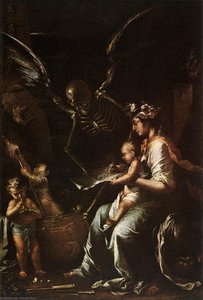
In the evocative depths of Salvator Rosa’s 1662 masterpiece, Ceres and Phytalus, we are transported into a realm where the boundaries between the divine and the mortal dissolve. This exquisite etching captures a pivotal moment of mythological encounter, rendered through the masterful use of monochromatic linework. The scene centers upon Ceres, the Roman goddess of agriculture and fertility, and the mortal Phytalus, whose kneeling posture radiates a profound sense of reverence and supplication. Through the delicate interplay of light and shadow, Rosa invites the viewer into a dense, primordial forest where every etched line breathes life into the surrounding foliage. The composition is not merely a depiction of a story, but an immersive experience of texture and atmosphere, where the organic curves of the human forms emerge from a rugged, untamed landscape.
The technical brilliance of this work lies in Rosa’s command over the medium of printmaking. Utilizing the intricate techniques of hatching and cross-hatching, the artist achieves a remarkable range of tonal variations that simulate depth and dimension without the need for color. These dense networks of lines create areas of profound darkness within the thickets, contrasting sharply with the lighter, more delicate strokes that define the figures' skin and the soft highlights on the leaves. This method lends the piece a tactile quality; one can almost feel the rough bark of the ancient trees and the dampness of the forest floor. The lack of a singular, piercing light source creates a diffused, ethereal glow, contributing to the dreamlike, somewhat ambiguous perspective that characterizes the Baroque fascination with the mysterious and the sublime.
The Baroque Spirit and Symbolic Resonance
As a prominent figure of the Italian Baroque, Salvator Rosa was renowned for his refusal to conform to the rigid classical standards of his era. In Ceres and Phytalus, we see his signature blend of naturalism and dramatic tension. The subject matter—a goddess descending to interact with humanity—carries heavy symbolic weight, touching upon themes of abundance, the cycle of life, and the sacred connection between the earth and its inhabitants. For the discerning collector or interior designer, this piece offers more than just visual beauty; it provides a window into the philosophical inquiries of the 17th century. The tension held in Phytalus’s bowed head and the commanding yet nurturing presence of Ceres creates an emotional resonance that lingers long after the first glance.
Integrating a high-quality reproduction of such a work into a contemporary space allows for a sophisticated dialogue between historical depth and modern elegance. Whether placed in a study filled with leather-bound books or as a focal point in a minimalist gallery-style living room, the monochromatic intensity of Rosa’s vision commands attention. It serves as an intellectual anchor, sparking conversation about mythology, the artistry of the etching needle, and the enduring power of the Baroque aesthetic. To possess such a work is to hold a fragment of history, capturing the very essence of a period defined by its passion, its shadows, and its profound reverence for the natural world.
Questions et réponses
Puis-je examiner « Ceres and Phytalus » plus en détail ?
La page Rayons X de «Ceres and Phytalus» de Salvator Rosa est un visionneur interactif qui vous permet de parcourir onze couches optiques de l'image de l'œuvre, incluant une vue de style radiographie.
L'œuvre «Ceres and Phytalus» de Salvator Rosa est-elle conservée dans le pays d'origine de l'artiste ?
Non - l'œuvre est conservée à l'étranger. Salvator Rosa est né(e) en Italie, et l'original de « Ceres and Phytalus » est conservé dans un musée en États-Unis d'Amérique.
Quand "Ceres and Phytalus" a-t-il été créé, et à quel mouvement appartient-il ?
«Ceres and Phytalus» a été réalisé en 1662, au sein du mouvement Baroque.
Quel usage est suggéré pour «Ceres and Phytalus» de Salvator Rosa ?
L'utilisation suggérée pour «Ceres and Phytalus» de Salvator Rosa est Accent. Elle peut également servir à d'autres fins.
Quelles couleurs dominent «Ceres and Phytalus» de Salvator Rosa ?
«Ceres and Phytalus» de Salvator Rosa utilise une palette Monochrome, avec le Putty (#c7c7c3) comme couleur dominante.
Un téléchargement est-il disponible pour « Ceres and Phytalus » ?
«Ceres and Phytalus» de Salvator Rosa peut être téléchargé depuis la page Télécharger de l'œuvre, en tant que un téléchargement d'image numérique haute résolution.
Quel niveau de contraste présente «Ceres and Phytalus» de Salvator Rosa ?
«Ceres and Phytalus» de Salvator Rosa présente un contraste Serene entre ses zones claires et ses zones sombres.
Est-ce que «Ceres and Phytalus» de Salvator Rosa est dans le domaine public ?
Concernant les droits d'auteur, « Ceres and Phytalus » est dans le dans le domaine public - ses droits d'auteur ont expiré.
Biographie de l'artiste
La Jeunesse et la Formation
Salvator Rosa, peintre baroque italien, poète et graveur, est né à Arenella, près de Naples, soit le 20 juin, soit le 21 juillet 1615. Sa mère, Giulia Greca Rosa, était issue d'une famille grecque sicilienne. Malgré les aspirations de son père à ce qu’il devienne avocat ou prêtre, Salvator manifesta très tôt une préférence pour les arts.L'Ascension Artistique
La carrière artistique de Salvator Rosa se caractérisa par un style non conventionnel et extravagant qui le distinguait de ses contemporains. Il fut actif à Naples, Rome et Florence, son œuvre étant influencée par le naturalisme de Ribera et le classicisme de Poussin. Cependant, il refusa d'être lié à un style ou un mouvement particulier.- Pythagore émergeant des enfers (Kimbell Art Museum, Fort Worth, États-Unis), l’une de ses œuvres les plus célèbres, illustre son mélange unique de thèmes philosophiques et artistiques.
- Le Baptême de l'eunuque (Chrysler Museum of Art, Norfolk, États-Unis) témoigne de sa capacité à insuffler un drame intense même dans des récits bibliques mineurs.
Influences et Héritage
L’œuvre de Salvator Rosa eut une influence significative sur le développement de l'art baroque. Son impact se retrouve dans les œuvres d'artistes ultérieurs, tels que Luca Giordano, qui continuaient à repousser les limites de l'expression artistique. Liens importants : Profil de Salvator Rosa sur OriginalUniqueArt Wikipédia: Salvatore RosaUn Artiste Rebelle et Innovant
Rosa était un artiste profondément rebelle, défiant les conventions artistiques de son époque. Ses paysages sombres et sauvages, souvent peuplés de figures marginales, étaient une rupture avec les vues classiques et idéalisées de Claude Lorrain. Il est considéré comme un précurseur du romantisme, anticipant l'accent mis sur la puissance brute de la nature et l'exploration des émotions intenses. Son œuvre a connu un regain d’intérêt à la fin du XXe siècle, bien qu’il ne soit pas classé parmi les plus grands peintres baroques par les historiens de l'art contemporains, il est reconnu comme un peintre de paysages innovant et un pionnier du mouvement romantique.Conclusion
La vie et l'œuvre de Salvator Rosa continuent de fasciner les amateurs d’art et les historiens. Son style non conventionnel et sa rébellion constante contre les normes de son temps ont consolidé sa place dans l'histoire de l'art baroque. En tant que peintre, poète et graveur, il demeure une figure énigmatique, et son œuvre continue d'inspirer de nouvelles générations d’artistes et d’amateurs d’art. Musées : Kimbell Art Museum, Chrysler Museum of Art
Salvator Rosa
1615 - 1673 , Italie
En bref
- Artistic Movement Or Style: Baroque
- Artists Or Movements Influenced By This Artist:
- Luca Giordano
- Romantisme
- Artists Who Influenced This Artist:
- Ribera
- Poussin
- Date Of Birth: 20 juin ou 21 juillet 1615
- Date Of Death: 15 mars 1673
- Full Name: Salvator Rosa
- Nationality: Italien
- Notable Artworks:
- Pythagore sortant des enfers
- Le baptême de l'eunuque
- Place Of Birth (City And Country): Arénèlle, Italie
Articles similaires
Shadow, Light, and Spectacle: The Dramatic Evolution of Baroque Landscape Painting
Explore the breathtaking drama of Baroque landscapes. Our expert guide delves into the interplay of light and shadow in 17th-century masterpieces. Discover art history and find museum-quality, hand-painted oil reproductions to bring classical grandeur to your home.

Drama in Nature: The Captivating Grandeur of Baroque Landscapes and the Art of Emotional Spectacle
Explore the breathtaking drama of Baroque landscapes. From Rubens's grand vistas to the mastery of chiaroscuro, discover how 17th-century artists transformed nature into a theatrical stage of emotion and light. A deep dive for true art enthusiasts.
Les 10 plus grandes gravures : Chefs-d'œuvre qui ont révolutionné l'art | OriginalUniqueArt
Plongez dans l'univers fascinant des 10 plus grandes gravures de l'histoire ! Découvrez les chefs-d'œuvre de Rembrandt, Goya et Dürer. Inspirez votre décoration intérieure avec OriginalUniqueArt : reproductions d'art de qualité muséale en ligne. Explorez la collection sur OriginalUniqueArt.com

Baroque Classicism: The Grandeur of Order and Drama in 17th-Century Art History
Explore the profound elegance of Baroque Classicism. Discover how 17th-century masters synthesized dramatic emotion with classical order through the lens of the Counter-Reformation and the works of legends like Carlo Maratta and Andrea Sacchi.

Salvator Rosa: A Baroque Rebel's Vision of Landscape, Allegory & the Human Condition
Explore the captivating world of Salvator Rosa, a rebellious Baroque master. Discover his dramatic landscapes, allegorical paintings & lasting influence on Romanticism. Hand-painted reproductions available at OriginalUniqueArt.