Passer au format impression
 Lire la suite







































 Pour les œuvres ou reproductions dont un côté mesure plus de 105 cm (environ 41 pouces), le cadre sera expédié sous forme de kit démonté. Cette méthode garantit une livraison sécurisée et prévient tout dommage pendant le transport.


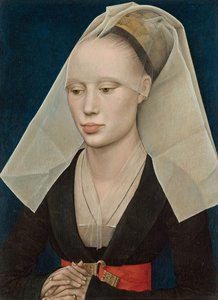
Seven Sacraments Altarpiece (detail) (10): A Masterpiece of Flemish Devotion
Rogier van der Weyden’s *Seven Sacraments Altarpiece* stands as a monumental achievement in Early Netherlandish painting, embodying the spiritual fervor and artistic innovation characteristic of its era. Completed around 1445-1450 for the Church of Saint John Baptist in Poligny, Belgium, this triptych transcends mere depiction; it strives to convey profound theological concepts through meticulous observation and masterful execution.
Subject Matter & Composition: The altarpiece’s central panel showcases a poignant scene of Christ on the Cross alongside the Eucharist—a deliberate juxtaposition designed to communicate the core tenets of Christian faith. Surrounding this focal point are depictions of Baptism, Confirmation, Reconciliation, Marriage and Holy Orders, each rendered with remarkable sensitivity and detail. The artist skillfully employs geometric shapes – particularly the intersecting lines of the chapel’s arches – to establish a balanced composition that directs the viewer's gaze towards the crucified Christ.
Artistic Techniques: Van der Weyden’s mastery lies in his innovative use of oil paint on panel, allowing for unparalleled luminosity and textural richness. Unlike many of his contemporaries who favored tempera—a pigment medium prone to cracking—van der Weyden achieved a velvety surface finish through layering thin glazes of color, creating an illusion of depth and realism that was revolutionary for its time. The artist’s meticulous attention to anatomical accuracy is evident in the figures' musculature and drapery folds, reflecting the humanist influence prevalent during the Renaissance.
Historical Context & Symbolism: Created during Philip the Good’s reign—a period marked by political instability and artistic patronage—the *Seven Sacraments Altarpiece* reflects the dominant religious beliefs of the Burgundian court. Each sacrament symbolizes a crucial element of Christian ritual and spiritual experience, conveying concepts of purification, grace, divine communion, and covenant. The inclusion of two dogs at the foot of the altar serves as a symbol of fidelity and devotion—a visual reminder of Christ’s unwavering love for humanity.
Relevance Today: Despite its age, *Seven Sacraments Altarpiece* continues to inspire admiration for its artistic brilliance and spiritual depth. Its enduring appeal stems from its ability to communicate universal themes of faith, compassion, and redemption—qualities that resonate powerfully with audiences across cultures and generations. Reproductions of this iconic artwork offer a tangible connection to the artistic heritage of Northern Europe.
Available Reproduction: Explore a stunning high-quality reproduction of *Seven Sacraments Altarpiece* on OriginalUniqueArt.com and discover the beauty of Flemish Renaissance art!
Questions et réponses
Quelle est la technique utilisée pour «Les sept sacrements» de Rogier van der Weyden ?
« Les sept sacrements » est réalisé en Huile sur toile.
Quel usage et quel espace sont recommandés pour «Les sept sacrements» de Rogier van der Weyden ?
L'utilisation (Élément d'accentuation) et l'espace (Salon) sont les deux recommandations enregistrées pour «Les sept sacrements» de Rogier van der Weyden.
Comment « Les sept sacrements » s'inscrit-il dans les thèmes et le style de Rogier van der Weyden ?
«Les sept sacrements» partage avec les autres œuvres de Rogier van der Weyden son style Early Netherlandish Renaissance ainsi que ses thèmes récurrents : scholastic theology influence, medieval piety expression, humanist naturalism focus, religious ritual representation, artist’s legacy monumentality.
 Aperçu en situation
 Envoyer
 Partager
 Détails de l'œuvre
 Guide
Guide

 Télécharger l'image
 Articles similaires
 Radiographie
 Diaporama
 Q&A
Q&A Statistiques