Text size

() ·

A painting made for you, by hand

Showing at Tattersalls

Reproduction à l'huile faite à la main

Huile sur toile peinte à la main, avec cadre et dimensions personnalisés, réalisée sur commande par nos artistes. ( Passer au format impression Passer au format numérique)

Description de la pièce

Robert Polhill Bevan's "Showing at Tattersalls" captures a vibrant horse race scene with dynamic figures and rich colors, reflecting the Camden Town Group’s innovative spirit.

Biographie de l'artiste

Robert Polhill Bevan (1865-1925) : peintre britannique & fondateur du groupe Camden Town. Pionnier du fauvisme, paysages vibrants et scènes de la vie quotidienne.

from ·

Chapter 1

How large should it be?

Slide to change the size; the picture on the left shows the frame at its real width. The proportions of the original are kept.

Format standard
sur mesure
CM
INCH

Choisissez parmi nos formats prédéfinis qui respectent les proportions originales de l’œuvre.

largeur
hauteur

Saisissez la largeur et la hauteur souhaitées, pour s'adapter à votre cadre ou à votre mur. Cette œuvre est peinte à la main ; ainsi, pour un format de forme différente, l'artiste peut peindre un peu plus autour du tableau ou réduire légèrement les bords — c'est vous qui choisissez. Nous vous envoyons une maquette numérique pour approbation avant que la peinture ne commence. L'image présentée sur cette page ne reflète pas le résultat réel — seule la maquette le fait.

Chapter 2

How should it arrive?

Choose the edges of the stretched canvas

Choose your frame

Corner sample of the WhiteWrap canvas edge finish, stretched on bois massif bars
White €1
Corner sample of the BlurSideWrap canvas edge finish, stretched on bois massif bars
Blurside €1
Corner sample of the ExtendedWrap canvas edge finish, stretched on bois massif bars
Extended €1
Corner sample of the P118B picture frame: polystyrène moulé, 5 cm wide and 3 cm thick
P118B €10
Corner sample of the P118H picture frame: polystyrène moulé, 5 cm wide and 3 cm thick
P118H €10
Corner sample of the P118W picture frame: polystyrène moulé, 5 cm wide and 3 cm thick
P118W €10
Corner sample of the P438Z picture frame: polystyrène moulé, 5.5 cm wide and 3.5 cm thick
P438Z €10
Corner sample of the P508JH picture frame: polystyrène moulé, 7 cm wide and 3.5 cm thick
P508JH €12
Corner sample of the P508YH picture frame: polystyrène moulé, 7 cm wide and 3.5 cm thick
P508YH €12
Corner sample of the P805H picture frame: polystyrène moulé, 5 cm wide and 3.5 cm thick
P805H €10
Corner sample of the P805Z picture frame: polystyrène moulé, 5 cm wide and 3.5 cm thick
P805Z €10
Corner sample of the P919BZ picture frame: polystyrène moulé, 7 cm wide and 3.5 cm thick
P919BZ €10
Corner sample of the P919G picture frame: polystyrène moulé, 7 cm wide and 3.5 cm thick
P919G €10
Corner sample of the P919XJ picture frame: polystyrène moulé, 7 cm wide and 3.5 cm thick
P919XJ €10
Corner sample of the P959ZH picture frame: polystyrène moulé, 5 cm wide and 3 cm thick
P959ZH €10
Corner sample of the P968JZ picture frame: polystyrène moulé, 6 cm wide and 4 cm thick
P968JZ €12
Corner sample of the W106C picture frame: bois massif, 5 cm wide and 3 cm thick
W106C €8
Corner sample of the W218G picture frame: bois massif, 5 cm wide and 3 cm thick
W218G €10
Corner sample of the W218JH picture frame: bois massif, 5 cm wide and 3 cm thick
W218JH €8
Corner sample of the W218Y picture frame: bois massif, 5 cm wide and 3 cm thick
W218Y €10
Corner sample of the W307PJ picture frame: bois massif, 6 cm wide and 3 cm thick
W307PJ €10
Corner sample of the W316G picture frame: bois massif, 6 cm wide and 3 cm thick
W316G €10
Corner sample of the W316PJ picture frame: bois massif, 6 cm wide and 3 cm thick
W316PJ €8
Corner sample of the W316Y picture frame: bois massif, 6 cm wide and 3 cm thick
W316Y €10
Corner sample of the W398PJ picture frame: bois massif, 5 cm wide and 3 cm thick
W398PJ €8
Corner sample of the W4111J picture frame: bois massif, 6.5 cm wide and 3.5 cm thick
W4111J €10
Corner sample of the W500HY picture frame: bois massif, 7 cm wide and 5 cm thick
W500HY €15
Corner sample of the W500JH picture frame: bois massif, 7 cm wide and 5 cm thick
W500JH €15
Corner sample of the W692G picture frame: bois massif, 8 cm wide and 4 cm thick
W692G €12
Corner sample of the W849H picture frame: bois massif, 5 cm wide and 3 cm thick
W849H €8
Corner sample of the W940BG picture frame: bois massif, 7.5 cm wide and 4.5 cm thick
W940BG €15
Corner sample of the W953PJ picture frame: bois massif, 6 cm wide and 3.5 cm thick
W953PJ €8
Corner sample of the H24-GOLD picture frame: bois sculpté et apprêté au gesso, 10 cm wide and 6 cm thick
H24-GOLD €30
Corner sample of the H24-SILVER picture frame: bois sculpté et apprêté au gesso, 10 cm wide and 6 cm thick
H24-SILVER €30
Corner sample of the H36-GOLD picture frame: bois sculpté et apprêté au gesso, 15 cm wide and 6.5 cm thick
H36-GOLD €45
Corner sample of the H36-SILVER picture frame: bois sculpté et apprêté au gesso, 15 cm wide and 6.5 cm thick
H36-SILVER €45
Aperçu du cadre
Sous cadre

Moulding: . Overall size with the frame: .

Chapter 3

Who paints it, and should anything change?

Examples of what can be changed: Replace face with customer photo; Add pet (e.g., replace cat with dog); Include hidden message in background; Change background landscape or elements.
After order, OriginalUniqueArt.com team will email client for instructions and provide a mockup preview

Livraison dans le monde entier () en 3 à 4 semaines au lieu des 5 semaines habituelles. (31 octobre). Aucun compromis sur la qualité.

Chapter 4

The finishing touches

A nameplate, as in a museum?

Détails de la plaque en bronze gravée

This elegant plaque features the artist's name and the title of the artwork, finely engraved for a timeless presentation.

It is made from bronze with a refined, elegant finish. The text is precisely laser-engraved for a sharp and permanent result. Measuring 9x2 cm, the plaque is compact yet easy to read. It's built to be durable and scratch-resistant, offering a professional, museum-quality look. Mounting is simple thanks to the included adhesive backing.

Détails de la plaque en acrylique transparent

The plaque includes essential engraved details such as the artist's name, the title of the artwork, the date it was created, the type of media used-like oil on canvas or watercolor-a brief description of the piece, and a QR code that links to the complete artwork information.

It is crafted from clear acrylic, offering a sleek, modern appearance. The text is UV-engraved in black to ensure strong visual contrast. With a size of 10x15 cm, it ensures optimal readability. It comes equipped with two metal hooks for secure wall mounting. The plaque is designed to be weather-resistant, making it suitable for various environments, and it includes interactive features that work seamlessly with smartphone scanning.

Détails de la plaque en acrylique noir

This elegant plaque includes engraved information such as the artist's name, the title of the artwork, the date it was created, the type of media used (like oil on canvas or watercolor), a short description of the artwork, and a QR code for quick access to more information.

The plaque itself is made from refined black acrylic with a premium finish. The text is laser-engraved in white for high contrast and readability. Its size is 10x15 cm, designed to be easy to read. It comes with two metal hooks for professional mounting. The design is sleek and fits any interior style. It is also weather-resistant and durable, with built-in digital integration for mobile compatibility.

A protective varnish?

When do you need it?

Chapter 5

Your painting, as you ordered it

Showing at Tattersalls

Technique de reproduction

Format de la reproduction

-

Artiste de prestige

Plus de détails, de finesse et un temps de production accru

-

Cadre de reproduction

-

-

Pour les œuvres ou reproductions dont un côté mesure plus de 105 cm (environ 41 pouces), le cadre sera expédié sous forme de kit démonté. Cette méthode garantit une livraison sécurisée et prévient tout dommage pendant le transport.

Assemblage professionnel requis - ce produit n'est pas destiné au bricolage (DIY).
Le kit doit être assemblé et la toile tendue par un encadreur professionnel expérimenté, en utilisant de la colle à bois (non fournie), une pince à tendre la toile et des serre-joints pour maintenir les traverses d'équerre pendant le séchage de la colle. Un assemblage incorrect ou une tension inégale de la toile peut endommager l'œuvre de manière irréversible et n'est pas couvert par notre garantie.

  • Toutes les baguettes en bois massif sont incluses, découpées avec précision à la taille requise.

  • À assembler avec les vis fournies, ainsi qu'avec de la colle à bois pour les assemblages d'angles (non fournie), à prévoir par votre encadreur.

  • L'utilisation d'outils professionnels est requise et non incluse : une pince à tendre la toile (tendeur) et des serre-joints pour maintenir les baguettes bien d'équerre pendant le séchage de la colle.

Important :
L'assemblage des angles nécessite de la colle à bois, les barres doivent être maintenues avec des serre-joints jusqu'au séchage complet de la colle, et le tendage de la toile sur le châssis assemblé nécessite une pince à tendre la toile. Aucun de ces éléments n'est inclus dans le kit. Veuillez consulter un encadreur professionnel expérimenté avant de commander ce format.

Cartel

-

-

Vernis de protection

Vernis brillant (intensifie les couleurs, protège de la lumière et de l'humidité)

-

Personnaliser mon œuvre

Exemples de personnalisation : remplacer le visage par une photo du client ; ajouter un animal de compagnie (par exemple, remplacer un chat par un chien) ; inclure un message caché en arrière-plan ; modifier le paysage ou les éléments d'arrière-plan.

-

Livraison urgente

Livraison dans le monde entier () en 3 à 4 semaines au lieu des 5 semaines habituelles. (31 octobre). Aucune concession sur la qualité.

-

Livraison express

Livraison dans le monde entier () sous 5 semaines. (7 novembre).

Inclus

Prix total

€ 267

Prix total € 267

L'option verre n'est disponible que pour les dimensions inférieures à 110 cm.

Included with every order

  • Livraison express gratuite dans le monde entier
  • Toile de lin de qualité supérieure
  • Assurance transport complète
  • Garantie de remboursement des droits de douane
  • Garantie de fidélité des couleurs
  • Politique de retour de 100 jours (uniquement en cas de défaut)
  • Garantie de remboursement à 100%
  • Offre de tarifs dégressifs

The Scene Unfolds: Robert Polhill Bevan’s Capturing of a Moment

Robert Polhill Bevan's "Showing at Tattersalls" isn’t merely a depiction of a horse race; it’s a meticulously crafted tableau vivant, a frozen moment brimming with the energy and social significance of Victorian England’s most prestigious racing event. Painted in 1919, during a period of significant artistic transition – moving away from the rigid formality of academic art towards the vibrant expressiveness of early modernism – the canvas offers a surprisingly intimate view of an elite world. The painting transports us to Tattersalls, not just as a venue for horse trading, but as a microcosm of Victorian society, a place where wealth, status, and tradition converged.

Bevan’s masterful use of light and shadow immediately draws the eye. A diffused daylight filters through the windows, casting long, dramatic shadows across the brick flooring, creating an atmospheric depth that anchors the scene. The figures are rendered with a remarkable degree of realism, yet imbued with a subtle sense of abstraction – their faces often obscured by hats or coats, suggesting a detachment and emphasizing the spectacle itself rather than individual personalities. This deliberate ambiguity invites the viewer to become part of the scene, observing from a slightly removed perspective.

A Camden Town Pioneer: Style and Technique

Bevan was a key figure in the Camden Town Group, a collective of artists who sought to capture the gritty realities of London life with bold colors and expressive brushstrokes. “Showing at Tattersalls” exemplifies this approach, though it’s arguably more restrained than some of his later works. The painting showcases Bevan's distinctive style – characterized by smooth planes of color, sharp outlines, and a deliberate flattening of perspective. He employs a technique reminiscent of Impressionism but pushes beyond mere representation, prioritizing the emotional impact of color and form.

  • Color Palette: A muted palette dominated by browns, grays, and ochres creates a sense of understated elegance and reflects the somber atmosphere of the scene.
  • Brushwork: Short, broken brushstrokes contribute to the painting’s dynamic energy, particularly in the depiction of the horses' musculature.
  • Composition: The carefully arranged figures and the receding perspective create a sense of depth and movement, guiding the viewer’s eye through the scene.

Historical Context & Symbolism

Tattersalls, established in 1763, held immense importance within British society. It was more than just a horse sales venue; it represented the pinnacle of equestrian achievement and a significant indicator of wealth and social standing. The presence of numerous spectators – gentlemen in top hats and coats, ladies elegantly dressed – underscores this status. The clock visible in the upper left corner subtly reinforces the importance of time and schedule within this world of racing and commerce.

Beyond the immediate depiction of a horse race, “Showing at Tattersalls” offers a glimpse into Victorian values: the emphasis on tradition, social hierarchy, and the pursuit of excellence. The meticulous detail given to the horses themselves – their powerful legs, flowing manes – speaks volumes about the value placed on these animals as symbols of status and prestige.

A Legacy of Modernism

Robert Polhill Bevan’s “Showing at Tattersalls” stands as a pivotal work in British art history. It represents a crucial bridge between Impressionism and modernism, demonstrating Bevan's willingness to experiment with color and form while retaining a strong sense of realism. His ability to capture the energy and atmosphere of a specific moment in time – a bustling scene within a world of privilege – solidifies his place as a pioneering figure in the development of British art at the turn of the 20th century. Reproductions of this painting offer a captivating window into a bygone era, inviting viewers to contemplate the enduring appeal of spectacle and social observation.

Questions et réponses

Quelle est l'atmosphère générale de «Showing at Tattersalls» de Robert Bevan ?

L'atmosphère générale de «Showing at Tattersalls» de Robert Bevan est Calm. Cette ambiance décrit l'impression globale de l'œuvre.

Quelle taille et quel format sont recommandés pour un tirage de «Showing at Tattersalls» de Robert Bevan ?

Pour « Showing at Tattersalls », la configuration d'impression recommandée est un format Medium avec une orientation Landscape.

«Showing at Tattersalls» de Robert Bevan est-il une œuvre lumineuse ou sombre ?

Les valeurs enregistrées pour «Showing at Tattersalls» de Robert Bevan sont : une luminosité de balanced, une luminance de Soft Shadow.

More about this painting

Aperçu en situation Visualiser en RA Passer au format impression Passer au format numérique Envoyer
Détails de l'œuvre Guide Ajouter aux favoris Télécharger l'image Articles similaires Radiographie Diaporama Q&A Statistiques

In numbers

  • 1919the year it was painted
  • 29frames to choose from
  • standard sizes, in its own proportions
  • 5weeks to paint and deliver it
Robert Bevan

Robert Bevan

1865 - 1925, Royaume-Uni

Quick facts about Robert Bevan

  • Artistes Influents:
    • Paul Gauguin
    • Renoir
    • Velázquez
    • Goya
  • Date De Décès: 1925
  • Date De Naissance: 1865
  • Lieu De Naissance: Hove, Royaume-Uni
  • Mouvement Artistique:
    • Groupe Camden Town
    • Fauvisme
    • Pointillisme
  • Nationalité: Britannique
  • Nom Complet: Robert Polhill Bevan
  • Oeuvres Notables:
    • Rosemary la vallée
    • Paysage dans les Blackdown Hills
    • Stanislawa Bevan, née de Karlowska
    • Dans les collines près de Lewes
    • Le Châtaignier
    • Queen's Grove, St John’s Wood
    • La Ferme
    • L’Arbre à noix

Biographie de l'artiste

Premières années et formation artistique

  • Né : Hove, Royaume-Uni (1865)
  • Décédé : 1925
  • Origines familiales : Robert Polhill Bevan est né dans une famille quaker ayant des liens avec la banque. Ses parents étaient Richard Alexander Bevan et Laura Maria Polhill.
  • Première éducation : Il a étudié à l'école d'art de Westminster sous la direction de Fred Brown. Plus tard, il a fréquenté l'Académie Julian à Paris où il a rencontré des artistes influents tels que Paul Sérusier, Pierre Bonnard, Édouard Vuillard et Maurice Denis.
  • Influence de Bretagne : Ses premiers voyages en Bretagne (1890 et 1891) ont considérablement influencé son développement artistique, notamment grâce à l'exposition au style de Pont-Aven.

Développement artistique et influences

  • Style précoce : Le travail précoce de Bevan montrait des influences du synthétisme, évident dans ses dessins et gravures réalisés pendant son séjour en Bretagne.
  • Fauvisme : Vers 1904, Bevan a expérimenté avec la couleur pure, démontrant une approche proto-fauve qui précédait de nombreux artistes britanniques à l'époque. Sa peinture "Courtyard" est considérée comme un exemple précoce de ce style.
  • Divisionnisme/Pointillisme : Par la suite, il a adopté une technique divisionniste ou pointilliste, comme on le voit dans des œuvres telles que "Ploughing on the Downs" et "The Turn-Rice Plough."
  • Influences clés : Les influences significatives comprenaient Paul Gauguin (évident dans son utilisation de la couleur) et les maîtres plus anciens tels que Velázquez et Goya. Il a également reconnu les conseils de Renoir pour dessiner des chevaux.

Appartenance à des groupes artistiques

  • Groupe de Camden Town : Bevan était un membre fondateur du Groupe de Camden Town, un collectif d'artistes qui cherchait à dépeindre la vie urbaine moderne.
  • London Group : Il a également appartenu au London Group, une autre organisation artistique progressiste.
  • Groupe Cumberland Market : Démontrant davantage son engagement envers les mouvements artistiques contemporains, Bevan faisait partie du Groupe Cumberland Market.
  • Association avec Walter Sickert : En 1908, il a rejoint le groupe de Fitzroy Street de Walter Sickert, où il a reçu des encouragements à se concentrer sur des sujets quotidiens.
  • Allied Artists' Association : Il a participé à la première exposition de l'Association des artistes alliés en 1908, qui a fourni une plateforme aux artistes progressistes et lui a présenté Wassily Kandinsky.

Œuvres majeures et thèmes

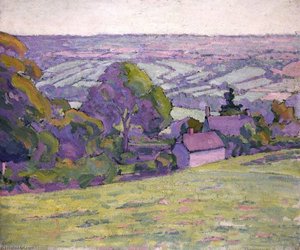
  • Paysages : Bevan est surtout connu pour ses paysages du Sussex et de la Bretagne, dépeignant souvent des scènes rurales avec des couleurs vibrantes et un travail pictural expressif. Des exemples incluent "In the Downs near Lewes", "The Chestnut Tree" et "Landscape in the Blackdown Hills, Devon".
  • Portraits : Il a créé des portraits, dont une représentation notable de sa femme, Stanislawa Bevan (née de Karłowska).
  • Scènes urbaines : Son travail comprenait également des représentations de la vie urbaine, telles que des peintures documentant le déclin du commerce des calèches ("The Cab Horse").
  • Peintures notables : Parmi les autres œuvres importantes figurent "Queen's Grove, St John's Wood", "The Farmhouse" et “Rosemary la vallée”.

Héritage et signification historique

  • Pionnier de l'art britannique moderne : Robert Polhill Bevan est reconnu comme un pionnier de l'art britannique moderne, en particulier pour son adoption précoce des principes fauves.
  • Influence sur l'utilisation de la couleur : Il a été parmi les premiers artistes britanniques à utiliser la couleur pure d'une manière significative, influençant ainsi les générations futures de peintres.
  • Contribution au Groupe de Camden Town : Sa participation au Groupe de Camden Town a contribué à façonner le développement de l'art moderne en Grande-Bretagne.
  • Exposition rétrospective : Une exposition rétrospective à Colnaghi's en 1961 a mis en évidence ses contributions et a consolidé sa place dans l'histoire de l'art.

Informations clés

  • Artistic style: Fauvism, Camden Town Group
  • Notable elements or techniques: Angular style, pure color
  • Movement: Early 20th Century
  • Dimensions: 58 x 71 cm
  • Year: 1919
  • Influences:
    • Pissarro
    • Van Gogh

Quiz d'art

Chaque question ne comporte qu'une seule bonne réponse.

Question 1:
What is the primary subject matter depicted in ‘Showing at Tattersalls’?
Question 2:
Which art movement is most closely associated with Robert Polhill Bevan’s style, as evidenced by this painting?
Question 3:
In what year was ‘Showing at Tattersalls’ painted?
Question 4:
Robert Polhill Bevan was a member of which influential British art group?
Question 5:
What does the presence of a clock in the painting suggest?