Post-Impressionism · 1924
Mount Stephen, Devon (Robert Bevan, 1924)
Robert Bevan (1865–1925) a réalisé Mount Stephen, Devon. Elle date de 1924. Il appartient au mouvement Post-Impressionism. Réalisée en Oil On Canvas. Ses dimensions sont 56 × 76 cm.
- 1924
- Oil On Canvas
- 56 × 76 cm

 Aperçu en situation

 Peinture à l'huile faite main
 Envoyer
 Partager
 Fiche pédagogique


 Télécharger l'image
 Articles similaires
 Radiographie
 Diaporama
 Questions et réponses

 Statistiques
Mount Stephen, Devon, en bref
- Titre
- Mount Stephen, Devon
- Artiste
- Robert Bevan (1865–1925)
- Lieu de naissance de l'artiste
- Hove, Royaume-Uni
- Date
- 1924
- Technique
- Oil On Canvas
- Dimensions
- 56 × 76 cm
- Mouvement
- Post-Impressionism
- Période
- Modern
- Sujet
- devon village, rural england, coastal scene, british art, village life, impressionism
Que représente Mount Stephen, Devon ?
Identification of Mount Stephen, Devon
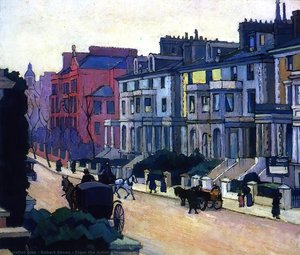
Mount Stephen, Devon is an oil on canvas painting by the artist Robert Bevan. This work was created in 1924. The piece measures 56 x 76 cm. It depicts a scene in Devon, England, featuring a red brick building in the foreground and two figures standing outside the structure.
The subject matter focuses on a small village setting. The composition includes residential architecture, specifically houses with thatched roofs, chimneys, and windows. Two people are positioned on the sidewalk, engaged in conversation. The perspective is slightly elevated, looking down a sloping street toward the sea. The sky is covered by clouds, which creates diffused lighting across the scene. This lighting casts soft shadows and highlights the various colors present in the village architecture and the surrounding landscape.
The Composition and Visual Elements
The composition presents a balanced arrangement of clustered buildings situated under a cloudy sky. The perspective is slightly elevated, looking down a sloping street that leads toward the sea. In the foreground, a red brick building anchors the scene. Two people stand outside this structure, positioned on the sidewalk near the architecture. The subject matter focuses on residential architecture, including houses characterized by thatched roofs, chimneys, and windows.
The arrangement of the village in Devon, England, relies on a series of rectangular shapes and organic lines. The rooflines of the houses create a structured pattern against the sky. Lines define the edges of the buildings, while the sloping street provides a sense of depth through atmospheric perspective. Distant elements appear paler and less distinct, establishing a clear recession into the background. The lighting is diffused by the overcast sky, casting soft shadows across the surfaces of the buildings and the street.
Technique and Artistic Style
The style of this work is reminiscent of the Post-Impressionist movement. It utilizes bold colors and geometric shapes to define the architecture and the landscape. The composition relies on rectangular forms for the buildings and organic shapes for the roofs. Visible brushstrokes are used throughout the piece, creating a sense of texture. On the walls and roofs, the paint appears thick and impasto-like, suggesting a deliberate layering of the medium.
The lighting in the scene is diffused, a result of the overcast sky. This soft light avoids harsh shadows and instead highlights the various colors across the village. Depth is achieved through the use of atmospheric perspective, where distant elements appear paler and less distinct than those in the foreground. This technique establishes a sense of space between the red brick building in the front and the elements further back in the composition.
Related Works by Robert Bevan
The artist's engagement with the Devon landscape is evident in other compositions from different periods. Landscape in the Blackdown Hills, Devon was painted in 1917. This work focuses on the rolling topography and the relationship between the land and the sky. Other depictions of the region include Devonshire Valley, No. 2, which was painted in 1913. This piece features a sweeping vista of a verdant valley where a small stone cottage with a pink-hued roof sits among dark trees.
Earlier works also demonstrate the artist's interest in atmospheric conditions and specific technical approaches. Haze over the Valley was created in 1913. In different studies, the artist utilized a divisionist technique, as seen in The Turn-Rice Plough. These varied approaches to color and form reflect a career spent exploring the structural elements of the English countryside and the application of light across different terrains.
Images haute résolution de Mount Stephen, Devon

Domaine public : l'artiste est décédé en 1925.
Autres formats, recadrages et citations →Robert Bevan, Mount Stephen, Devon (1924).
Robert Bevan (1865–1925), Mount Stephen, Devon, 1924, oil on canvas. Domaine public Crédit photo : OriginalUniqueArt.com.
Questions sur Mount Stephen, Devon, réponses
En quelle année «Mount Stephen, Devon» de Robert Bevan a-t-il été créé ?
L'œuvre «Mount Stephen, Devon» de Robert Bevan date de 1924.
Quelle technique a été utilisée pour «Mount Stephen, Devon» de Robert Bevan ?
«Mount Stephen, Devon» de Robert Bevan est réalisé en Oil On Canvas. Les reproductions visent à restituer l'aspect de cette technique.
Quelles sont les dimensions réelles de «Mount Stephen, Devon» de Robert Bevan ?
L'œuvre originale «Mount Stephen, Devon» de Robert Bevan mesure 56 x 76 cm.
Que représente «Mount Stephen, Devon» de Robert Bevan ?
Les thèmes présents dans «Mount Stephen, Devon» de Robert Bevan incluent devon village, rural england, coastal scene, british art, village life, impressionism, colorful painting. Ensemble, ils résument le sujet de l'œuvre.
L'image de «Mount Stephen, Devon» de Robert Bevan peut-elle être librement reproduite ?
«Mount Stephen, Devon» de Robert Bevan est dans le dans le domaine public - ses droits d'auteur sont tombés dans le domaine public. Ce statut régit les modalités de reproduction de l'image de l'œuvre.
Qui est l'auteur de "Mount Stephen, Devon" ?
L'artiste à l'origine de « Mount Stephen, Devon » est Robert Bevan. L'œuvre est répertoriée sous le nom de Robert Bevan.
À quel courant artistique «Mount Stephen, Devon» de Robert Bevan appartient-il ?
« Mount Stephen, Devon » est une œuvre issue du Post-Impressionism. Ce mouvement définit la tradition artistique à laquelle l'œuvre appartient.
À quelle étape de la carrière de Robert Bevan « Mount Stephen, Devon » s'inscrit-elle ?
«Mount Stephen, Devon» appartient à la période Mature Period de la carrière de Robert Bevan. Cette classification relie l'œuvre à l'évolution de l'artiste.
Quel âge avait Robert Bevan lors de la création de « Mount Stephen, Devon » en 1924 ?
Robert Bevan avait 59 ans lors de la création de « Mount Stephen, Devon » en 1924. L'âge est calculé à partir de l'année de naissance de l'artiste, 1865.
À propos de l'artiste, Robert Bevan

1865–1925, Royaume-Uni
Robert Bevan
Premières années et formation artistique Né : Hove, Royaume-Uni (1865) Décédé : 1925 Origines familiales : Robert Polhill Bevan est né dans une famille quaker ayant des liens avec la banque. Ses parents étaient Richard Alexander Bevan et Laura Maria Polhill. Première éducation : Il a étudié à l'école d'art de Westminster sous la direction de Fred Brown. Plus tard, il a fréquenté l'Académie Julian à Paris où il a rencontré des artistes influents tels que Paul Sérusier, Pierre Bonnard, Édouard Vuillard et Maurice Denis.
Autres œuvres de Robert Bevan
 Depuis la fenêtre de l'artiste1915
 Marchands de chevaux (Vente au dépôt Ward n°1)1918
 Vallée de Devonshire, n° 21913
 Paysage dans les collines de Blackdown, Devon1917

Essais sur Mount Stephen, Devon
 10 peintures magnifiques de collines et de paysages terreuxExplorez 10 œuvres iconiques de Renoir à Munch sur les collines. Découvrez nos reproductions de qualité musée sur OriginalUniqueArt.com.
 Pierre Puvis de Chavannes : 25 peintures clés pour découvrir son styleExplorez 25 œuvres clés de Pierre Puvis de Chavannes et le symbolisme français. Découvrez la collection complète sur OriginalUniqueArt.com.
 Les 25 chefs-d'œuvre de Bernardo Bellotto : Maître de la lumière urbainePlongez dans les chefs-d'œuvre de Bernardo Bellotto. Explorez ses vedutas sublimes sur OriginalUniqueArt.com, la référence pour des reprodu…