Aperçu en situation
 Envoyer
 Partager
 Détails de l'œuvre

 Télécharger
 Articles similaires
 Radiographie
 Diaporama
Tam Gan


 Lire la suite
Reproduction à l'huile faite à la main
Huile sur toile peinte à la main, avec cadre et dimensions personnalisés, réalisée sur commande par nos artistes. ( Commander l'impression Acheter l'image haute résolution)




P118B $10

P118H $10

P118W $10

P438Z $10

P508JH $12

P508YH $12

P805H $10

P805Z $10

P919BZ $10

P919G $10

P919XJ $10

P959ZH $10

P968JZ $12

W106C $8

W218G $10

W218JH $8

W218Y $10

W307PJ $10

W316G $10

W316PJ $8

W316Y $10

W398PJ $8

W4111J $10

W500HY $15

W500JH $15

W692G $12

W849H $8

W940BG $15

W953PJ $8




Choisissez parmi nos formats prédéfinis qui respectent les proportions originales de l’œuvre.

Vous pouvez saisir vos propres dimensions pour l'adapter à un cadre ou à un espace spécifique. Si la taille sélectionnée ne correspond pas aux proportions de l'image d'origine, nous recadrerons l'œuvre ou prolongerons la peinture avec des éléments peints à la main supplémentaires. Une maquette numérique vous sera envoyée pour approbation avant le début de la production.
Veuillez noter que l'aperçu à l'écran ne reflète pas le recadrage ou l'extension réels. Seule la maquette montrera fidèlement la composition finale.
Bien que des tailles personnalisées soient disponibles, nous vous recommandons de sélectionner une dimension dans la liste prédéfinie afin de préserver les proportions d'origine.
Après la commande, l’équipe OriginalUniqueArt.com contactera le client par e-mail pour recueillir ses instructions et lui fournira une maquette d’aperçu
Livraison dans le monde entier () en 3 à 4 semaines au lieu des 5 semaines habituelles. (7 septembre). Aucun compromis sur la qualité.

Livraison express gratuite dans le monde entier

Toile de lin de qualité supérieure

Assurance transport complète

Garantie de remboursement des droits de douane

Garantie de fidélité des couleurs

Politique de retour de 100 jours (uniquement en cas de défaut)

Garantie de remboursement à 100%

Offre de tarifs dégressifs
 L'option verre n'est disponible que pour les dimensions inférieures à 110 cm.

Tam Gan
Technique de reproduction
Format de la reproduction
-


Prix total
$ 300
The Quiet Resonance of American Realism
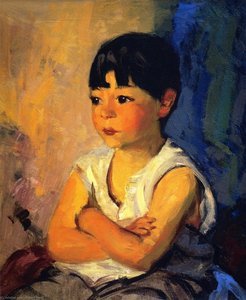
To stand before Robert Henri's Tam Gan is to encounter a moment suspended in time—a breath held between the observer and the observed. Painted in 1914, this oil on canvas portrait transcends mere likeness; it captures an inner landscape. Robert Henri, a master of American Realism, possessed a singular gift for distilling the very spirit of his subjects. His brushwork, often described as bold and expressive, never sacrifices emotional truth at the altar of perfect academic finish. Instead, he uses visible strokes to suggest life lived—a vibrant tapestry woven from light, shadow, and palpable human emotion. The painting invites the viewer not just to look, but to feel the quietude emanating from the young subject.
A Study in Serenity: Subject and Composition
The focal point, undeniably, is the girl herself. Dressed in a serene blue garment, she sits with an almost regal composure, her black hair styled into a neat ponytail that frames a face of profound stillness. Her gaze, directed outward toward the viewer, is neither challenging nor retiring; it is simply present. This direct yet gentle connection draws the eye deep into the painting's core. While two other figures occupy the background, they recede gracefully, serving only to deepen the sense of intimacy surrounding the main subject. The artist masterfully employs a subdued background palette, ensuring that all visual energy converges upon the girl’s expression—a testament to Henri's understanding of pictorial hierarchy.
The Brushstroke as Biography: Technique and Style
Henri’s technique in Tam Gan is a perfect marriage of realism and expressive freedom. One can observe the loose, confident application of paint that characterizes his style. These are not hesitant touches; they are declarations. The interplay between the rich blues of her dress and the subtle tones defining her skin speaks to an advanced handling of oil paint. This commitment to visible brushwork is what elevates the piece beyond mere portraiture into a study of artistic process itself. It suggests that the act of seeing, and the act of painting, are inseparable from the subject's very being.
Historical Echoes and Enduring Appeal
As an artifact of American art history, Tam Gan marks a significant moment in the shift toward more emotionally resonant artistic expression. It stands as a powerful counterpoint to rigid academic traditions, championing instead the raw, beating heart of American experience. For the collector or designer seeking art that speaks with depth, this piece offers both historical weight and immediate emotional resonance. Owning a reproduction allows one to bring this palpable sense of calm—this quiet, enduring spirit—into a modern living space, making it an object of contemplation as much as decoration.
Biographie de l'artiste
Un commencement tumultueux
Robert Henri, né Robert Henry Cozad le 24 juin 1865 à Cincinnati, Ohio, était un peintre et enseignant américain. Sa vie précoce fut marquée par la relation tumultueuse entre son père, John Jackson Cozad, joueur et promoteur immobilier, et sa mère, Theresa Gatewood Cozad. Cela mena à un événement significatif en 1882, qui allait modifier le cours de leur existence.L'École Ashcan et les Huit
Robert Henri devint une figure de proue de l’école ashcan du réalisme américain et un organisateur des Huit, une association informelle d’artistes qui protestaient contre les pratiques d’exposition restrictives de la puissante et conservatrice National Academy of Design. Ce groupe comprenait William Glackens, George Luks, Everett Shinn et John Sloan.Évolution artistique
Le parcours artistique d'Henri commença en 1886 à la Pennsylvania Academy of the Fine Arts de Philadelphie, sous la direction de Thomas Anshutz. Il se rendit ensuite à Paris en 1888 pour étudier à l’Académie Julian, où il fut influencé par William-Adolphe Bouguereau et François Millet, embrassant finalement l'impressionnisme.Enseignement et influence
Henri commença à enseigner à la Philadelphia School of Design for Women en 1892. Parmi ses élèves figuraient Joseph Stella, Edward Hopper, Rockwell Kent, George Bellows, Norman Raeben, Louis D. Fancher et Stuart Davis. En 1898, il épousa Linda Craige, une étudiante de son cours d'art privé. Après le décès de celle-ci en 1905, il se remarie avec Marjorie Organ en 1908. Ses dernières années furent marquées par son influence continue sur le réalisme américain.- Œuvres clés : "Woman in Manteau" (1899) et "La Neige" ("The Snow"), qui fut achetée par le gouvernement français pour être exposée au Musée du Luxembourg.
- Élèves notables : Joseph Stella, Edward Hopper, Rockwell Kent, George Bellows, Norman Raeben, Louis D. Fancher et Stuart Davis.
- Mouvement artistique : École ashcan du réalisme américain.
Héritage
L'impact de Robert Henri sur l’art américain est indéniable. Son engagement envers le réalisme et son influence sur la prochaine génération d’artistes ont laissé une marque indélébile. Explorez davantage Robert Henri et ses contemporains dans le mouvement artistique du réalisme américain ou plongez dans le monde d’Edward Hopper, l'un de ses élèves les plus notables.
Robert Henri
1865 - 1929 , États-Unis d'Amérique
L'essentiel de l'artiste
- Artistic Movement Or Style: Réalisme américain (Ashcan)
- Artists Or Movements Influenced By This Artist:
- Edward Hopper
- Rockwell Kent
- Artists Who Influenced This Artist:
- William-Adolphe Bouguereau
- François Millet
- Date Of Birth: 24 juin 1865
- Date Of Death: 1929
- Full Name: Robert Henri
- Nationality: Américain
- Notable Artworks:
- Woman in Manteau
- La Neige
- Place Of Birth (City And Country): Cincinnati, États-Unis
Articles connexes
Robert Henri & the Spirit of American Realism: A Legacy of Urban Life and Artistic Independence
Explore the life & legacy of Robert Henri, a pivotal figure in American Realism. Discover his captivating portraits, influence on the Ashcan School, and enduring impact on art history. Learn more at OriginalUniqueArt.

Henri Matisse : Les 25 Œuvres Maîtresses d'un Génie de la Couleur | OriginalUniqueArt
Plongez dans l'univers vibrant d'Henri Matisse ! Découvrez les 25 œuvres majeures du fauvisme et de la peinture moderne. Explorez La Danse, L'Atelier Rouge & plus encore. Reproductions de qualité musée sur OriginalUniqueArt.com.

Réalisme Américain : 10 Chefs-d'œuvre Incontournables pour une Déco Inspirée
Plongez au cœur du Réalisme Américain avec 10 chefs-d'œuvre d'Edward Hopper, Andrew Wyeth et plus. Découvrez l'histoire et les techniques de ces artistes emblématiques. Reproductions de tableaux de qualité musée sur OriginalUniqueArt.com !

The Unvarnished Truth: A Cultural Journey Through the Soul of American Realism
Explore the profound beauty of American Realism. From the Ashcan School's urban grit to intimate portraits, discover how artists captured the authentic soul of a nation through unvarnished truth and masterful observation.
Le Réalisme Américain du XXe siècle : Un commentaire social et artistique poignant
Explorez le Réalisme Américain du XXe siècle : de l'Ashcan School à Hopper. Analyse approfondie des artistes, techniques et l'impact social de ce mouvement artistique puissant. Découvrez son héritage sur OriginalUniqueArt.