
 Aperçu en situation
 Envoyer
 Partager
 Détails de l'œuvre

 Télécharger
 Articles similaires
 Radiographie
 Diaporama
Snow in New York
 Oil On Canvas
- WallArt
- Ashcan School
 1902
1902- 19th Century
 105.0 x 89.0 cm
 Lire la suite
Giclées et impressions d'art
Impressions giclées ou sur toile de qualité musée, avec une production rapide et des finitions au choix. ( Commander la reproduction peinte à la main Télécharger l'image haute résolution)




P118B $10

P118H $10

P118W $10

P438Z $10

P508JH $12

P508YH $12

P805H $10

P805Z $10

P919BZ $10

P919G $10

P919XJ $10

P959ZH $10

P968JZ $12

W106C $8

W218G $10

W218JH $8

W218Y $10

W307PJ $10

W316G $10

W316PJ $8

W316Y $10

W398PJ $8

W4111J $10

W500HY $15

W500JH $15

W692G $12

W849H $8

W940BG $15

W953PJ $8




Choisissez parmi nos formats prédéfinis qui respectent les proportions originales de l’œuvre.

Vous pouvez saisir vos propres dimensions pour vous adapter à un cadre ou à un espace spécifique. Si la taille sélectionnée ne correspond pas aux proportions de l'image originale, nous recadrerons l'œuvre ou étendrons l'image avec une bordure en miroir ou une couleur unie. Une maquette numérique vous sera envoyée pour approbation avant le début de la production.
Veuillez noter que l'aperçu à l'écran ne reflète pas le recadrage ou l'extension réelle. Seule la maquette montrera avec précision la composition finale.
Bien que des tailles personnalisées soient disponibles, nous vous recommandons de choisir une dimension dans la liste prédéfinie afin de préserver les proportions originales.
Livraison dans le monde entier () en 2 semaines au lieu des 4/5 semaines habituelles. (20 août)

Livraison express gratuite dans le monde entier

Toile de lin de qualité supérieure

Assurance transport complète

Garantie de remboursement des droits de douane

Garantie de fidélité des couleurs

Politique de retour de 60 jours (uniquement en cas de défaut)

Garantie de remboursement à 100%

Offre de tarifs dégressifs
 L'option verre n'est disponible que pour les dimensions inférieures à 110 cm.

Snow in New York
Giclées et impressions d'art
Format de la reproduction
-


Prix total
$ 80
Description de la pièce
A Winter's Breath in the Heart of Manhattan
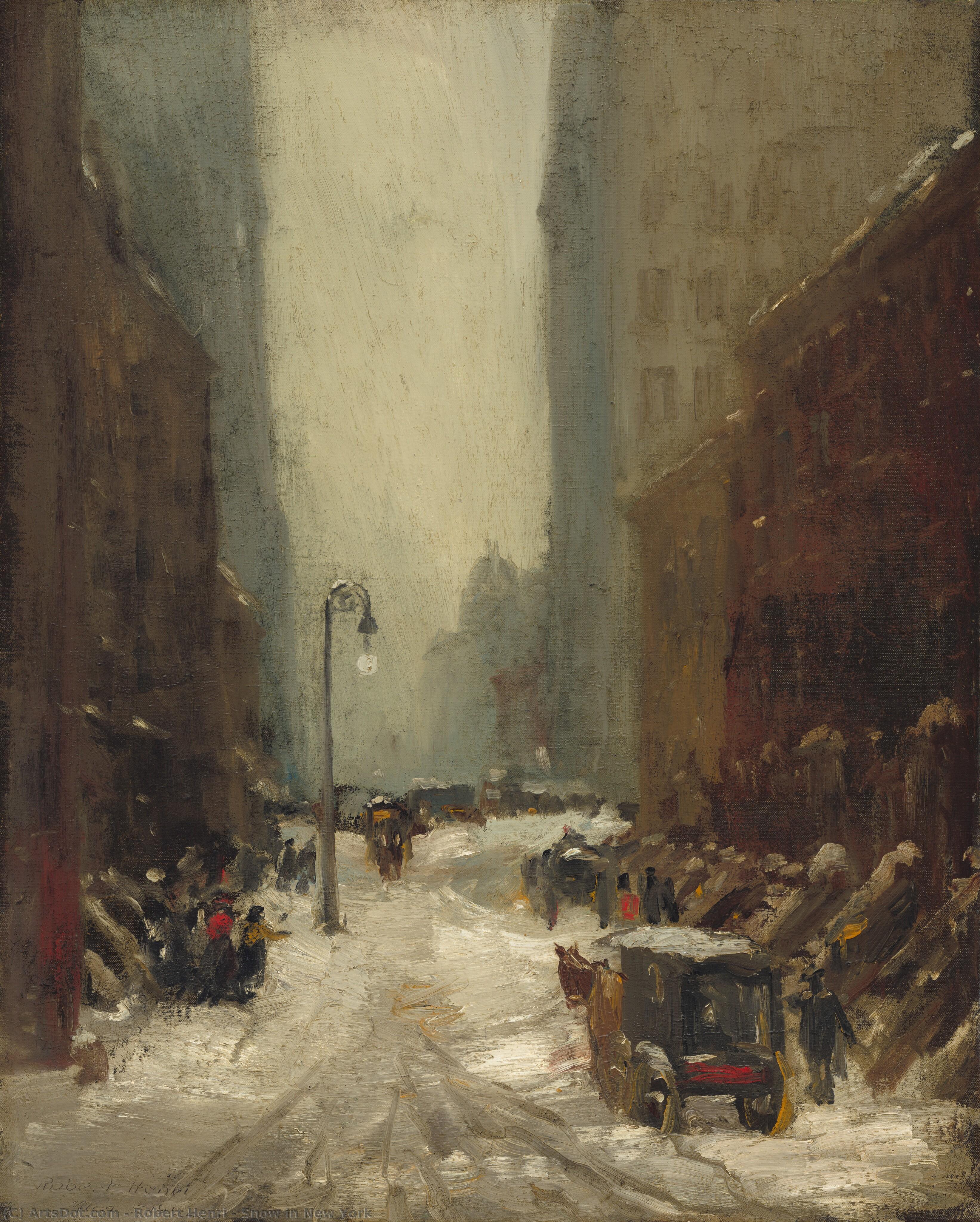
In the quiet, muffled atmosphere of a New York winter, Robert Henri’s "Snow in New York" (1902) invites the viewer to step into a moment frozen in time. The painting captures a gritty yet poetic urban landscape, where the bustling energy of the city is softened by a heavy blanket of snow. A horse and carriage move through the center of the composition, disappearing into the hazy depth of a street lined with towering architecture. The scene is not one of pristine, sparkling white, but rather a study in muted, atmospheric tones—shades of coffee, earth brown, and slate gray that evoke the damp, heavy air of a late nineteenth-century metropolis. Through his masterful use of light and shadow, Henri transforms a common street corner into a profound meditation on urban solitude and the enduring rhythm of city life.
The technique employed in this masterpiece is a testament to the Ashcan School's commitment to realism and raw emotion. Eschewing the delicate, polished finishes of academic art, Henri utilizes a thick, impasto-like application of oil paint that lends a tactile, sculptural quality to the canvas. Visible, expressive brushstrokes dance across the surface, particularly in the facades of the buildings and the textured snow beneath the carriage wheels. This painterly approach does not merely depict the scene; it recreates the very sensation of looking through a flurry of falling flakes. The palette is intentionally restrained, relying on ivory, cream, and parchment tones to represent the snow, punctuated only by sudden, spirited strokes of black, golden yellow, and crimson red that suggest the presence of distant pedestrians.
Beyond its visual splendor, "Snow in New York" carries a deep symbolic weight, reflecting the turbulent era in which it was created. As a leading figure of the Ashcan School, Henri sought to find beauty in the unvarnished reality of the streets. The verticality of the buildings creates a sense of enclosure, perhaps mirroring the claustrophobia and rapid expansion of New York during the turn of the century. Yet, within this confinement, there is a romanticized quietude—a sense of peace found in the seasonal lull. For the discerning collector or interior designer, this piece offers more than just decoration; it provides an emotional anchor. Its somber yet warm tones make it an exquisite addition to a sophisticated space, offering a window into a vanished world and a timeless reminder of the quiet majesty found within the urban grind.
Biographie de l'artiste
Un commencement tumultueux
Robert Henri, né Robert Henry Cozad le 24 juin 1865 à Cincinnati, Ohio, était un peintre et enseignant américain. Sa vie précoce fut marquée par la relation tumultueuse entre son père, John Jackson Cozad, joueur et promoteur immobilier, et sa mère, Theresa Gatewood Cozad. Cela mena à un événement significatif en 1882, qui allait modifier le cours de leur existence.L'École Ashcan et les Huit
Robert Henri devint une figure de proue de l’école ashcan du réalisme américain et un organisateur des Huit, une association informelle d’artistes qui protestaient contre les pratiques d’exposition restrictives de la puissante et conservatrice National Academy of Design. Ce groupe comprenait William Glackens, George Luks, Everett Shinn et John Sloan.Évolution artistique
Le parcours artistique d'Henri commença en 1886 à la Pennsylvania Academy of the Fine Arts de Philadelphie, sous la direction de Thomas Anshutz. Il se rendit ensuite à Paris en 1888 pour étudier à l’Académie Julian, où il fut influencé par William-Adolphe Bouguereau et François Millet, embrassant finalement l'impressionnisme.Enseignement et influence
Henri commença à enseigner à la Philadelphia School of Design for Women en 1892. Parmi ses élèves figuraient Joseph Stella, Edward Hopper, Rockwell Kent, George Bellows, Norman Raeben, Louis D. Fancher et Stuart Davis. En 1898, il épousa Linda Craige, une étudiante de son cours d'art privé. Après le décès de celle-ci en 1905, il se remarie avec Marjorie Organ en 1908. Ses dernières années furent marquées par son influence continue sur le réalisme américain.- Œuvres clés : "Woman in Manteau" (1899) et "La Neige" ("The Snow"), qui fut achetée par le gouvernement français pour être exposée au Musée du Luxembourg.
- Élèves notables : Joseph Stella, Edward Hopper, Rockwell Kent, George Bellows, Norman Raeben, Louis D. Fancher et Stuart Davis.
- Mouvement artistique : École ashcan du réalisme américain.
Héritage
L'impact de Robert Henri sur l’art américain est indéniable. Son engagement envers le réalisme et son influence sur la prochaine génération d’artistes ont laissé une marque indélébile. Explorez davantage Robert Henri et ses contemporains dans le mouvement artistique du réalisme américain ou plongez dans le monde d’Edward Hopper, l'un de ses élèves les plus notables.
Robert Henri
1865 - 1929 , États-Unis d'Amérique
L'essentiel de l'artiste
- Artistic Movement Or Style: Réalisme américain (Ashcan)
- Artists Or Movements Influenced By This Artist:
- Edward Hopper
- Rockwell Kent
- Artists Who Influenced This Artist:
- William-Adolphe Bouguereau
- François Millet
- Date Of Birth: 24 juin 1865
- Date Of Death: 1929
- Full Name: Robert Henri
- Nationality: Américain
- Notable Artworks:
- Woman in Manteau
- La Neige
- Place Of Birth (City And Country): Cincinnati, États-Unis
Articles connexes

Henri Matisse : Les 25 Œuvres Maîtresses d'un Génie de la Couleur | OriginalUniqueArt
Plongez dans l'univers vibrant d'Henri Matisse ! Découvrez les 25 œuvres majeures du fauvisme et de la peinture moderne. Explorez La Danse, L'Atelier Rouge & plus encore. Reproductions de qualité musée sur OriginalUniqueArt.com.
Robert Henri & the Spirit of American Realism: A Legacy of Urban Life and Artistic Independence
Explore the life & legacy of Robert Henri, a pivotal figure in American Realism. Discover his captivating portraits, influence on the Ashcan School, and enduring impact on art history. Learn more at OriginalUniqueArt.
Les 25 Chefs-d'œuvre du Metropolitan Museum of Art : Voyage Artistique et Décor d'Exception
Plongez au cœur du Metropolitan Museum of Art avec notre sélection des 25 œuvres les plus emblématiques. Découvrez l'histoire de Van Gogh, Monet et d'autres maîtres, et trouvez l'inspiration pour une décoration intérieure raffinée. Reproductions de qualité muséale sur OriginalUniqueArt.com.

The Ashcan School: Capturing the Raw Spirit and Urban Realism of New York City Life
Explore the raw, evocative beauty of the Ashcan School. Discover how masters like Bellows and Glackens captured New York's urban soul through American Realism, and learn to bring this gritty, historical elegance into your modern art collection.
L'École d'Ashcan : Réalisme urbain et démocratisation de l'art américain
Explorez l'École d'Ashcan : un mouvement artistique révolutionnaire capturant la vie urbaine américaine au début du XXe siècle. Découvrez ses figures clés, thèmes et son héritage durable avec OriginalUniqueArt.



