Aperçu en situation
 Partager
 Partager
 Détails
 Guide imprimable

 Télécharger
 Articles similaires
 Radiographie
 Voir le diaporama
 Statistiques
Mary Fanton Roberts


 Afficher la suite
Giclées et impressions d'art
Impressions giclées ou sur toile de qualité musée, avec une production rapide et des finitions au choix. ( Acheter la peinture faite à la main Passer au format image numérique)




P118B €10

P118H €10

P118W €10

P438Z €10

P508JH €12

P508YH €12

P805H €10

P805Z €10

P919BZ €10

P919G €10

P919XJ €10

P959ZH €10

P968JZ €12

W106C €8

W218G €10

W218JH €8

W218Y €10

W307PJ €10

W316G €10

W316PJ €8

W316Y €10

W398PJ €8

W4111J €10

W500HY €15

W500JH €15

W692G €12

W849H €8

W940BG €15

W953PJ €8




Choisissez parmi nos formats prédéfinis qui respectent les proportions originales de l’œuvre.

Saisissez la largeur et la hauteur souhaitées pour qu'elles s'adaptent à votre cadre ou à votre mur. Une impression ne peut être que découpée, elle ne peut jamais être agrandie au-delà de l'image originale ; ainsi, un format de forme différente entraînera la perte d'une partie de l'image. Nous vous envoyons une maquette numérique pour approbation avant toute impression. L'image présentée sur cette page ne montre pas le recadrage réel — seule la maquette le permet.
Livraison dans le monde entier () en 2 semaines au lieu des 4/5 semaines habituelles. (23 octobre)

Livraison express gratuite dans le monde entier

Toile de lin de haute qualité

Assurance transport complète

Garantie de remboursement des droits de douane

Garantie de fidélité des couleurs

Garantie de retour de 100 jours (uniquement en cas de défaut)

Garantie de remboursement à 100%

Tarifs dégressifs sur quantité
 L'option verre n'est disponible que pour les dimensions inférieures à 110 cm.

Mary Fanton Roberts
Giclées et impressions d'art
Format de la reproduction
-


Prix total final
€ 70
A Gaze Through Time: The Soul of Mary Fanton Roberts
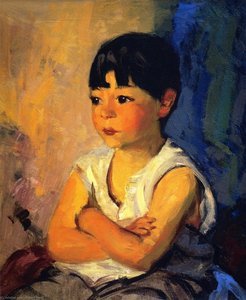
In the quiet intensity of Robert Henri’s Portrait of Mary Fanton Roberts, we encounter more than just a likeness; we meet a presence that commands the room. The painting captures a woman of profound character, her features framed by the vibrant, tactile warmth of a red scarf that draws the eye immediately to the center of the composition. Her long, dark hair cascades with a natural, unstudied grace, suggesting a person of both elegance and substance. As she gazietes toward the viewer, her expression remains enigmatically serious, inviting an intimate dialogue between the subject and the observer. This is not merely a depiction of a face, but an exploration of a spirit caught in a moment of contemplative stillness.
The composition breathes with a sense of lived reality, moving beyond the singular focus of the portrait to suggest a wider, bustling world. In the soft-focus periphery, the presence of other figures and the suggestion of domestic furniture create a layered narrative, as if we have stumbled upon a private moment in a crowded salon. This use of depth and secondary subjects adds a cinematic quality to the work, grounding the subject within a social context that feels both immediate and timeless. For the discerning collector or interior designer, this piece offers a sophisticated focal point, capable of anchoring a room with its rich textures and narrative complexity.
Mastery of Light and the Ashcan Legacy
Technically, the work is a masterclass in the chiaroscuro technique, where the dramatic interplay between light and shadow sculpts the subject's features with remarkable precision. Henri, a leading figure of the Ashcan School, utilizes bold, painterly strokes that lend the canvas an impressionistic vitality. The light does not merely illuminate; it caresses the folds of the red fabric and catches the subtle highlights in the woman's eyes, creating a sense of three-dimensional life. This interplay of light and dark creates a rhythmic movement across the canvas, guiding the viewer’s eye from the striking crimson of the scarf to the more muted, atmospheric tones of the background.
The emotional impact of the painting lies in its raw, unpretentious realism. There is no attempt to idealize the subject into a porcelain doll; instead, Henri celebrates the rugged beauty of human character. The brushwork is confident and expressive, reflecting the artist's belief that art should capture the "vitality" of life rather than just its surface appearance. For those seeking to adorn a space with art that possesses emotional weight and historical significance, this reproduction serves as a window into the early 20th-century American spirit—a piece that brings both the warmth of classical portraiture and the edgy energy of modern realism into the contemporary home.
Questions et réponses
Où puis-je acheter une reproduction peinte à la main de «Mary Fanton Roberts» de Robert Henri ?
Les reproductions peintes à la main de «Mary Fanton Roberts» de Robert Henri sont vendues sur ce site web : une reproduction à l'huile peinte à la main sur toile de lin, via sa page Reproduction peinte à la main.
Que représente "Mary Fanton Roberts" et quelle atmosphère s'en dégage ?
«Mary Fanton Roberts» de Robert Henri représente portrait, woman, red scarf, realism, chiaroscuro, female subject, dans une atmosphère Dramatic. Le sujet et l'ambiance définissent ensemble l'œuvre.
Quelle technique et quel style caractérisent «Mary Fanton Roberts» de Robert Henri ?
«Mary Fanton Roberts» de Robert Henri allie la technique de Oil au style Ashcan School. La technique et le mouvement décrivent respectivement la réalisation et le style de l'œuvre.
Biographie de l'artiste
Un commencement tumultueux
Robert Henri, né Robert Henry Cozad le 24 juin 1865 à Cincinnati, Ohio, était un peintre et enseignant américain. Sa vie précoce fut marquée par la relation tumultueuse entre son père, John Jackson Cozad, joueur et promoteur immobilier, et sa mère, Theresa Gatewood Cozad. Cela mena à un événement significatif en 1882, qui allait modifier le cours de leur existence.L'École Ashcan et les Huit
Robert Henri devint une figure de proue de l’école ashcan du réalisme américain et un organisateur des Huit, une association informelle d’artistes qui protestaient contre les pratiques d’exposition restrictives de la puissante et conservatrice National Academy of Design. Ce groupe comprenait William Glackens, George Luks, Everett Shinn et John Sloan.Évolution artistique
Le parcours artistique d'Henri commença en 1886 à la Pennsylvania Academy of the Fine Arts de Philadelphie, sous la direction de Thomas Anshutz. Il se rendit ensuite à Paris en 1888 pour étudier à l’Académie Julian, où il fut influencé par William-Adolphe Bouguereau et François Millet, embrassant finalement l'impressionnisme.Enseignement et influence
Henri commença à enseigner à la Philadelphia School of Design for Women en 1892. Parmi ses élèves figuraient Joseph Stella, Edward Hopper, Rockwell Kent, George Bellows, Norman Raeben, Louis D. Fancher et Stuart Davis. En 1898, il épousa Linda Craige, une étudiante de son cours d'art privé. Après le décès de celle-ci en 1905, il se remarie avec Marjorie Organ en 1908. Ses dernières années furent marquées par son influence continue sur le réalisme américain.- Œuvres clés : "Woman in Manteau" (1899) et "La Neige" ("The Snow"), qui fut achetée par le gouvernement français pour être exposée au Musée du Luxembourg.
- Élèves notables : Joseph Stella, Edward Hopper, Rockwell Kent, George Bellows, Norman Raeben, Louis D. Fancher et Stuart Davis.
- Mouvement artistique : École ashcan du réalisme américain.
Héritage
L'impact de Robert Henri sur l’art américain est indéniable. Son engagement envers le réalisme et son influence sur la prochaine génération d’artistes ont laissé une marque indélébile. Explorez davantage Robert Henri et ses contemporains dans le mouvement artistique du réalisme américain ou plongez dans le monde d’Edward Hopper, l'un de ses élèves les plus notables.
Robert Henri
1865 - 1929 , États-Unis d'Amérique
En bref
- Artistic Movement Or Style: Réalisme américain (Ashcan)
- Artists Or Movements Influenced By This Artist:
- Edward Hopper
- Rockwell Kent
- Artists Who Influenced This Artist:
- William-Adolphe Bouguereau
- François Millet
- Date Of Birth: 24 juin 1865
- Date Of Death: 1929
- Full Name: Robert Henri
- Nationality: Américain
- Notable Artworks:
- Woman in Manteau
- La Neige
- Place Of Birth (City And Country): Cincinnati, États-Unis
Articles connexes
Les 10 Chefs-d'œuvre Fauves : Couleurs Émotionnelles et Décor d'Art Intemporel
Plongez au cœur du Fauvisme avec les 10 œuvres majeures de Matisse, Derain et Vlaminck. Découvrez l'histoire, la technique et l'impact émotionnel de ces chefs-d’œuvre colorés. Reproductions d'art exceptionnelles sur OriginalUniqueArt.com.

Hubert Robert: Picturing Ruins, Preserving Memory – A Study of Romantic Antiquarianism & Artistic Innovation
Explore the captivating world of Hubert Robert, master of Romantic landscape painting & 'capriccio' ruins. Discover his historical context, artistic innovations, and collecting insights with OriginalUniqueArt.
Robert Henri & the Spirit of American Realism: A Legacy of Urban Life and Artistic Independence
Explore the life & legacy of Robert Henri, a pivotal figure in American Realism. Discover his captivating portraits, influence on the Ashcan School, and enduring impact on art history. Learn more at OriginalUniqueArt.

Crimson Threads of Narrative: Exploring Symbolism & Representation in Artworks Featuring the Red Dress
Explore the rich symbolism of the red dress in art history! From ancient power displays to iconic portraits like Cézanne’s 'Madame Cezanne', discover the cultural and artistic significance behind this captivating color. Expert analysis & insights.

Henri Matisse : Les 25 Œuvres Maîtresses d'un Génie de la Couleur | OriginalUniqueArt
Plongez dans l'univers vibrant d'Henri Matisse ! Découvrez les 25 œuvres majeures du fauvisme et de la peinture moderne. Explorez La Danse, L'Atelier Rouge & plus encore. Reproductions de qualité musée sur OriginalUniqueArt.com.