Aperçu en situation
 Partager
 Partager
 Détails
 Guide imprimable

 Télécharger
 Articles similaires
 Radiographie
 Voir le diaporama
 Statistiques
John Butler Yeats


 Afficher la suite
Giclées et impressions d'art
Impressions giclées ou sur toile de qualité musée, avec une production rapide et des finitions au choix. ( Acheter la peinture faite à la main Passer au format image numérique)




P118B €10

P118H €10

P118W €10

P438Z €10

P508JH €12

P508YH €12

P805H €10

P805Z €10

P919BZ €10

P919G €10

P919XJ €10

P959ZH €10

P968JZ €12

W106C €8

W218G €10

W218JH €8

W218Y €10

W307PJ €10

W316G €10

W316PJ €8

W316Y €10

W398PJ €8

W4111J €10

W500HY €15

W500JH €15

W692G €12

W849H €8

W940BG €15

W953PJ €8




Choisissez parmi nos formats prédéfinis qui respectent les proportions originales de l’œuvre.

Saisissez la largeur et la hauteur souhaitées pour qu'elles s'adaptent à votre cadre ou à votre mur. Une impression ne peut être que découpée, elle ne peut jamais être agrandie au-delà de l'image originale ; ainsi, un format de forme différente entraînera la perte d'une partie de l'image. Nous vous envoyons une maquette numérique pour approbation avant toute impression. L'image présentée sur cette page ne montre pas le recadrage réel — seule la maquette le permet.
Livraison dans le monde entier () en 2 semaines au lieu des 4/5 semaines habituelles. (24 octobre)

Livraison express gratuite dans le monde entier

Toile de lin de haute qualité

Assurance transport complète

Garantie de remboursement des droits de douane

Garantie de fidélité des couleurs

Garantie de retour de 100 jours (uniquement en cas de défaut)

Garantie de remboursement à 100%

Tarifs dégressifs sur quantité
 L'option verre n'est disponible que pour les dimensions inférieures à 110 cm.

John Butler Yeats
Giclées et impressions d'art
Format de la reproduction
-


Prix total final
€ 70
A Dialogue of Vision: The Soul Within the Portrait
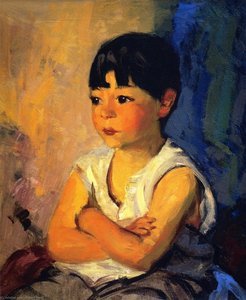
In the quiet intensity of Robert Henri’s 1909 portrait, John Butler Yeats, we encounter more than just a likeness; we witness a profound psychological encounter. This masterpiece serves as a bridge between two distinct worlds—the ethereal, Symbolist-inspired Romanticism of the Irish master and the gritty, unyielding realism that Henri would eventually pioneer through the Ashcan School. The subject, the esteemed father of poet W.B. and artist Jack B. Yeats, sits before us with a presence that is both commanding and contemplative. His gaze, directed squarely at the viewer, pierces through the layers of time, inviting an intimate communion that transcends the mere application of oil on canvas.
The composition is masterfully balanced, capturing a moment of stillness amidst the burgeoning energy of the early twentieth century. As the subject rests with hands crossed, there is a palpable sense of weight and history in his posture. The presence of other figures, partially glimpsed in the periphery, adds a layer of narrative depth, suggesting a shared space of intellectual or artistic discourse. This is not a solitary study but a window into a social and creative ecosystem where ideas were exchanged as fluidly as the brushstrokes themselves.
Technique and the Texture of Reality
To behold this work is to appreciate the visceral power of Henri’s technique. Eschewing the polished, academic finish of his predecessors, Henri employs a method characterized by rapid, energetic application. The paint is not merely applied; it is sculpted upon the surface. One can trace the movement of the brush through the thick, textured layers that define the subject's beard and the heavy folds of his attire. This tactile quality lends the portrait an organic vitality, making the sitter feel as though he possesses a physical breath and warmth.
The palette is a sophisticated study in earthy resonance. Henri utilizes a spectrum of browns, ochres, and muted grays to ground the subject in reality, yet he infuses these tones with a luminous quality that prevents the scene from feeling somber. The interplay of light and shadow—the chiaroscuro effect—is used not just for anatomical accuracy, but to sculpt emotion. The way light catches the edge of a collar or the glint in an eye creates a rhythmic movement across the canvas, guiding the viewer’s eye through a landscape of skin, fabric, and atmosphere.
A Legacy for the Discerning Collector
For the art lover or the interior designer, a reproduction of this portrait offers much more than aesthetic decoration; it provides an anchor of intellectual and emotional depth. The painting embodies the tension between the old world and the new, making it a perfect centerpiece for spaces that value heritage, storytelling, and the profound beauty of human character. Its muted, sophisticated color scheme allows it to integrate seamlessly into diverse environments, from the classic elegance of a traditional library to the bold, contemporary lines of a modern loft.
Owning a piece that captures such a pivotal moment in art history—the collision of Yeats’s lyrical depth and Henri’s unflinching honesty—is an opportunity to surround oneself with the very essence of artistic evolution. This portrait remains a testament to the enduring power of the human spirit, captured through a lens of uncompromising truth and masterful artistry.
Questions et réponses
À quel courant artistique «John Butler Yeats» de Robert Henri appartient-il ?
« John Butler Yeats » est une œuvre de American Realism. Ce mouvement indique la tradition artistique à laquelle l'œuvre appartient.
Puis-je visionner « John Butler Yeats » sous forme de diaporama en plein écran ?
Vous pouvez visionner «John Butler Yeats» de Robert Henri sous forme de diaporama sur la page Diaporama de l'œuvre.
À quel sentiment "John Butler Yeats" est-il associé ?
Le ton émotionnel relevé pour «John Butler Yeats» de Robert Henri est Reflective. Il résume le sentiment exprimé par l'œuvre.
Biographie de l'artiste
Un commencement tumultueux
Robert Henri, né Robert Henry Cozad le 24 juin 1865 à Cincinnati, Ohio, était un peintre et enseignant américain. Sa vie précoce fut marquée par la relation tumultueuse entre son père, John Jackson Cozad, joueur et promoteur immobilier, et sa mère, Theresa Gatewood Cozad. Cela mena à un événement significatif en 1882, qui allait modifier le cours de leur existence.L'École Ashcan et les Huit
Robert Henri devint une figure de proue de l’école ashcan du réalisme américain et un organisateur des Huit, une association informelle d’artistes qui protestaient contre les pratiques d’exposition restrictives de la puissante et conservatrice National Academy of Design. Ce groupe comprenait William Glackens, George Luks, Everett Shinn et John Sloan.Évolution artistique
Le parcours artistique d'Henri commença en 1886 à la Pennsylvania Academy of the Fine Arts de Philadelphie, sous la direction de Thomas Anshutz. Il se rendit ensuite à Paris en 1888 pour étudier à l’Académie Julian, où il fut influencé par William-Adolphe Bouguereau et François Millet, embrassant finalement l'impressionnisme.Enseignement et influence
Henri commença à enseigner à la Philadelphia School of Design for Women en 1892. Parmi ses élèves figuraient Joseph Stella, Edward Hopper, Rockwell Kent, George Bellows, Norman Raeben, Louis D. Fancher et Stuart Davis. En 1898, il épousa Linda Craige, une étudiante de son cours d'art privé. Après le décès de celle-ci en 1905, il se remarie avec Marjorie Organ en 1908. Ses dernières années furent marquées par son influence continue sur le réalisme américain.- Œuvres clés : "Woman in Manteau" (1899) et "La Neige" ("The Snow"), qui fut achetée par le gouvernement français pour être exposée au Musée du Luxembourg.
- Élèves notables : Joseph Stella, Edward Hopper, Rockwell Kent, George Bellows, Norman Raeben, Louis D. Fancher et Stuart Davis.
- Mouvement artistique : École ashcan du réalisme américain.
Héritage
L'impact de Robert Henri sur l’art américain est indéniable. Son engagement envers le réalisme et son influence sur la prochaine génération d’artistes ont laissé une marque indélébile. Explorez davantage Robert Henri et ses contemporains dans le mouvement artistique du réalisme américain ou plongez dans le monde d’Edward Hopper, l'un de ses élèves les plus notables.
Robert Henri
1865 - 1929 , États-Unis d'Amérique
En bref
- Artistic Movement Or Style: Réalisme américain (Ashcan)
- Artists Or Movements Influenced By This Artist:
- Edward Hopper
- Rockwell Kent
- Artists Who Influenced This Artist:
- William-Adolphe Bouguereau
- François Millet
- Date Of Birth: 24 juin 1865
- Date Of Death: 1929
- Full Name: Robert Henri
- Nationality: Américain
- Notable Artworks:
- Woman in Manteau
- La Neige
- Place Of Birth (City And Country): Cincinnati, États-Unis
Articles connexes

Constable : Les 25 Chefs-d'Œuvre du Maître Anglais | OriginalUniqueArt
Plongez dans l'univers de John Constable avec les 25 œuvres incontournables du maître anglais. Découvrez l'histoire, la technique et l'émotion derrière ses paysages romantiques. Reproductions de qualité muséale sur OriginalUniqueArt.com.
Henri Matisse : Les 25 Œuvres Maîtresses d'un Génie de la Couleur | OriginalUniqueArt
Plongez dans l'univers vibrant d'Henri Matisse ! Découvrez les 25 œuvres majeures du fauvisme et de la peinture moderne. Explorez La Danse, L'Atelier Rouge & plus encore. Reproductions de qualité musée sur OriginalUniqueArt.com.

John Singer Sargent : Les 25 Œuvres Maîtresses d'un Portraitiste Éminent | OriginalUniqueArt
Plongez dans l'univers de John Singer Sargent : découvrez les 25 œuvres qui ont marqué l'histoire de l'art. Portraits impressionnants, réalisme exquis et couleurs vibrantes. Retrouvez ces chefs-d'œuvre en reproduction haute définition sur OriginalUniqueArt.com.
Robert Henri & the Spirit of American Realism: A Legacy of Urban Life and Artistic Independence
Explore the life & legacy of Robert Henri, a pivotal figure in American Realism. Discover his captivating portraits, influence on the Ashcan School, and enduring impact on art history. Learn more at OriginalUniqueArt.
L'École d'Ashcan : Réalisme urbain et démocratisation de l'art américain
Explorez l'École d'Ashcan : un mouvement artistique révolutionnaire capturant la vie urbaine américaine au début du XXe siècle. Découvrez ses figures clés, thèmes et son héritage durable avec OriginalUniqueArt.