Aperçu en situation
 Partager
 Partager
 Détails
 Guide imprimable

 Télécharger
 Articles similaires
 Radiographie
 Voir le diaporama
 Statistiques
John
 Oil On Canvas
- WallArt
- Ashcan School
 1908
1908- Modern
 61.0 x 51.0 cm
 Metropolitan Museum of Art
 Afficher la suite
Giclées et impressions d'art
Impressions giclées ou sur toile de qualité musée, avec une production rapide et des finitions au choix. ( Acheter la peinture faite à la main Passer au format image numérique)




P118B €10

P118H €10

P118W €10

P438Z €10

P508JH €12

P508YH €12

P805H €10

P805Z €10

P919BZ €10

P919G €10

P919XJ €10

P959ZH €10

P968JZ €12

W106C €8

W218G €10

W218JH €8

W218Y €10

W307PJ €10

W316G €10

W316PJ €8

W316Y €10

W398PJ €8

W4111J €10

W500HY €15

W500JH €15

W692G €12

W849H €8

W940BG €15

W953PJ €8




Choisissez parmi nos formats prédéfinis qui respectent les proportions originales de l’œuvre.

Saisissez la largeur et la hauteur souhaitées pour qu'elles s'adaptent à votre cadre ou à votre mur. Une impression ne peut être que découpée, elle ne peut jamais être agrandie au-delà de l'image originale ; ainsi, un format de forme différente entraînera la perte d'une partie de l'image. Nous vous envoyons une maquette numérique pour approbation avant toute impression. L'image présentée sur cette page ne montre pas le recadrage réel — seule la maquette le permet.
Livraison dans le monde entier () en 2 semaines au lieu des 4/5 semaines habituelles. (20 octobre)

Livraison express gratuite dans le monde entier

Toile de lin de haute qualité

Assurance transport complète

Garantie de remboursement des droits de douane

Garantie de fidélité des couleurs

Garantie de retour de 100 jours (uniquement en cas de défaut)

Garantie de remboursement à 100%

Tarifs dégressifs sur quantité
 L'option verre n'est disponible que pour les dimensions inférieures à 110 cm.

John
Giclées et impressions d'art
Format de la reproduction
-


Prix total final
€ 70
A Soul Captured in Monochrome: The Intimacy of Robert Henri’s John
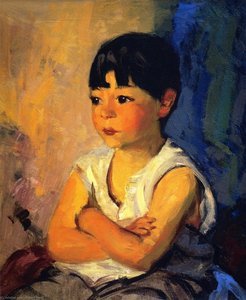
In the quiet, evocative depths of Robert Henri’s 1908 masterpiece, John, we encounter more than just a portrait; we meet a moment of profound human stillness. This monochrome study of a young boy serves as a breathtaking testament to the power of tonal mastery. Painted during the height of the Ashcan School movement, the work eschews the distractions of vibrant color to focus entirely on the raw, emotional essence of its subject. The boy sits before us, his gaze direct and somewhat somber, creating an immediate and unshakeable connection with the viewer. There is a haunting quality to his expression—a contemplative weight that seems far beyond his years, inviting anyone who lingers before the canvas to contemplate the mysteries of childhood and the quiet dignity of the individual.
The technical brilliance of John lies in Henri’s ability to sculpt form using nothing but a grayscale palette. Through a sophisticated range of tones—from the deepest, velvety blacks of the background to the luminous whites that catch the light on the boy's collar—the artist achieves a remarkable sense of three-dimensionality. The lighting, appearing to descend from an unseen source above and to the left, casts subtle shadows across the contours of the face, lending a sculptural quality to the flesh. This use of light does not merely illuminate; it breathes life into the subject, creating a soft, atmospheric glow that contrasts beautifully with the more rugged, textured applications of paint found in the boy's clothing.
The Mastery of the Ashcan Aesthetic
The brushwork itself is a masterclass in the Ashcan School aesthetic, characterized by its immediacy and expressive freedom. Rather than relying on rigid, clinical outlines, Henri defines shapes through fluid, visible strokes that suggest movement and texture. One can almost feel the weight of the fabric and the slight roughness of the boy's coat through the artist's vigorous application of oil paint. This technique avoids the polished idealism of academic art, opting instead for a gritty realism that captures the very texture of life. The lack of hard outlines allows the subject to emerge organically from the shadows, creating a sense of depth and atmosphere that is both visceral and poetic.
For the discerning collector or interior designer, this piece offers a profound sense of presence. Its monochromatic palette makes it an incredibly versatile addition to a sophisticated space, capable of anchoring a room with its quiet intensity without clashing with surrounding colors. The artwork does not demand attention through loudness, but rather commands it through depth and emotional resonance. It is a piece that rewards long periods of observation, revealing new nuances in the play of light and shadow each time it is viewed.
A Legacy of Realism and Emotion
To understand John is to understand the spirit of Robert Henri himself. As a pioneer of American realism, Henri sought to depict life as it truly was—unvarnished, raw, and deeply human. This portrait reflects his deep empathy for his subjects, capturing a sense of character that transcends the simple depiction of a face. The boy's direct gaze establishes an intimate communion with the viewer, bridging the gap between 1908 and the present day. It is this timeless quality, combined with the technical sophistication of the Ashcan style, that makes this work a perennial favorite for those who appreciate art that speaks to the enduring complexities of the human condition.
Questions et réponses
Puis-je commander une reproduction à l'huile de « John » ?
«John» est disponible en tant que une reproduction à l'huile peinte à la main sur toile de lin. La commande peut être effectuée sur sa page Reproduction peinte à la main, avec un choix de formats.
Où puis-je voir un aperçu de « John » ?
Pour prévisualiser une reproduction de «John» de Robert Henri, ouvrez la page Aperçu de l'œuvre.
De quelle période date «John» de Robert Henri ?
La période historique de «John» de Robert Henri est Modern. Cette classification situe l'œuvre dans l'histoire de l'art.
Biographie de l'artiste
Un commencement tumultueux
Robert Henri, né Robert Henry Cozad le 24 juin 1865 à Cincinnati, Ohio, était un peintre et enseignant américain. Sa vie précoce fut marquée par la relation tumultueuse entre son père, John Jackson Cozad, joueur et promoteur immobilier, et sa mère, Theresa Gatewood Cozad. Cela mena à un événement significatif en 1882, qui allait modifier le cours de leur existence.L'École Ashcan et les Huit
Robert Henri devint une figure de proue de l’école ashcan du réalisme américain et un organisateur des Huit, une association informelle d’artistes qui protestaient contre les pratiques d’exposition restrictives de la puissante et conservatrice National Academy of Design. Ce groupe comprenait William Glackens, George Luks, Everett Shinn et John Sloan.Évolution artistique
Le parcours artistique d'Henri commença en 1886 à la Pennsylvania Academy of the Fine Arts de Philadelphie, sous la direction de Thomas Anshutz. Il se rendit ensuite à Paris en 1888 pour étudier à l’Académie Julian, où il fut influencé par William-Adolphe Bouguereau et François Millet, embrassant finalement l'impressionnisme.Enseignement et influence
Henri commença à enseigner à la Philadelphia School of Design for Women en 1892. Parmi ses élèves figuraient Joseph Stella, Edward Hopper, Rockwell Kent, George Bellows, Norman Raeben, Louis D. Fancher et Stuart Davis. En 1898, il épousa Linda Craige, une étudiante de son cours d'art privé. Après le décès de celle-ci en 1905, il se remarie avec Marjorie Organ en 1908. Ses dernières années furent marquées par son influence continue sur le réalisme américain.- Œuvres clés : "Woman in Manteau" (1899) et "La Neige" ("The Snow"), qui fut achetée par le gouvernement français pour être exposée au Musée du Luxembourg.
- Élèves notables : Joseph Stella, Edward Hopper, Rockwell Kent, George Bellows, Norman Raeben, Louis D. Fancher et Stuart Davis.
- Mouvement artistique : École ashcan du réalisme américain.
Héritage
L'impact de Robert Henri sur l’art américain est indéniable. Son engagement envers le réalisme et son influence sur la prochaine génération d’artistes ont laissé une marque indélébile. Explorez davantage Robert Henri et ses contemporains dans le mouvement artistique du réalisme américain ou plongez dans le monde d’Edward Hopper, l'un de ses élèves les plus notables.
Robert Henri
1865 - 1929 , États-Unis d'Amérique
En bref
- Artistic Movement Or Style: Réalisme américain (Ashcan)
- Artists Or Movements Influenced By This Artist:
- Edward Hopper
- Rockwell Kent
- Artists Who Influenced This Artist:
- William-Adolphe Bouguereau
- François Millet
- Date Of Birth: 24 juin 1865
- Date Of Death: 1929
- Full Name: Robert Henri
- Nationality: Américain
- Notable Artworks:
- Woman in Manteau
- La Neige
- Place Of Birth (City And Country): Cincinnati, États-Unis
Articles connexes

The Power of One Hue: Mastering Monochrome Art for Sophisticated and Timeless Interiors
Elevate your interiors with the profound elegance of monochrome art. Explore OriginalUniqueArt.com’s curated collection of hand-painted oil reproductions and bespoke commissions, designed to bring sophisticated simplicity and timeless texture to every professional design project.

L'École de La Haye : Réalisme, Atmosphère et l'Aube de l'Impressionnisme Néerlandais
Explorez l'École de La Haye et le réalisme néerlandais : découvrez les maîtres hollandais, leur quête d'atmosphère et leur influence sur l'impressionnisme. Analyse approfondie et héritage artistique.
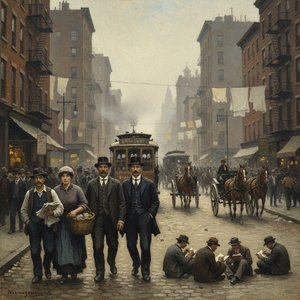
L'École d'Ashcan : Réalisme urbain et démocratisation de l'art américain
Explorez l'École d'Ashcan : un mouvement artistique révolutionnaire capturant la vie urbaine américaine au début du XXe siècle. Découvrez ses figures clés, thèmes et son héritage durable avec OriginalUniqueArt.

The Ashcan School: A Guide to Urban Realism for Professional Interior Design and Hospitality Procurement
Discover the raw energy of the Ashcan School. Our guide for hotel designers explores urban realism, offering professional insights into sourcing hand-painted oil reproductions and custom large-scale murals for high-end hospitality and corporate interiors.

The Ashcan School: Capturing the Raw Spirit and Urban Realism of New York City Life
Explore the raw, evocative beauty of the Ashcan School. Discover how masters like Bellows and Glackens captured New York's urban soul through American Realism, and learn to bring this gritty, historical elegance into your modern art collection.