Aperçu en situation
 Partager
 Partager
 Détails
 Guide imprimable

 Télécharger
 Articles similaires
 Radiographie
 Voir le diaporama
 Statistiques
Rhythm


 Afficher la suite
Giclées et impressions d'art
Impressions giclées ou sur toile de qualité musée, avec une production rapide et des finitions au choix. ( Acheter la peinture faite à la main Passer au format image numérique)




P118B €10

P118H €10

P118W €10

P438Z €10

P508JH €12

P508YH €12

P805H €10

P805Z €10

P919BZ €10

P919G €10

P919XJ €10

P959ZH €10

P968JZ €12

W106C €8

W218G €10

W218JH €8

W218Y €10

W307PJ €10

W316G €10

W316PJ €8

W316Y €10

W398PJ €8

W4111J €10

W500HY €15

W500JH €15

W692G €12

W849H €8

W940BG €15

W953PJ €8




Choisissez parmi nos formats prédéfinis qui respectent les proportions originales de l’œuvre.

Saisissez la largeur et la hauteur souhaitées pour qu'elles s'adaptent à votre cadre ou à votre mur. Une impression ne peut être que découpée, elle ne peut jamais être agrandie au-delà de l'image originale ; ainsi, un format de forme différente entraînera la perte d'une partie de l'image. Nous vous envoyons une maquette numérique pour approbation avant toute impression. L'image présentée sur cette page ne montre pas le recadrage réel — seule la maquette le permet.
Livraison dans le monde entier () en 2 semaines au lieu des 4/5 semaines habituelles. (21 octobre)

Livraison express gratuite dans le monde entier

Toile de lin de haute qualité

Assurance transport complète

Garantie de remboursement des droits de douane

Garantie de fidélité des couleurs

Garantie de retour de 100 jours (uniquement en cas de défaut)

Garantie de remboursement à 100%

Tarifs dégressifs sur quantité
 L'option verre n'est disponible que pour les dimensions inférieures à 110 cm.

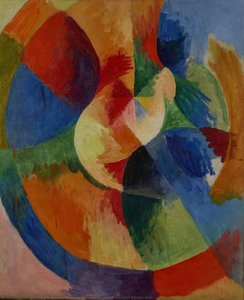
Rhythm
Giclées et impressions d'art
Format de la reproduction
-


Prix total final
€ 70
A Symphony of Pure Light and Motion
In the early twentieth century, as the world accelerated into the modern age, Robert Delaunay captured its frantic, beautiful pulse in his 1912 masterpiece, Rhythm. This striking duo of panels serves as a cornerstone of early modernist abstraction, immediately captivating the viewer with a dynamic interplay of color and geometric precision. Rather than depicting a tangible landscape or a human figure, Delaunay invites us into a realm of pure sensation. Large, luminous circles are interwoven with squares and intersecting lines, creating an unmistakable impression of pulsating energy. It is a visual dance where form and color do not merely sit upon the canvas but seem to vibrate against one another, mimicking the very heartbeat of urban life and scientific discovery.
The artwork stands as a profound testament to the Orphism movement, a style Delaunay pioneered alongside his wife, Sonia Delaunay. Moving beyond the fragmented, monochromatic constraints of traditional Cubism, Rhythm embraces a bold, chromatic palette that celebrates the autonomy of color. The technique is nothing short of masterful; executed in oil on canvas, the painting showcases visible, intentional brushstrokes that lend a rich, tactile texture to the surface. Through the skillful use of color gradients and overlapping planes, Delaunay generates an extraordinary sense of depth and luminosity. This layering of pigment allows light to appear as if it is trapped within the circles themselves, creating a glowing effect that breathes life into the abstract composition.
The Dawn of Abstract Expression
To understand Rhythm is to understand a pivotal moment in art history when the boundaries of representation were being irrevocably shattered. Painted during the formative years of the avant-garde, this work reflects the broader European currents that sought to move past Impressionism toward a more distilled visual experience. Delaunay’s vision was not to replicate reality, but to capture its fundamental essence—movement, vibration, and harmony. By rejecting traditional spatial cues and embracing a flattened, asymmetrical perspective, he anticipated the revolutionary shifts of later movements like Surrealism and Expressionism. The painting acts as a bridge between the recognizable world and the limitless possibilities of non-figurative art.
For the discerning collector or interior designer, Rhythm offers more than just aesthetic beauty; it provides an emotional anchor of energy and playfulness. The bright, energetic tones and the rhythmic arrangement of shapes make it a commanding presence in any sophisticated space, capable of injecting vitality into a contemporary setting. It is a piece that speaks to the soul through its lack of literal subject matter, instead communicating through the universal language of light and geometry. Owning a high-quality reproduction of this work means bringing a fragment of the historical avant-garde into the home—a permanent celebration of the moment when art learned to sing in color.
Questions et réponses
De quelle époque date « Rhythm » ?
«Rhythm» de Robert Delaunay date de la période Modern. Cette époque apporte le contexte historique de l'œuvre.
Comment la palette de «Rhythm» de Robert Delaunay est-elle décrite ?
La palette de «Rhythm» de Robert Delaunay est décrite comme étant Dark. Il s'agit d'une description concise des couleurs de l'œuvre.
À quelle période de la carrière de Robert Delaunay appartient « Rhythm » ?
Au cours de la carrière de Robert Delaunay, « Rhythm » s'inscrit dans la période Early Modern. Cette phase permet de le comparer aux autres œuvres de l'artiste.
Biographie de l'artiste
Premières années et débuts artistiques
Robert Delaunay, un artiste français, est né le 12 avril 1885 à Paris. Il est surtout connu pour avoir cofondé le mouvement artistique orphique avec sa femme Sonia Delaunay et d'autres. Ce mouvement, caractérisé par l'utilisation de couleurs vives et de formes géométriques, visait à exprimer la vie moderne à travers des formes abstraites.Style artistique et influences
Le style artistique de Delaunay se distinguait par une utilisation audacieuse de la couleur et un amour clair pour l'expérimentation tant en termes de profondeur que de tonalité. Ses œuvres ultérieures étaient plus abstraites, rappelant celles de Paul Klee. L’influence clé de l’artiste était liée à l’utilisation de la couleur comme moyen expressif et structurel.- La série de la Tour Eiffel, qui capture l'essence de cet emblème parisien dans une forme unique et abstraite.
- Contrastes simultanés : soleil et lune, une peinture qui met en valeur l'art de Delaunay et son engagement théorique avec la couleur.
- Fenêtres ouvertes simultanément, 1ère partie, 3ème motif, une peinture qui démontre l'utilisation par Delaunay de blocs de couleurs pour créer de la profondeur et du mouvement.
Œuvres notables et héritage
Parmi les œuvres notables de Delaunay, on trouve :- La Tour Eiffel (126 x 93 cm, Solomon R. Guggenheim Museum, New York, États-Unis)
- Contrastes simultanés : soleil et lune (orphisme)
- Fenêtres ouvertes simultanément, 1ère partie, 3ème motif (orphisme)
Conclusion
Robert Delaunay, un pionnier de l’orphisme, a laissé une marque indélébile sur le monde de l'art avec son utilisation audacieuse de la couleur et ses formes abstraites. Son héritage continue d'inspirer les artistes et les amateurs d'art, faisant de lui une figure importante dans l'histoire de l'art moderne. Découvrez plus d’œuvres de Robert Delaunay sur OriginalUniqueArt
Robert Delaunay
1885 - 1941 , France
En bref
- Artistes Influents:
- Paul Klee
- Cézanne
- Date De Naissance: 12 avril 1885
- Influence Sur Les Artistes:
- Stanton Macdonald-Wright
- Morgan Russell
- Franz Marc
- Lieu De Naissance: Paris, France
- Mouvement Artistique: Orphisme, Cubisme
- Nationalité: Française
- Nom Complet: Robert Delaunay
- Oeuvres Notables:
- La Tour Eiffel
- Simultanés : Soleil et Lune
- Fenêtres ouvertes simultanément
Articles connexes

Abstraction Géométrique : Les 10 Chefs-d'œuvre qui ont Marqué l'Histoire de l'Art
Plongez au cœur de l'abstraction géométrique avec OriginalUniqueArt.com ! Découvrez les 10 œuvres majeures de Mondrian, Malevitch et Kandinsky qui ont révolutionné l'art moderne. Inspirez votre décoration intérieure avec des reproductions de tableaux exceptionnelles. Explorez la collection en ligne !
Sonia Delaunay: A Life in Color – Exploring the Rhythms of Abstraction and Synesthesia
Explore the vibrant world of Sonia Delaunay, a pioneer of abstract art and co-founder of Orphism. Discover her revolutionary use of color, geometric forms, and influence on modern design. A deep dive into her life & legacy.
Orphism Unveiled: The Radiant Dance of Color and Light in the Evolution of Abstract Art
Discover the luminous world of Orphism. Explore how masters like Robert and Sonia Delaunay revolutionized art through a radiant dance of color, light, and geometric abstraction in this deep dive into modern art history.
Fernand Léger : Les 25 Œuvres Maîtresses d'un Pionnier du Modernisme | OriginalUniqueArt
Plongez dans l'univers vibrant de Fernand Léger ! Découvrez les 25 œuvres majeures du cubisme et du tubisme, explorant formes géométriques et couleurs audacieuses. Retrouvez des reproductions d'art exceptionnelles sur OriginalUniqueArt.com.

Kandinsky : Les 25 Œuvres Maîtresses d'un Pionnier de l'Art Abstrait | OriginalUniqueArt
Plongez dans l'univers vibrant de Kandinsky ! Découvrez les 25 œuvres majeures du pionnier de l'art abstrait. Explorez son expressionnisme, ses couleurs audacieuses et l'histoire fascinante derrière chaque tableau. Reproductions d'exception sur OriginalUniqueArt.com.