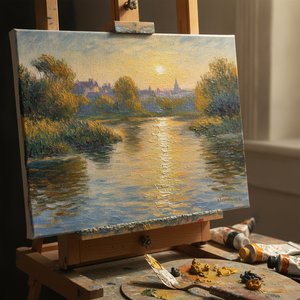
Miss Knowles
Reproduction à l'huile faite à la main
Huile sur toile peinte à la main, avec cadre et dimensions personnalisés, réalisée sur commande par nos artistes. ( Commander l'impression
Télécharger l'image haute résolution)
Choisissez parmi nos formats prédéfinis qui respectent les proportions originales de l’œuvre.
Vous pouvez saisir vos propres dimensions pour l'adapter à un cadre ou à un espace spécifique. Si la taille sélectionnée ne correspond pas aux proportions de l'image d'origine, nous recadrerons l'œuvre ou prolongerons la peinture avec des éléments peints à la main supplémentaires. Une maquette numérique vous sera envoyée pour approbation avant le début de la production.
Veuillez noter que l'aperçu à l'écran ne reflète pas le recadrage ou l'extension réels. Seule la maquette montrera fidèlement la composition finale.
Bien que des tailles personnalisées soient disponibles, nous vous recommandons de sélectionner une dimension dans la liste prédéfinie afin de préserver les proportions d'origine.
Après la commande, l’équipe OriginalUniqueArt.com contactera le client par e-mail pour recueillir ses instructions et lui fournira une maquette d’aperçu
Livraison dans le monde entier () en 3 à 4 semaines au lieu des 5 semaines habituelles. (15 août). Aucun compromis sur la qualité.
Livraison express gratuite dans le monde entier

Toile de lin de qualité supérieure
Assurance transport complète
Garantie de remboursement des droits de douane
Garantie de fidélité des couleurs
Politique de retour de 60 jours (uniquement en cas de défaut)
Garantie de remboursement à 100%
Offre de tarifs dégressifs
Miss Knowles
Technique de reproduction
Format de la reproduction
-
Prix total
$ 300
Description de l'œuvre
Artist Background
Richard Rothwell was a prominent Irish artist known for his exceptional skill in capturing the essence of his subjects. His works often featured detailed and realistic depictions of people, showcasing their personalities and characteristics. Rothwell's style is characterized by the use of oil on canvas, and his paintings often feature subtle color palettes and intricate details. Key Features of the painting Miss Knowles include:- The subject's facial expression, which appears to be one of contemplation or thoughtfulness
- The detailed depiction of the subject's clothing and accessories, which provides insight into her social status and personality
- The use of subtle color palettes and intricate details, which adds depth and complexity to the painting
The painting Miss Knowles is a significant piece of art history, and its beauty and intricacy make it a must-see for art enthusiasts. As a handmade oil painting reproduction, it can be appreciated in a new light, allowing viewers to experience the artist's skill and craftsmanship firsthand. For more information on Richard Rothwell and his works, visit OriginalUniqueArt.com.
Biographie de l'artiste
Richard Rothwell (1800–68): Painter of Dignified Portraits and Italian Visions
Richard Rothwell (20 November 1800 – 13 September 1868) was an Irish painter who achieved renown for his distinguished portraiture and captivating depictions of the Italian landscape tradition. Born in Dublin, he embarked on a prolific artistic journey spanning across Ireland, Britain, Rome, and America, leaving behind a legacy marked by meticulous craftsmanship and profound sensitivity to both human form and natural beauty. His career unfolded during the Romantic era, reflecting the prevailing fascination with emotion and imagination—traits that permeate his oeuvre.Early Life and Training
Richard Rothwell’s formative years were shaped by familial circumstances; he was born into a family of considerable means, with his father being James Rothwell (possibly a soldier) of Lisdaly, near Cloghen, King's Co. (Offaly), though primary source evidence suggests that he was the son of William Rothwell, gentleman, who appears in the 1820s as a publican of Ferbane, King’s Co., acquiring land at Ballicknahee, King’s Co. His mother was Elizabeth Rothwell (née Holmes). He had at least three siblings—a brother and two sisters—and possibly as many as six. Recognizing his artistic aptitude early on, he enrolled in the Dublin Society's school of art from 1814 until 1820 where he honed his skills under the tutelage of accomplished instructors. Notably, Rothwell secured a silver medal for his work at the school—a testament to his burgeoning talent and dedication. This formative experience instilled within him a disciplined approach to artistic practice that would characterize his subsequent endeavors.Academic Recognition and Artistic Influences
Rothwell’s ambition propelled him toward London in 1829, where he became an assistant to Sir Thomas Lawrence (1769–1830), one of the era's most celebrated portrait painters. Lawrence’s mentorship profoundly impacted Rothwell’s artistic sensibilities, fostering a deep appreciation for classical technique and compositional balance—influences that would become integral to his distinctive style. The Royal Hibernian Academy elected him as an associate member shortly thereafter, marking a pivotal moment in his professional life. From 1826 to 1829 Rothwell exhibited portraits at the RHA, showcasing his growing reputation and establishing himself as a prominent figure within the British art scene. His artistic vision drew inspiration from luminism—a style championed by William Trost Richards—characterized by soft tonal gradations and atmospheric perspective—techniques that conveyed an emotional resonance mirroring the Romantic spirit.Notable Paintings and Artistic Style
Rothwell’s artistic output encompassed both portraiture and landscape painting, demonstrating his versatility as a painter. He produced portraits of notable figures including Gerald Griffin and Mary Shelley, capturing their likenesses with remarkable accuracy and conveying subtle psychological nuances. His landscapes—particularly “Calisto”—were imbued with an ethereal quality reflecting the influence of Italian art style. Rothwell’s meticulous brushwork and masterful use of color—often employing warm hues—created images that resonated with a profound sense of beauty and tranquility. He was particularly proud of "Calisto," which he considered his masterpiece, embodying the culmination of his artistic explorations and demonstrating his unwavering commitment to excellence.Legacy and Historical Significance
Richard Rothwell’s contribution to Irish and British art history is undeniable. His paintings stand as enduring symbols of Romantic idealism—a celebration of nature's grandeur and human dignity. He died in Rome in 1868, leaving behind a body of work that continues to captivate audiences today. Rothwell’s legacy resides not merely in his artistic achievements but also in his embodiment of the values—discipline, observation, and passion—that underpinned the Romantic movement. His paintings serve as poignant reminders of an era defined by intellectual curiosity and emotional intensity—a testament to the enduring power of art to transcend time and inspire contemplation.richard rothwell
1800 - 1868
L'essentiel de l'artiste
- Artistic Movement Or Style: Portrait painting; Luminism
- Artists Or Movements Influenced By This Artist: ['Hudson River School']
- Artists Who Influenced This Artist: ['Thomas Lawrence']
- Date Of Death: 1868
- Full Name: Richard Rothwell
- Nationality: Irish
- Notable Artworks:
- The Little Roamer
- William Huskisson
- Place Of Birth: Dublin, Ireland


L'option verre n'est disponible que pour les dimensions inférieures à 110 cm.