 Aperçu en situation
 Partager
 Partager
 Détails
 Guide imprimable

 Télécharger
 Articles similaires
 Radiographie
 Voir le diaporama
 Statistiques
La Raza Blanca


 Afficher la suite
L’œuvre d'art présentée sur cette page est protégée par le droit d'auteur, ce qui signifie que nous ne pouvons légalement créer ou vendre de reproduction identique. Cette protection est appliquée en vertu d'accords internationaux tels que la Convention de Berne et par les lois nationales, notamment celles énoncées par le Loi américaine sur le droit d'auteur - Titre 17.
Cette méthode est pleinement conforme aux réglementations sur le droit d'auteur car elle ne repose pas sur la copie ou la duplication de l'œuvre protégée. Il s'agit plutôt d'une réinterprétation créative — une nouvelle peinture qui s'inspire de l'original sans pour autant lui être identique.
Giclées et impressions d'art
Impressions giclées ou sur toile de qualité musée, avec une production rapide et des finitions au choix. ( Acheter la peinture faite à la main Passer au format image numérique)




P118B €10

P118H €10

P118W €10

P438Z €10

P508JH €12

P508YH €12

P805H €10

P805Z €10

P919BZ €10

P919G €10

P919XJ €10

P959ZH €10

P968JZ €12

W106C €8

W218G €10

W218JH €8

W218Y €10

W307PJ €10

W316G €10

W316PJ €8

W316Y €10

W398PJ €8

W4111J €10

W500HY €15

W500JH €15

W692G €12

W849H €8

W940BG €15

W953PJ €8




Choisissez parmi nos formats prédéfinis qui respectent les proportions originales de l’œuvre.

Saisissez la largeur et la hauteur souhaitées pour qu'elles s'adaptent à votre cadre ou à votre mur. Une impression ne peut être que découpée, elle ne peut jamais être agrandie au-delà de l'image originale ; ainsi, un format de forme différente entraînera la perte d'une partie de l'image. Nous vous envoyons une maquette numérique pour approbation avant toute impression. L'image présentée sur cette page ne montre pas le recadrage réel — seule la maquette le permet.
Livraison dans le monde entier () en 2 semaines au lieu des 4/5 semaines habituelles. (23 octobre)

Livraison express gratuite dans le monde entier

Toile de lin de haute qualité

Assurance transport complète

Garantie de remboursement des droits de douane

Garantie de fidélité des couleurs

Garantie de retour de 100 jours (uniquement en cas de défaut)

Garantie de remboursement à 100%

Tarifs dégressifs sur quantité
 L'option verre n'est disponible que pour les dimensions inférieures à 110 cm.

La Raza Blanca
Giclées et impressions d'art
Format de la reproduction
-


Prix total final
€ 70
La Raza Blanca : A Dreamscape of Perception
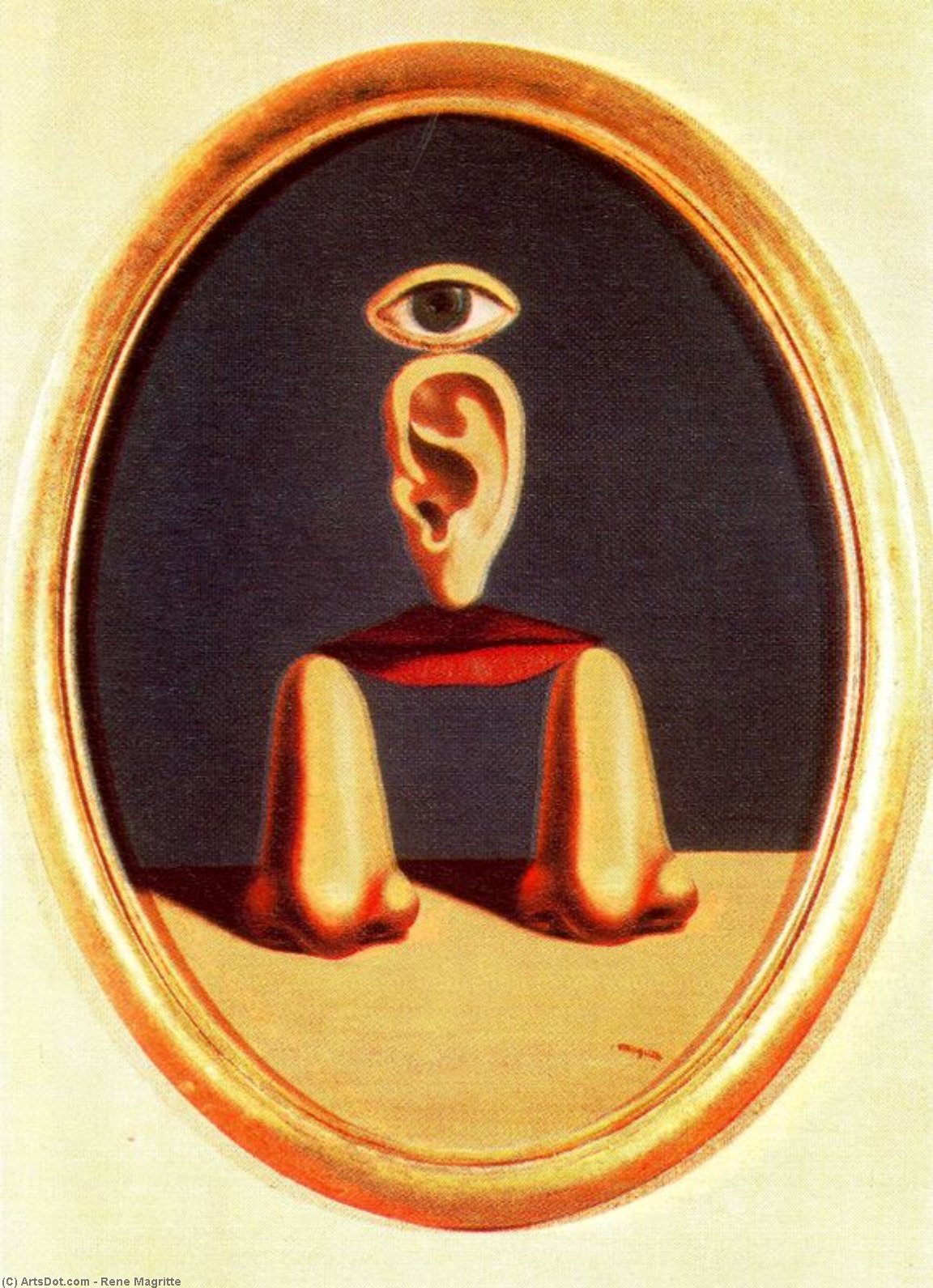
René Magritte's La Raza Blanca (The White Race) is not merely a painting; it’s an invitation to question the very nature of perception. Executed with meticulous detail, this oval-shaped work transcends simple representation, drawing viewers into a realm where logic dissolves and psychological exploration takes center stage. The artwork presents a fragmented human form—an assemblage of anatomical elements that defy conventional understanding. It isn't a portrait in the traditional sense, but rather a carefully constructed puzzle of legs supporting a torso, culminating in a head featuring an unsettlingly placed eye, ear, and mouth. This deliberate disjointedness, coupled with Magritte’s rejection of standard perspective—flattening the image within its oval frame—creates a contained, almost claustrophobic space that intensifies the focus on this enigmatic figure.
The Surrealist Vision and Masterful Technique
Rooted firmly in the Surrealist movement, La Raza Blanca embodies the era’s fascination with illogical juxtapositions and the rejection of rational thought. However, Magritte distinguishes himself through a precise, almost clinical rendering of imagery. The technique appears to be watercolor or gouache on paper, evidenced by the soft blending of colors and subtle tonal variations achieved through delicate layering. Lines are used sparingly but effectively, defining contours without harshness, contributing to the overall smoothness and ethereal quality of the piece. This meticulous approach is key to Magritte’s power; he doesn’t rely on chaotic brushstrokes or expressive textures, but rather on a controlled precision that amplifies the unsettling nature of his subject matter. He wasn’t interested in depicting dreams themselves, but in creating dreamlike images while fully conscious—a distinction crucial to understanding his unique contribution to Surrealism.
Historical Echoes and Symbolic Ambiguity
To understand *La Raza Blanca*, one must consider the historical context of its creation. René Magritte (1898-1967) navigated an artistic journey that began with Impressionism and Cubism before fully embracing Surrealism in the mid-1920s. His work emerged during a period of profound societal upheaval following World War I, a time when artists questioned established norms and sought new ways to express the complexities of the human condition. Magritte’s unique ability was to imbue everyday objects with unsettling strangeness, challenging our perceptions of reality. The symbolism within La Raza Blanca is deliberately open-ended, inviting multiple interpretations. The prominent eye, ear, and mouth suggest a focus on perception—seeing, hearing, and experiencing the world. The fragmented nature of the figure could represent the fractured self, or perhaps the limitations of human understanding. Even the title itself, “The White Race,” adds another layer of complexity, potentially alluding to themes of identity, purity, or even societal constructs – a provocative choice that resists easy answers.
Emotional Resonance and Aesthetic Appeal
La Raza Blanca evokes a sense of unease and mystery. The muted color palette, dominated by dark tones punctuated by flashes of yellow and red, contributes to the painting’s somber mood. Despite its unsettling subject matter, the artwork possesses a compelling aesthetic appeal due to Magritte’s masterful technique and precise execution. It is a piece that lingers in the mind long after viewing, prompting introspection and challenging our assumptions about reality. This work would be an exceptional addition to any collection seeking thought-provoking art with a strong visual presence, or for interior design projects aiming for a sophisticated and intellectually stimulating atmosphere. Its enigmatic quality invites ongoing dialogue and contemplation, making it not just a beautiful object but a catalyst for deeper understanding.
- Artist: René Magritte
- Birth Year: 1898
- Death Year: 1967
- Medium: Watercolor or Gouache on Paper
- Style: Surrealism
The artwork’s oval frame enhances its formal presentation, emphasizing its contained space and contributing to the overall feeling of contemplation. Its subtle tonal variations and careful blending of colors create an ethereal quality.
Questions et réponses
Quelle est la luminosité globale de « La Raza Blanca » ?
Dans l'ensemble, « La Raza Blanca » présente une luminosité de éclatant. La luminosité perçue décrit si l'œuvre paraît claire ou sombre.
À quelle période de la carrière de René Magritte appartient « La Raza Blanca » ?
«La Raza Blanca» appartient à la période Mature Period de la carrière de René Magritte. Cette classification relie l'œuvre à l'évolution de l'artiste.
«La Raza Blanca» de René Magritte est-il une peinture, un dessin ou une estampe ?
« La Raza Blanca » est une œuvre de type Art mural.
Biographie de l'artiste
jeunesse et débuts artistiques
René François Ghislain Magritte, artiste surréaliste belge renommé, est né le 21 novembre 1898 à Lessines, province de la Haine, en Belgique. Sa jeunesse reste quelque peu mystérieuse, avec peu d'informations connues sur son enfance. Cependant, il est documenté qu’il a commencé des cours de dessin en 1910.évolution artistique et influences
Le style artistique de Magritte a évolué considérablement au fil des ans, influencé par divers mouvements tels que l’impressionnisme, le futurisme et le cubisme. Ses premières peintures, datant d'environ 1915, étaient de style impressionniste. De 1916 à 1918, il a étudié à l’Académie Royale des Beaux-Arts de Bruxelles, sous la direction de Constant Montald.période surréaliste et œuvres notables
En 1926, Magritte a produit sa première peinture surréaliste, Le jockey perdu (The Lost Jockey), marquant le début de son association avec le mouvement surréaliste. Son œuvre est caractérisée par des images stimulantes et provocatrices, souvent représentant des objets ordinaires dans des contextes inhabituels, remettant en question la perception de la réalité par les observateurs.- Les amants (1927-1928), une série de peintures mettant en scène des personnes dont les visages sont dissimulés par du tissu, est vraisemblablement inspirée par l'histoire de la mort de sa mère.
- Les amants, une autre œuvre emblématique, présente un couple s’embrassant avec les visages couverts de tissu blanc, invitant le spectateur à réfléchir sur l'amour et l'identité. (Disponible à l'achat en reproduction à l'huile artisanale ou impression sur toile à OriginalUniqueArt.com)
vie tardive et héritage
L’œuvre de Magritte a été exposée aux États-Unis en 1936 et à nouveau lors de deux expositions rétrospectives, l'une au Musée d'Art Moderne en 1965 et l'autre au Metropolitan Museum of Art en 1992. Il est resté engagé politiquement à gauche, mais a plaidé pour l’autonomie artistique. Musées notables présentant l'œuvre de Magritte :- Musées royaux des Beaux-Arts de Belgique, Bruxelles, en Belgique (Découvrez les chefs-d'œuvre des musées royaux des beaux-arts de Belgique à OriginalUniqueArt.com)
- Musée Magritte, intégré aux musées royaux des Beaux-Arts de Belgique, présentant la plus grande collection d'œuvres de Magritte au monde.
Conclusion
L’héritage de René Magritte en tant que maître surréaliste perdure, ses images stimulantes continuant à inspirer et à intriguer. Son œuvre, caractérisée par son mélange unique de l'ordinaire et du surprenant, reste un pilier essentiel de l'art surréaliste. En savoir plus sur René Magritte
René Magritte
1898 - 1967 , Belgique
En bref
- Artistes Influents: ['Constant Montald']
- Date De Décès: 1967
- Date De Naissance: 21 novembre 1898
- Lieu De Naissance: Lessines, Belgique
- Mouvement Artistique: Surréalisme
- Nationalité: Belge
- Nom Complet: René Magritte
- Oeuvres Notables:
- Le Jockey Perdu
- Les Amants
- La Trahison des images
- Temps suspendu
Articles connexes

The Enduring Form: Exploring Themes & Techniques in Sculpture Across Historical Periods
Explore the rich history of sculpture from ancient masterpieces to contemporary innovations. Discover key techniques, influential artists & investment potential for discerning art collectors.

The Enduring Form: Sculpture Across History, Technique & Emotional Resonance
Explore the rich history of sculpture with OriginalUniqueArt. Discover key techniques, influential artists & investment potential for discerning collectors. Expert insights into valuing and collecting timeless masterpieces.
Surréalisme : Les 10 Chefs-d'Œuvre Indéfinissables pour une Déco d'Exception |
Plongez dans l'univers fascinant du Surréalisme avec . Découvrez les 10 chefs-d'œuvre de Dalí, Magritte & Miró qui ont marqué l'histoire de l'art. Reproductions haute définition et inspiration déco sur .

Les 10 Chefs-d'œuvre Bronzes Qui Ont Révolutionné la Sculpture | OriginalUniqueArt
Plongez dans l'univers fascinant des 10 sculptures en bronze les plus emblématiques de l'histoire de l'art. Rodin, Degas et autres maîtres révélés ! Découvrez leur histoire, leurs techniques et trouvez l'œuvre parfaite pour sublimer votre intérieur sur OriginalUniqueArt.com.

Les 10 Chefs-d'œuvre en Bronze qui ont Révolutionné l'Art : Collection OriginalUniqueArt
Plongez dans l'univers fascinant des 10 chefs-d'œuvre en bronze qui ont marqué l'histoire de l'art. Découvrez Rodin, Degas et les secrets de ces sculptures iconiques. Reproductions d'art exceptionnelles sur OriginalUniqueArt.com – Explorez la collection !