Social Realism · 1935
Bowery Nocturne (Raphaël Soyer, 1935)
Raphaël Soyer (1899–1987) a réalisé Bowery Nocturne. Elle date de 1935. Il appartient au mouvement Social Realism. Réalisée en Oil On Canvas. Ses dimensions sont 59 × 82 cm.
- 1935
- Oil On Canvas
- 59 × 82 cm

 Aperçu en situation

 Peinture à l'huile faite main
 Envoyer
 Partager
 Fiche pédagogique


 Télécharger l'image
 Articles similaires
 Radiographie
 Diaporama
 Questions et réponses

 Statistiques
Bowery Nocturne, en bref
- Titre
- Bowery Nocturne
- Artiste
- Raphaël Soyer (1899–1987)
- Lieu de naissance de l'artiste
- Borissoglebsk, Russie
- Date
- 1935
- Technique
- Oil On Canvas
- Dimensions
- 59 × 82 cm
- Mouvement
- Social Realism
- Période
- Modern
- Sujet
- men, figures, street, night, clothing, shadows
Que représente Bowery Nocturne ?
The Depiction of Bowery Nocturne
In Bowery Nocturne, Raphael Soyer captures a heavy, nocturnal stillness on a street in New York City. Painted about 1935, the scene finds a group of men gathered within the shadows of a dimly lit alleyway. These figures, likely laborers or members of the working class, exist in the quiet spaces between the city's movements. They are silhouettes of endurance, huddled together in a landscape of urban grit.
The subject matter focuses on the weight of the everyday. Through these gathered men, Raphael Soyer explores the quiet realities of poverty and hardship. There is a sense of urban alienation in the way the figures occupy the dark street, caught in a moment of shared, silent experience. The city breathes around them, yet they remain anchored in their own stillness. A single light source casts long shadows, leaving much of the Bowery to the dark.
Composition and Visual Elements
The scene is crowded, a cluster of men gathered in the narrowness of a street or alleyway. Soyer employs a slightly elevated perspective, looking down upon the group as they huddle together. This viewpoint, combined with the way the figures overlap, creates a sense of intimacy and shared experience. The background remains dark and indistinct, a void that pushes the subjects forward into the light. A limited depth of field tightens the space, making the urban environment feel claustrophobic.
Light arrives from a single, unseen source, perhaps a solitary street lamp. It is subdued and uneven, casting long shadows that stretch across the pavement. This light carves out the forms of the men, creating dramatic contrasts that highlight specific features while leaving others lost to the gloom. The shadows anchor the figures to the grit of the Bowery. The darkness does not merely surround them; it presses against them.
Color Palette and Mood
The palette is a study in muted earth tones. Browns, grays, and blacks anchor the scene, while subtle ochres emerge from the shadows. This limited range of color strips away any sense of artifice. It leaves only the grit of the city. The colors do not compete; they settle into the cracks of the urban landscape like soot on a windowsill.
A somber atmosphere clings to the figures. The darkness is not empty; it is heavy with a quiet desperation. This realism captures a specific kind of melancholy, one found in the dim light of a street lamp. The shadows are long and uneven. They swallow the edges of the men, blending their presence into the gloom of the Bowery.
The mood is one of stillness and isolation. Even in a crowded space, the colors suggest a profound loneliness. The muted tones reflect the weight of the night. Everything feels weathered and worn. The light provides only enough clarity to witness the quietude of the street.
Style and Artistic Technique
The work is an expression of Social Realism, rendered in oil paint on canvas. Soyer builds the scene through a method of layering thin washes of color over a dark underpainting. This approach allows the shadows to hold weight, creating a foundation for the figures to emerge from the gloom. The surface is rough and painterly, marked by visible brushstrokes that refuse to smooth over the grit of the street.
Loose, gestural lines define the edges of the men and their worn clothing. These shapes remain organic and somewhat undefined, avoiding the rigidity of geometric precision. Soyer uses loose brushwork to instill a sense of movement and spontaneity within the crowded grouping. The texture of the paint mimics the weathered surfaces of the urban environment, where light catches on the ridges of the pigment. A single, uneven light source casts long shadows, carving the figures out of the darkness.
Related Works by Raphael Soyer
The shadows of the city often find their way into his other canvases. In 1935, he produced The Mission, a work that captures a quiet, communal moment of survival. This theme of the urban struggle continues in his 1936 painting Transients, where the stillness of the unemployed is rendered with a heavy, psychological weight. These pieces share a focus on the individual caught within the machinery of the Great Depression.
His gaze also turned toward the daily rhythms of the working class. In 1936, he created Office Girls, documenting the presence of women in the city's professional spaces. Other compositions, such as Two Girls and The Flowered Skirt, offer different glimpses into the human experience through his specific, representational lens. Each work acts as a window into the quiet, unvarnished reality of New York life.
Images haute résolution de Bowery Nocturne

Protégé par le droit d'auteur : ces fichiers sont destinés à un usage personnel et ne constituent pas une licence de republication.
Raphaël Soyer, Bowery Nocturne (1935).
Questions sur Bowery Nocturne, réponses
En quelle année «Bowery Nocturne» de Raphaël Soyer a-t-il été créé ?
L'œuvre «Bowery Nocturne» de Raphaël Soyer date de 1935.
Quelle est la technique utilisée pour «Bowery Nocturne» de Raphaël Soyer ?
«Bowery Nocturne» de Raphaël Soyer est réalisé en Oil On Canvas. Les reproductions visent à restituer l'aspect de cette technique.
Quelles sont les dimensions de l'original «Bowery Nocturne» de Raphaël Soyer ?
L'œuvre originale «Bowery Nocturne» de Raphaël Soyer mesure 59 x 82 cm.
Que représente « Bowery Nocturne » ?
«Bowery Nocturne» de Raphaël Soyer représente : men, figures, street, night, clothing, shadows, urban scene.
L'œuvre « Bowery Nocturne » est-elle dans le domaine public ?
Concernant les droits d'auteur, « Bowery Nocturne » est dans le toujours protégé par le droit d'auteur.
À quel artiste est attribuée l'œuvre "Bowery Nocturne" ?
« Bowery Nocturne » est attribué à Raphaël Soyer.
À quel mouvement artistique appartient «Bowery Nocturne» de Raphaël Soyer ?
Le mouvement associé à «Bowery Nocturne» de Raphaël Soyer est Social Realism. Cette classification situe l'œuvre parmi des artistes et des œuvres d'art apparentés.
À quelle période de la carrière de Raphaël Soyer se situe « Bowery Nocturne » ?
« Bowery Nocturne » est représentatif de la période Mature Period de Raphaël Soyer.
Quel âge avait Raphaël Soyer lors de la création de « Bowery Nocturne » en 1935 ?
Raphaël Soyer a réalisé « Bowery Nocturne » à l'âge de 36. L'artiste est né en 1899 et l'œuvre date de 1935.
À propos de l'artiste, Raphaël Soyer
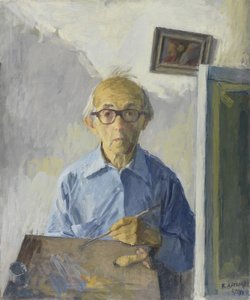
1899–1987, Russie
Raphaël Soyer
L'Âme de la Ville : La Vie et l'Héritage de Raphael Soyer Dans le paysage bouillonnant et souvent indifférent du New York du XXe siècle, peu d'artistes ont capturé le pouls calme et mélancolique de l'humanité urbaine avec autant de tendresse que Raphael Sоyer. Né en 1899 à Borisoglebsk, en Russie, le parcours de Soyer fut marqué par l'immigration, la résilience et un engagement indéfectible envers la vérité représentative. Aux côtés de son frère jumeau identique, Moses, Raphael a grandi dans un foyer où l'intellect et l'art étaient primordiaux. Son père, Abraham, érudit hébreu et enseignant, a instauré un environnement de profonde quête académique qui allait plus tard fournir l'échafaudage intellectuel du commentaire social de Raphael.
 Adieu à Lincoln Square (Piétons)1959
 Soyer, Moses, Portrait Of1965
 Girl in White Blouse1932
 Two Girls1931