
 Aperçu en situation
 Envoyer
 Partager
 Détails de l'œuvre
 Guide
Guide

 Télécharger l'image
 Articles similaires
 Radiographie
 Diaporama
 Questions et réponses
 Statistiques
Athenais

- 101.0 x 61.0 cm


 Lire la suite
Giclées et impressions d'art
Impressions giclées ou sur toile de qualité musée, avec une production rapide et des finitions au choix. ( Commander la reproduction peinte à la main Passer au format numérique)




P118B €10

P118H €10

P118W €10

P438Z €10

P508JH €12

P508YH €12

P805H €10

P805Z €10

P919BZ €10

P919G €10

P919XJ €10

P959ZH €10

P968JZ €12

W106C €8

W218G €10

W218JH €8

W218Y €10

W307PJ €10

W316G €10

W316PJ €8

W316Y €10

W398PJ €8

W4111J €10

W500HY €15

W500JH €15

W692G €12

W849H €8

W940BG €15

W953PJ €8




Choisissez parmi nos formats prédéfinis qui respectent les proportions originales de l’œuvre.

Saisissez la largeur et la hauteur souhaitées pour qu'elles s'adaptent à votre cadre ou à votre mur. Une impression peut être recadrée, mais jamais agrandie au-delà de l'image originale ; ainsi, un format de forme différente entraînera la perte d'une partie de l'image. Nous vous envoyons une maquette numérique pour approbation avant toute impression. L'image présentée sur cette page ne montre pas le recadrage réel — seule la maquette le permet.
Livraison dans le monde entier () en 2 semaines au lieu des 4/5 semaines habituelles. (5 novembre)

Livraison express gratuite dans le monde entier

Toile de lin de qualité supérieure

Assurance transport complète

Garantie de remboursement des droits de douane

Garantie de fidélité des couleurs

Politique de retour de 100 jours (uniquement en cas de défaut)

Garantie de remboursement à 100%

Offre de tarifs dégressifs
 L'option verre n'est disponible que pour les dimensions inférieures à 110 cm.

Athenais
Giclées et impressions d'art
Format de la reproduction
-


Prix total
€ 72
A Vision of Classical Splendor
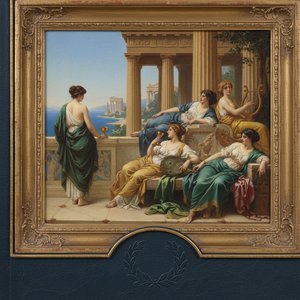
In the luminous realm of Neo-Classicism, few works capture the serene intersection of human grace and architectural grandeur as exquisitely as John William Godward’s Athenais. Painted in 1908, this masterpiece serves as a breathtaking window into a lost era of antiquity, reimagined through the meticulous lens of the late Victorian era. The painting presents us with a central figure of incomparable elegance, draped in a flowing, vibrant red gown that commands the viewer's gaze. As she stands with a poised hand upon her hip, her presence is not merely decorative but foundational to the composition, embodying a sense of quiet confidence and timeless beauty. The rich, crimson hue of her attire creates a striking visual dialogue with the pale, marble textures surrounding her, ensuring that the subject remains the beating heart of this classical dreamscape.
The setting of Athenais is nothing short of theatrical, designed to transport the observer to a world of myth and marble. Godward surrounds his protagonist with an array of sculpted figures—Greek gods and goddesses carved into architectural elements—which lend the scene an air of sacred permanence. These statues, rendered with such precision that one can almost feel the coolness of the stone, provide a structural rhythm to the piece. The inclusion of delicate birds, fluttering near the periphery, introduces a subtle layer of life and movement, breaking the stillness of the marble and infusing the atmosphere with a sense of tranquil harmony. This careful balance between the static permanence of architecture and the fleeting vitality of nature is what makes the work so profoundly captivating.
Mastery of Technique and Light
To behold Athenais is to witness the pinnacle of academic realism and the masterful application of oil on canvas. Godward’s technique is characterized by an extraordinary attention to texture; he layers his pigments with a devotion that allows the viewer to distinguish between the soft, supple folds of silk and the hard, weathered grain of ancient stone. The lighting within the painting is masterfully diffused, casting gentle shadows that sculpt the woman's form and provide a realistic sense of depth. This soft illumination avoids harsh contrasts, instead bathing the entire scene in a warm, nostalgic glow that enhances the romanticism of the subject matter.
The color palette is a sophisticated study in balance, dominated by deep reds, pristine whites, and muted earth tones. These colors work in concert to create a sense of stability and order, reflecting the core tenets of the Neo-Classical movement. The lines are predominantly smooth and flowing, guiding the eye through the organic curves of the human form and into the geometric precision of the classical backdrop. For the discerning collector or interior designer, this painting offers more than just visual beauty; it provides a sophisticated focal point that brings an aura of cultured refinement and historical depth to any space.
Symbolism and Lasting Emotional Resonance
Beyond its aesthetic brilliance, Athenais is steeped in symbolic resonance. The figure herself, often interpreted through the lens of classical mythology, evokes themes of purity, vulnerability, and the eternal nature of beauty. The architectural setting—a monument to civilization and human achievement—serves as a powerful counterpoint to the organic grace of the woman, suggesting a harmonious coexistence between humanity and the enduring legacies of the past. There is a profound sense of nostalgia in Godward's work, a longing for the perceived order and moral seriousness of the ancient world.
For those seeking to adorn their homes with art that inspires contemplation, this painting offers an emotional journey into the sublime. It invites the viewer to pause, to breathe in the stillness of the scene, and to reconnect with the classical ideals of beauty and grace. Whether viewed as a historical document of the late 19th-century academic style or as a timeless piece of decorative art, Athenais remains an enduring testament to the power of the brush to resurrect the splendor of antiquity.
Questions et réponses
Quel est le niveau de contraste de «Athenais» de R.B.A John William Godward ?
«Athenais» de R.B.A John William Godward présente un contraste Bold entre ses zones claires et ses zones sombres.
Où et pour quel usage l'œuvre "Athenais" est-elle recommandée ?
« Athenais » est idéal pour Focal et s'intègre parfaitement dans une Living Room.
Où est-il recommandé d'exposer le format Tall de « Athenais » ?
Le format (Tall) et l'espace recommandé (Living Room) sont les deux caractéristiques de disposition enregistrées pour «Athenais» de R.B.A John William Godward.
Biographie de l'artiste
John William Godward : Un Maître du Néoclassicisme Victorien
Jeunesse et Origines
- Né le : 9 août 1861, Wimbledon, Angleterre.
- Décédé le : 13 décembre 1922, Londres, Angleterre.
- John William Godward était l'aîné de cinq enfants nés de John Godward, employé de banque, et Sarah Eboral.
- Son enfance a été marquée par une nature recluse, largement attribuée aux personnalités autoritaires de ses parents. Cette introversion a profondément influencé ses sensibilités artistiques.
Développement Artistique et Influences
- Formation Initiale : Godward a reçu une formation artistique formelle, bien que des détails spécifiques restent rares en raison de la destruction de ses papiers personnels.
- Influences Clés : Il a été fortement influencé par Sir Lawrence Alma-Tadema et Frederic Leighton, deux figures importantes du Néoclassicisme victorien.
- Comme Alma-Tadema, Godward a fait preuve d'une attention méticuleuse aux détails dans la représentation de l’architecture classique et des textures. Cependant, il a développé son propre style distinctif caractérisé par des couleurs vives et des représentations idéalisées de la beauté.
Carrière et Œuvres Majeures
- Expositions à la Royal Academy : Godward a commencé à exposer à la Royal Academy en 1887, marquant le début de sa reconnaissance publique.
- Peintures Notables :
- Dolce far Niente (1904) : Peut-être son œuvre la plus célèbre, achetée par Andrew Lloyd Webber en 1995.
- When the Heart is Young (1902) : Exemples de sa capacité à capturer l'innocence et la beauté juvéniles.
- The Mirror (1899) : Montre son habileté à contraster les textures et à créer une sensation de profondeur.
- In the Tepidarium (1913) : Une figure semi-nue démontrant sa versatilité dans le genre néoclassique.
- Athenais : Un exemple époustouflant de ses figures féminines idéalisées dans des décors classiques.
- Déménagement en Italie : En 1912, Godward s'est installé à Rome avec l'une de ses modèles, une décision qui a conduit à un éloignement de sa famille.
Style et Thèmes
- Style Néoclassique : Son œuvre est caractérisée par son adhésion aux formes, thèmes et esthétiques classiques.
- Motifs Répétés : Il a fréquemment représenté de belles femmes vêtues d'une tenue classique, souvent engagées dans des moments de repos ou de contemplation.
- Maîtrise Technique : Godward était réputé pour son attention méticuleuse aux détails, en particulier dans la représentation des textures telles que le marbre, le fourrure et les tissus. Son utilisation de couleurs vives a également distingué son style.
- On le décrit souvent comme un « Rêveur Victorien Élevé » en raison de la nature idéalisée et romantique de ses peintures.
Fin Tragique et Héritage
- Décès : Godward s'est tragiquement suicidé en 1922 à l’âge de 61 ans.
- Réaction Familiale : Sa famille, honteuse de son suicide, a détruit ses papiers et tenté d'effacer sa mémoire.
- Signification Historique : Malgré les tentatives pour supprimer son héritage, l’œuvre de Godward a connu un regain de popularité. Il reste une figure importante du Néoclassicisme victorien, célébré pour son habileté technique, sa beauté idéalisée et ses représentations évocatrices des thèmes classiques.

R.B.A John William Godward
1861 - 1922 , Angleterre
L'essentiel de l'artiste
- Artistic Movement Or Style: Neo-Classique Victorien
- Artists Or Movements Influenced By This Artist: ['Art de la Belle Époque']
- Artists Who Influenced This Artist:
- Alma-Tadema
- Leighton
- Date Of Birth: 1861
- Date Of Death: 1922
- Full Name: John William Godward
- Nationality: Britannique
- Notable Artworks:
- Dolce far Niente
- When the Heart is Young
- The Mirror
- Place Of Birth: Wimbledon, Angleterre
Articles connexes

Les 10 Chefs-d'œuvre du Néoclassicisme : Artistes et Décor Intemporels
Plongez au cœur du Néoclassicisme avec les 10 chefs-d'œuvre incontournables de David, Ingres et autres maîtres. Découvrez l'histoire fascinante de ces tableaux célèbres et trouvez l'inspiration déco classique sur !

The Enduring Allure of the Nude: A Historical & Artistic Exploration of the Human Form
Explore the captivating history of nude art! Discover iconic paintings & artists from classical to modern eras. Uncover symbolism, techniques & find museum-quality reproductions at OriginalUniqueArt.

Les 25 chefs-d'œuvre de John Constable : l'âme du paysage anglais
Explorez les 25 chefs-d'œuvre de John Constable et l'âme du romantisme anglais. Découvrez toute la collection sur OriginalUniqueArt.com.
R.B.A. John William Godward: A Study in Neoclassical Sensibility & Decadence
Explore the captivating Neo-Classical world of John William Godward. Discover his exquisite paintings, artistic influences, and investment potential. Expert analysis for discerning collectors.

John Singer Sargent : Les 25 Œuvres Maîtresses d'un Portraitiste Éminent | OriginalUniqueArt
Plongez dans l'univers de John Singer Sargent : découvrez les 25 œuvres qui ont marqué l'histoire de l'art. Portraits impressionnants, réalisme exquis et couleurs vibrantes. Retrouvez ces chefs-d'œuvre en reproduction haute définition sur OriginalUniqueArt.com.


