Aperçu en situation
 Envoyer
 Partager
 Détails de l'œuvre
 Guide
Guide

 Télécharger l'image
 Articles similaires
 Radiographie
 Diaporama
 Q&A
Q&A Statistiques
L'arbre rouge
 Acrylique sur toile
- Décoration murale
- Autres
 1908
1908- Époque moderne
 70.0 x 99.0 cm
 Lire la suite
Giclées et impressions d'art
Impressions giclées ou sur toile de qualité musée, avec une production rapide et des finitions au choix. ( Commander la reproduction peinte à la main Passer au format numérique)




P118B €10

P118H €10

P118W €10

P438Z €10

P508JH €12

P508YH €12

P805H €10

P805Z €10

P919BZ €10

P919G €10

P919XJ €10

P959ZH €10

P968JZ €12

W106C €8

W218G €10

W218JH €8

W218Y €10

W307PJ €10

W316G €10

W316PJ €8

W316Y €10

W398PJ €8

W4111J €10

W500HY €15

W500JH €15

W692G €12

W849H €8

W940BG €15

W953PJ €8




Choisissez parmi nos formats prédéfinis qui respectent les proportions originales de l’œuvre.

Saisissez la largeur et la hauteur souhaitées pour qu'elles s'adaptent à votre cadre ou à votre mur. Une impression peut être recadrée, mais jamais agrandie au-delà de l'image originale ; ainsi, un format de forme différente entraînera la perte d'une partie de l'image. Nous vous envoyons une maquette numérique pour approbation avant toute impression. L'image présentée sur cette page ne montre pas le recadrage réel — seule la maquette le permet.
Livraison dans le monde entier () en 2 semaines au lieu des 4/5 semaines habituelles. (28 octobre)

Livraison express gratuite dans le monde entier

Toile de lin de qualité supérieure

Assurance transport complète

Garantie de remboursement des droits de douane

Garantie de fidélité des couleurs

Politique de retour de 100 jours (uniquement en cas de défaut)

Garantie de remboursement à 100%

Offre de tarifs dégressifs
 L'option verre n'est disponible que pour les dimensions inférieures à 110 cm.

L'arbre rouge
Giclées et impressions d'art
Format de la reproduction
-


Prix total
€ 71
Red Tree – A Pivotal Moment in Mondrian’s Artistic Journey
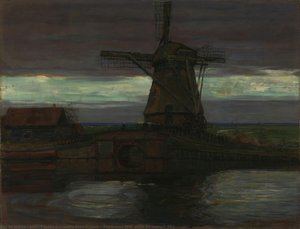
Piet Mondrian, a foundational figure in modern abstract art, created the captivating painting Red Tree in 1908. This oil on canvas masterpiece is currently housed at the Haags Gemeentemuseum in the Netherlands. As we delve into the world of Mondrian’s early work, it becomes evident that "Red Tree" represents a pivotal moment in his artistic journey—a decisive step away from representational painting towards the radical simplification of geometric abstraction that would define his later career.Post-Impressionist Roots and Early Influences
Mondrian's transition from figurative art to pure abstraction is meticulously documented. Red Tree exemplifies the post-impressionist style, characterized by its deliberate attempt to capture light and color with heightened intensity—a conscious reaction against the muted palettes of Impressionism. The painting depicts a solitary tree, rendered in shades of blue and red, symbolizing winter’s dormancy. This careful selection of hues reflects Mondrian's fascination with Cézanne and Van Gogh, artists who championed expressive brushwork and tonal modulation as vehicles for conveying emotion. However, unlike his predecessors, Mondrian sought to transcend subjective experience altogether, aiming instead for an objective depiction of nature—a quest that would ultimately lead him to embrace a radically different aesthetic approach.The Embrace of Divisionism: Exploring Luminosity Through Fragmented Color
Divisionism, championed by Georges Seurat and Paul Signac, profoundly impacted Mondrian’s artistic sensibilities during this formative period. This technique involves fracturing color into minuscule dots or patches—a method designed to maximize luminosity and create an illusion of shimmering surface texture. Although Red Tree doesn’t strictly adhere to divisionist principles in the strictest sense—the dots are less prominent than in Seurat's works—it nevertheless embodies the influence of this movement through its vibrant, distinct colors. Mondrian recognized Divisionism as a crucial step toward achieving pure abstraction and capturing the essence of light itself.Proto-Cubism and Foreshadowing Geometric Abstraction
Furthermore, Mondrian’s artistic explorations coincided with the emergence of proto-cubism—a transitional phase wherein artists experimented with geometric forms and reduced color palettes. Artists like Picasso and Braque were dismantling traditional perspective and exploring fragmented planes—a stylistic innovation that foreshadowed the monumental breakthroughs of Cubism. While Red Tree doesn’t fully embrace cubist techniques—such as multiple viewpoints—it nevertheless anticipates Mondrian's subsequent shift towards neoplasticism by prioritizing geometric abstraction and minimizing tonal variation. The simplified forms contribute to a sense of stillness and contemplation, mirroring the artist’s desire for universal harmony.Symbolic Resonance: Winter’s Quiet Strength
Beyond its formal innovations, “Red Tree” carries significant symbolic weight. The tree itself represents resilience—the enduring presence of life amidst apparent desolation—a motif that resonates deeply with Mondrian's philosophical convictions. The stark contrast between the dominant blue and red hues underscores this duality—representing both tranquility and passion—creating a visual dialogue that invites contemplation on themes of balance, harmony, and spiritual aspiration. As a testament to Mondrian’s pioneering vision, "Red Tree" remains an enduring emblem of modern art's quest for beauty and truth. Piet Mondrian: Red Tree and Piet Mondrian: Silver Tree showcase his exploration of different styles. His later work, such as Piet Mondrian: Composition with yellow patch, reflects a more abstract and geometric approach. For more information on Piet Mondrian and his works, visit Piet Mondrian at OriginalUniqueArt. To learn about the styles that influenced him, see Divisionism and Proto-Cubism.Questions et réponses
Comment "L'arbre rouge" équilibre-t-il l'ombre et la lumière ?
Les valeurs enregistrées pour «L'arbre rouge» de Piet Mondrian sont : une luminosité de équilibrée, une luminance de Ombre douce.
Comment puis-je découvrir des œuvres d'art similaires à «L'arbre rouge» de Piet Mondrian ?
La page Œuvres similaires de «L'arbre rouge» de Piet Mondrian présente des œuvres similaires.
Existe-t-il une fiche informative sur «L'arbre rouge» de Piet Mondrian destinée aux étudiants ?
La page Fiche pédagogique de «L'arbre rouge» de Piet Mondrian propose une fiche pédagogique imprimable en deux volets : l'œuvre accompagnée de sa fiche d'identité, une frise chronologique la situant dans la vie de l'artiste, d'autres œuvres de l'artiste, la palette de couleurs mesurée, ainsi que des citations prêtes à être copiées en quatre styles différents.
Biographie de l'artiste
**Je jeunesse et sa carrière aux Pays-Bas (1872-1911)**
pieter cornelis mondriaan, connu depuis 1911 sous le nom de piet mondrian, était un peintre et théoriciens de l'art néerlandais né le 7 mars 1872 à Amersfoort, aux Pays-Bas. Il a commencé sa carrière comme enseignant dans l'enseignement primaire tout en pratiquant la peinture, initialement dans le style impressionniste néerlandais de l'École de La Haye.- Ses premières œuvres, caractérisées par des paysages naturalistes, peuvent être vues dans des peintures telles que The Red Mill et Trees in Moonrise, exposées au Kunstmuseum Den Haag.
- La recherche de Mondrian d'un style personnel l'a conduit à explorer divers mouvements artistiques, notamment le pointillisme et le fauvisme.
- Sa première exposition en 1893 a marqué le début de sa carrière prolifique.
**L’évolution du style de Mondrian**
De la figure à l'abstraction La direction artistique de Mondrian s'est orientée vers un style de plus en plus abstrait, culminant dans une forme non-représentative qu'il a appelée néoplasticisme. Cette « art plastique pur » visait à créer « une beauté universelle », limitant son vocabulaire formel aux couleurs primaires (rouge, bleu et jaune), aux valeurs (noir, blanc et gris) et aux directions (horizontale et verticale).- Des exemples de ce style peuvent être vus dans des peintures telles que Composition with Yellow Patch (46 x 46 cm, néoplasticisme, huile sur toile).
- Le travail de Mondrian a eu une influence énorme sur l'art du XXe siècle, impactant non seulement la peinture abstraite mais aussi la conception, l'architecture et la mode.
**Héritage et influence**
L’héritage de Mondrian s’étend au-delà de son propre travail, influençant les grands styles et mouvements tels que la couleur field painting, l'expressionnisme abstrait et le minimalisme. L'historien d'art Stephen Bayley a noté que Mondrian est devenu un totem pour tout ce que le modernisme visait à être.- Découvrez davantage du travail de Mondrian sur OriginalUniqueArt.com.
- Apprenez-en plus sur le mouvement De Stijl et son influence sur l'art moderne à wikipedia.
- Découvrez d’autres artistes influents tels que Vincent van Gogh et leur impact sur le monde de l'art.
**Œuvres clés et expositions**
* Piet Mondrian: Apple Blossom (Cubisme) (voir sur OriginalUniqueArt.com) * Piet Mondrian: Still Life with Vase of Spices II (Cubisme) (voir sur OriginalUniqueArt.com) * Piet Mondrian: Passionflower (73 x 48 cm, Kunstmuseum Den Haag, post impressionisme, aquarelle) (voir sur OriginalUniqueArt.com)
Piet Mondrian
1872 - 1944 , Pays-Bas
L'essentiel de l'artiste
- Artistes Influents:
- École de La Haye
- Pointillisme
- Fauvisme
- Cubisme
- Date De Naissance: 7 mars 1872
- Influences Artistiques:
- Color Field painting
- Expressionnisme abstrait
- Minimalisme
- Lieu De Naissance: Amersfoort, Pays-Bas
- Mouvement Artistique: De Stijl, Néoplasticisme
- Nationalité: Néerlandais
- Nom Complet: Piet Mondrian
- Oeuvres Notables:
- Composition avec Rouge, Jaune et Bleu
- Broadway Boogie Woogie
- Tableau n°2 Composition V
- Arbres sur le Gein. Lever de lune
Articles connexes
Au-Delà de la Forme : Explorer les Fondements Philosophiques de l'Abstraction Géométrique
Explorez les fondements philosophiques de l'abstraction géométrique avec OriginalUniqueArt. Découvrez Malevitch, Mondrian et Lissitzky. Analyse approfondie pour collectionneurs et amateurs d'art.
Neoplasticism Unveiled: The Power of Pure Color and Geometric Form in Modern Abstract Art
Explore the profound essence of Neoplasticism. Discover how Piet Mondrian and De Stijl masters used pure color and geometric form to redefine modern art. An essential guide for collectors seeking to understand the enduring power of abstract harmony and universal order.

Abstraction Géométrique : Les 10 Chefs-d'œuvre qui ont Marqué l'Histoire de l'Art
Plongez au cœur de l'abstraction géométrique avec OriginalUniqueArt.com ! Découvrez les 10 œuvres majeures de Mondrian, Malevitch et Kandinsky qui ont révolutionné l'art moderne. Inspirez votre décoration intérieure avec des reproductions de tableaux exceptionnelles. Explorez la collection en ligne !

Beyond Form & Color: Geometric Abstraction's Evolution in 20th/21st Century Art
Explore the evolution of geometric abstraction from Cubism to contemporary art. Discover key artists like Malevich & Mondrian, investment insights, and expert collecting advice at OriginalUniqueArt.
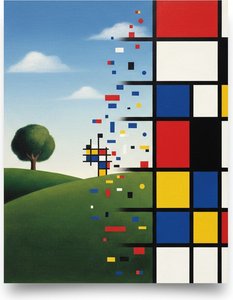
Piet Mondrian : Déconstruction de la réalité – Étude du Néoplasticisme et de l'harmonie universelle
Explorez le monde fascinant de Piet Mondrian et du Néoplasticisme. Découvrez les principes clés de ce mouvement artistique révolutionnaire, son influence durable et l'harmonie universelle qu'il recherche. Analyse approfondie et œuvres emblématiques.