 Aperçu en situation
 Envoyer
 Partager
 Détails de l'œuvre
 Guide
Guide

 Télécharger l'image
 Articles similaires
 Radiographie
 Diaporama
 Statistiques
Composition III bleue et jaune


 Lire la suite
Reproduction à l'huile faite à la main
Huile sur toile peinte à la main, avec cadre et dimensions personnalisés, réalisée sur commande par nos artistes. ( Passer au format impression Passer au format numérique)




P118B €10

P118H €10

P118W €10

P438Z €10

P508JH €12

P508YH €12

P805H €10

P805Z €10

P919BZ €10

P919G €10

P919XJ €10

P959ZH €10

P968JZ €12

W106C €8

W218G €10

W218JH €8

W218Y €10

W307PJ €10

W316G €10

W316PJ €8

W316Y €10

W398PJ €8

W4111J €10

W500HY €15

W500JH €15

W692G €12

W849H €8

W940BG €15

W953PJ €8




Choisissez parmi nos formats prédéfinis qui respectent les proportions originales de l’œuvre.

Saisissez la largeur et la hauteur souhaitées, pour s'adapter à votre cadre ou à votre mur. Cette œuvre est peinte à la main ; ainsi, pour un format de forme différente, l'artiste peut peindre un peu plus autour du tableau ou réduire légèrement les bords — c'est vous qui choisissez. Nous vous envoyons une maquette numérique pour approbation avant que la peinture ne commence. L'image présentée sur cette page ne reflète pas le résultat réel — seule la maquette le fait.
Après la commande, l’équipe OriginalUniqueArt.com contactera le client par e-mail pour recueillir ses instructions et lui fournira une maquette d’aperçu
Livraison dans le monde entier () en 3 à 4 semaines au lieu des 5 semaines habituelles. (28 octobre). Aucun compromis sur la qualité.

Livraison express gratuite dans le monde entier

Toile de lin de qualité supérieure

Assurance transport complète

Garantie de remboursement des droits de douane

Garantie de fidélité des couleurs

Politique de retour de 100 jours (uniquement en cas de défaut)

Garantie de remboursement à 100%

Offre de tarifs dégressifs
 L'option verre n'est disponible que pour les dimensions inférieures à 110 cm.

Composition III bleue et jaune
Technique de reproduction
Format de la reproduction
-


Prix total
€ 264
Composition III blue and yellow
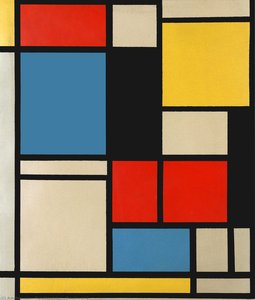
Piet Mondrian’s Composition III blue and yellow isn't merely a painting; it’s a declaration of artistic intent, distilled from the turbulent currents of early 20th-century abstraction into a visual emblem of harmonious equilibrium. Emerging from the vanguard of Neoplasticism – a style Mondrian championed as a pathway toward universal beauty – this canvas presents a rigorously structured grid of black lines dividing space into rectangles filled with primary colors: bold reds, serene blues, and luminous yellows punctuated by areas of pure white. It’s deceptively simple in appearance but harbors a profound intellectual quest rooted in geometric abstraction.
From Impressionism to Neo-Plasticism: A Journey Towards Pure Form
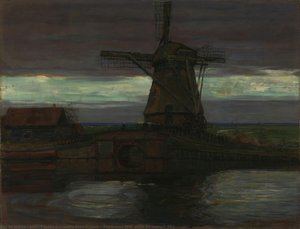
To truly appreciate Composition III blue and yellow, one must understand Mondrian's artistic evolution from his initial foray into landscape painting—characterized by Impressionistic brushstrokes capturing the fleeting beauty of Dutch scenery—to his decisive embrace of Cubism. This pivotal shift propelled him toward deconstructing forms, dismantling traditional perspective, and gradually reducing his palette. This transformative process culminated in the birth of Neo-Plasticism around 1917, a stylistic manifesto driven by philosophical convictions about expressing underlying spiritual truths through the purest possible visual language.
The Language of Geometry: Balance and Dynamic Harmony
Neo-Plasticism wasn’t simply an aesthetic preference; it was a systematic approach to art informed by Mondrian's belief in opposing forces – masculine and feminine, static and dynamic – achieving equilibrium when perfectly balanced. The horizontal and vertical lines represent these antithetical principles, creating a rhythmic interplay that governs the composition. Simultaneously, the primary colors—red, blue, and yellow—were chosen for their inherent energy and clarity, devoid of emotional connotations. White serves as a crucial element, allowing the colors to breathe and resonating with their fundamental purity.
A Microcosm of Universal Harmony: Analyzing the Composition
Consider the arrangement itself. The black lines delineate a square grid, dividing the canvas into nine rectangles—four horizontal and five vertical—each filled with one of the primary colors. This seemingly austere structure belies a meticulous calculation designed to achieve dynamic equilibrium. As Stephanie Chadwick eloquently observes, “Mondrian’s *Composition III blue and yellow* demonstrates his commitment to relational opposites, asymmetry, and pure planes of color.” The careful placement of colored rectangles isn't random; it reflects Mondrian’s conviction that visual art could embody universal harmony.
A Legacy Enduring: Influence on Modern Design
The impact of Piet Mondrian extends far beyond the confines of painting. His geometric aesthetic principles have profoundly influenced architects, designers, and artists throughout the 20th century—and continue to inspire contemporary creations. From furniture design to fashion, the clean lines, bold colors, and simplified forms characteristic of Neo-Plasticism embody a timeless elegance that transcends stylistic trends. Owning a reproduction of Composition III blue and yellow isn’t merely acquiring an artwork; it's embracing a legacy of artistic innovation—a testament to Mondrian’s unwavering belief in the transformative power of abstraction.
Questions et réponses
Les couleurs de « Composition III bleue et jaune » paraissent-elles vives ou douces ?
L'intensité des couleurs de « Composition III bleue et jaune » est Vif. L'intensité décrit la force avec laquelle les couleurs apparaissent.
Quelle taille de reproduction est suggérée pour «Composition III bleue et jaune» de Piet Mondrian ?
Pour «Composition III bleue et jaune», un format d'impression de Grand format est recommandé. D'autres tailles sont disponibles avec les mêmes proportions.
Puis-je prévisualiser «Composition III bleue et jaune» de Piet Mondrian avant de commander ?
Un aperçu de «Composition III bleue et jaune» de Piet Mondrian est disponible sur la page Aperçu en situation de l'œuvre.
Biographie de l'artiste
**Je jeunesse et sa carrière aux Pays-Bas (1872-1911)**
pieter cornelis mondriaan, connu depuis 1911 sous le nom de piet mondrian, était un peintre et théoriciens de l'art néerlandais né le 7 mars 1872 à Amersfoort, aux Pays-Bas. Il a commencé sa carrière comme enseignant dans l'enseignement primaire tout en pratiquant la peinture, initialement dans le style impressionniste néerlandais de l'École de La Haye.- Ses premières œuvres, caractérisées par des paysages naturalistes, peuvent être vues dans des peintures telles que The Red Mill et Trees in Moonrise, exposées au Kunstmuseum Den Haag.
- La recherche de Mondrian d'un style personnel l'a conduit à explorer divers mouvements artistiques, notamment le pointillisme et le fauvisme.
- Sa première exposition en 1893 a marqué le début de sa carrière prolifique.
**L’évolution du style de Mondrian**
De la figure à l'abstraction La direction artistique de Mondrian s'est orientée vers un style de plus en plus abstrait, culminant dans une forme non-représentative qu'il a appelée néoplasticisme. Cette « art plastique pur » visait à créer « une beauté universelle », limitant son vocabulaire formel aux couleurs primaires (rouge, bleu et jaune), aux valeurs (noir, blanc et gris) et aux directions (horizontale et verticale).- Des exemples de ce style peuvent être vus dans des peintures telles que Composition with Yellow Patch (46 x 46 cm, néoplasticisme, huile sur toile).
- Le travail de Mondrian a eu une influence énorme sur l'art du XXe siècle, impactant non seulement la peinture abstraite mais aussi la conception, l'architecture et la mode.
**Héritage et influence**
L’héritage de Mondrian s’étend au-delà de son propre travail, influençant les grands styles et mouvements tels que la couleur field painting, l'expressionnisme abstrait et le minimalisme. L'historien d'art Stephen Bayley a noté que Mondrian est devenu un totem pour tout ce que le modernisme visait à être.- Découvrez davantage du travail de Mondrian sur OriginalUniqueArt.com.
- Apprenez-en plus sur le mouvement De Stijl et son influence sur l'art moderne à wikipedia.
- Découvrez d’autres artistes influents tels que Vincent van Gogh et leur impact sur le monde de l'art.
**Œuvres clés et expositions**
* Piet Mondrian: Apple Blossom (Cubisme) (voir sur OriginalUniqueArt.com) * Piet Mondrian: Still Life with Vase of Spices II (Cubisme) (voir sur OriginalUniqueArt.com) * Piet Mondrian: Passionflower (73 x 48 cm, Kunstmuseum Den Haag, post impressionisme, aquarelle) (voir sur OriginalUniqueArt.com)
Piet Mondrian
1872 - 1944 , Pays-Bas
L'essentiel de l'artiste
- Artistes Influents:
- École de La Haye
- Pointillisme
- Fauvisme
- Cubisme
- Date De Naissance: 7 mars 1872
- Influences Artistiques:
- Color Field painting
- Expressionnisme abstrait
- Minimalisme
- Lieu De Naissance: Amersfoort, Pays-Bas
- Mouvement Artistique: De Stijl, Néoplasticisme
- Nationalité: Néerlandais
- Nom Complet: Piet Mondrian
- Oeuvres Notables:
- Composition avec Rouge, Jaune et Bleu
- Broadway Boogie Woogie
- Tableau n°2 Composition V
- Arbres sur le Gein. Lever de lune
Articles connexes

Abstraction Géométrique : Les 10 Chefs-d'œuvre qui ont Marqué l'Histoire de l'Art
Plongez au cœur de l'abstraction géométrique avec OriginalUniqueArt.com ! Découvrez les 10 œuvres majeures de Mondrian, Malevitch et Kandinsky qui ont révolutionné l'art moderne. Inspirez votre décoration intérieure avec des reproductions de tableaux exceptionnelles. Explorez la collection en ligne !
Piet Mondrian : Déconstruction de la réalité – Étude du Néoplasticisme et de l'harmonie universelle
Explorez le monde fascinant de Piet Mondrian et du Néoplasticisme. Découvrez les principes clés de ce mouvement artistique révolutionnaire, son influence durable et l'harmonie universelle qu'il recherche. Analyse approfondie et œuvres emblématiques.

Beyond Form & Color: Geometric Abstraction's Evolution in 20th/21st Century Art
Explore the evolution of geometric abstraction from Cubism to contemporary art. Discover key artists like Malevich & Mondrian, investment insights, and expert collecting advice at OriginalUniqueArt.

Kandinsky : Les 25 Œuvres Maîtresses d'un Pionnier de l'Art Abstrait | OriginalUniqueArt
Plongez dans l'univers vibrant de Kandinsky ! Découvrez les 25 œuvres majeures du pionnier de l'art abstrait. Explorez son expressionnisme, ses couleurs audacieuses et l'histoire fascinante derrière chaque tableau. Reproductions d'exception sur OriginalUniqueArt.com.

Les 10 Chefs-d'œuvre Dominés par le Bleu Ardoise : Art, Histoire & Décor
Plongez dans l'univers fascinant des 10 plus beaux tableaux dominés par le bleu ardoise. Découvrez l'histoire, les artistes et les techniques de ces chefs-d'œuvre impressionnistes et contemporains. Inspirez votre décoration intérieure avec !