
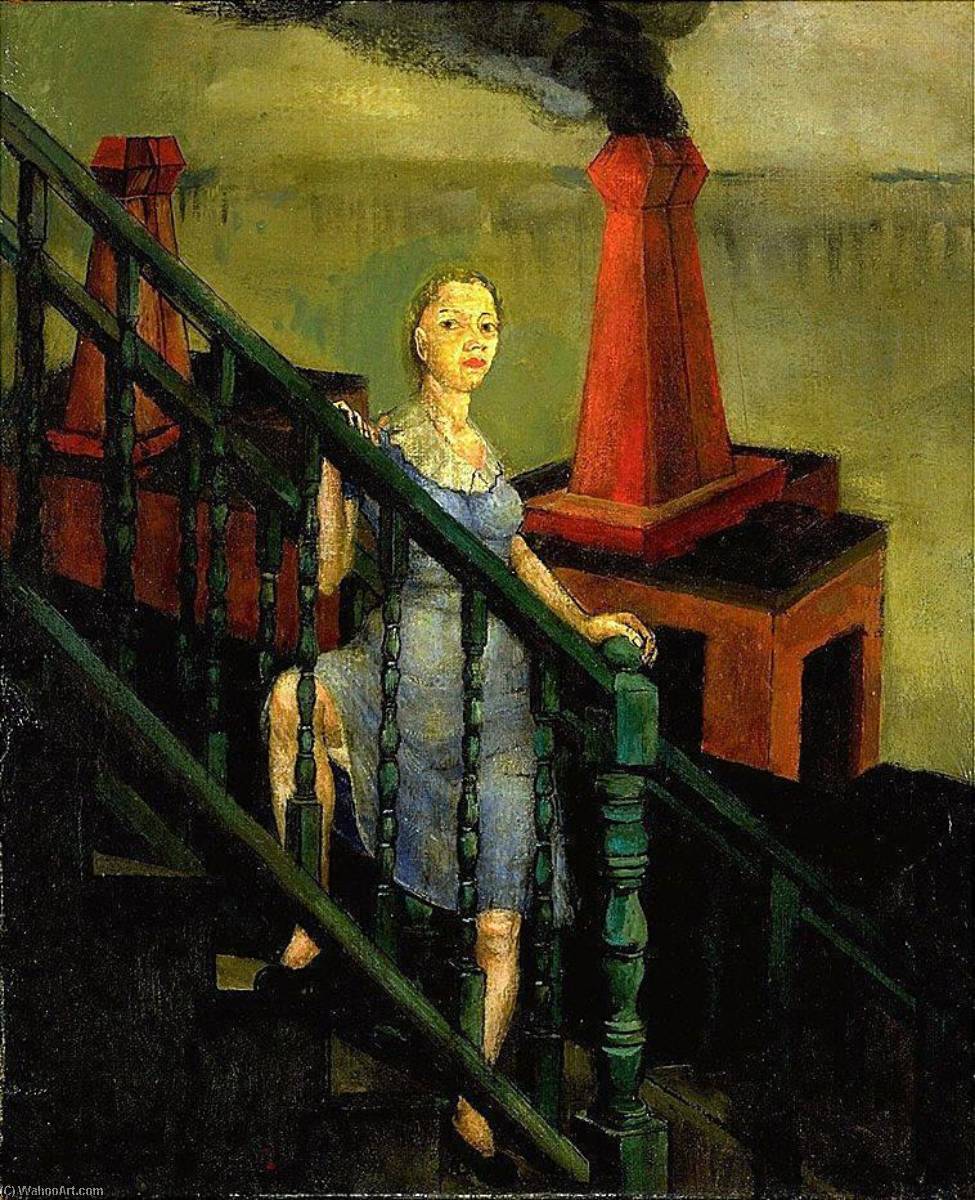
 Aperçu en situation
 Envoyer
 Partager
 Détails de l'œuvre
 Guide
Guide

 Télécharger l'image
 Articles similaires
 Radiographie
 Diaporama
 Statistiques
Turmoil
 1942
1942 62.0 x 52.0 cm
 Lire la suite
Get a print-ready file that goes far beyond the web preview. Every digital image we sell comes from a high-resolution master in our stock database — usually 5,000 to 15,000 pixels wide — so you can print large, crop tightly, or reproduce fine detail with confidence.
No file leaves our studio untouched. A digital expert checks the colors against the original painting and corrects them if needed, then improves clarity and detail with professional retouching tools — always staying faithful to the artist's brushwork and style. The result is an image that looks like the painting, not like a filtered scan.
You approve before you're done: our expert sends the image by e-mail within 72 hours for your review. Not satisfied? Ask for improvements or corrections, or request a refund if the quality falls short.
This is the quality relied on by publishers, design studios, galleries and print shops.
Image numérique
Téléchargez un fichier haute résolution pour votre usage personnel, l'impression et vos projets créatifs. ( Passer au format impression Commander la reproduction peinte à la main)
Inclus avec chaque commande d'image numérique
Livraison numérique experte, garantie.
En choisissant OriginalUniqueArt.com, vous n'obtenez pas seulement une simple image : vous recevez une œuvre numérique sublimée avec professionnalisme, conçue avec précision et accompagnée d'une garantie de satisfaction. Voici tout ce qui accompagne automatiquement votre commande :

Envoi rapide par e-mail
Votre fichier d'image numérique haute résolution vous sera envoyé par e-mail sous 72 heures après votre commande — prêt à un usage immédiat.

Fichier numérique optimisé par l'IA
Votre œuvre d'art bénéficie d'une optimisation professionnelle grâce à des outils d'IA avancés et une retouche manuelle, garantissant un niveau maximal de détail, de clarté et de fidélité chromatique.

Réexpédition gratuite à vie
Vous avez accidentellement supprimé ou perdu votre fichier ? Pas d'inquiétude — nous vous le renverrons gratuitement, quand vous le souhaitez.

Aucuns frais de douane — À jamais
Profitez de votre œuvre d'art instantanément sans frais de douane ni de livraison — les téléchargements numériques sont toujours exonérés de taxes.

Garantie de fidélité des couleurs
Nous garantissons que votre image numérique reproduit les couleurs de l'original aussi fidèlement que possible grâce à des outils professionnels et une gestion rigoureuse des couleurs.

Garantie de satisfaction 100 jours
Si vous n'êtes pas satisfait de votre image numérique, nous la retoucherons ou vous rembourserons 100% sous 100 jours — sans poser de questions.

Garantie de remboursement à 100%
Pas satisfait ? Obtenez un remboursement intégral dans les 100 jours suivant la réception de votre fichier numérique — sans aucune question posée.

Réductions sur les commandes groupées
Achetez 3 images, économisez 10% - Achetez 5, économisez 15% - Achetez 10+, économisez 20%. Idéal pour les projets créatifs, les galeries et les agences.
Biographie de l'artiste
Early Life and Education
Philip Howard Francis Dixon Evergood (born Howard Blashki; 1901–1973) was born in New York City to Miles Evergood, an Australian artist of Polish Jewish descent, and Elsie (née Rosenblum) Evergood. His father’s artistic influence profoundly shaped his own creative path. From a young age, Philip demonstrated musical talent, performing piano concerts with his teacher by 1908. Recognizing this aptitude, he pursued formal education at various English boarding schools starting in 1909, culminating in degrees from Eton and Cambridge University. At Cambridge, he studied literature alongside music, fostering a well-rounded intellectual curiosity that would inform his artistic vision throughout his life.Artistic Training and Influences
Philip’s artistic journey began seriously in 1921 when he enrolled at Slade School of Art in London under the tutelage of Henry Tonks, absorbing the principles of tonal painting and exploring expressive brushwork. He continued his studies at the Art Students League of New York with George Luks and William von Schlegell, honing his skills in American Realism. A pivotal encounter occurred during his time abroad when he studied etching with Stanley William Hayter at Atelier 17, mastering the technique of printmaking and gaining invaluable insight into artistic experimentation. Evergood’s artistic sensibilities were deeply impacted by masters such as El Greco, Bosch, Brueghel, Goya, Daumier, Toulouse-Lautrec, and Sloan's Ashcan paintings—artists who championed social realism and explored psychological depth within their compositions. Furthermore, he drew inspiration from prehistoric cave art, recognizing its primal power and symbolic resonance.Career Highlights: WPA Murals and Teaching
During the Great Depression and World War II eras, Philip Evergood achieved considerable recognition through his involvement with the Works Progress Administration (WPA). He undertook two ambitious mural projects: “The Story of Richmond Hill” (1936–37) for the Public Library branch in Queens, New York, and “Cotton from Field to Mill” (1938) commissioned by the Post Office in Jackson, Georgia. These murals exemplify Evergood’s commitment to portraying social realities with bold lines and evocative imagery—a hallmark of his artistic style. Beyond his painting endeavors, he served as a professor of music and art at various institutions, nurturing young talent and disseminating knowledge about creative expression.Later Years and Legacy
In 1952, Evergood relocated to Southbury, Connecticut, establishing himself as a respected artist and educator. He remained an active member of the Art Students League of New York and was inducted into the National Institute of Arts and Letters—honors recognizing his contribution to American art history. Tragically, he perished in a house fire on August 17, 1973, at the age of 72. His ashes were interred in Green-Wood Cemetery, Brooklyn, marking the final resting place of a prolific artist who left an indelible mark on American art. Evergood’s distinctive style—characterized by awkward drawing and spontaneous bold lines—continues to inspire artists today, cementing his position as a significant figure in 20th-century visual culture. His paintings are celebrated for their humor, fantasy, and symbolic depth, reflecting his unwavering belief in the power of art to engage with social issues and convey profound emotional truths.
Philip Evergood
1901 - 1973 , États-Unis
En bref
- Artistic Movement Or Style: Social Réalisme
- Artists Or Movements Influenced By This Artist: ['Henry Tonks']
- Artists Who Influenced This Artist:
- El Greco
- Bosch
- Date Of Birth: 1901
- Full Name: Philip Howard Francis Dixon Evergood
- Nationality: Américain
- Notable Artworks:
- Good Morning Little Redhead
- Romance
- Place Of Birth: New York City, États-Unis