

 Aperçu en situation
 Partager
 Partager
 Détails
 Guide imprimable

 Télécharger
 Articles similaires
 Radiographie
 Voir le diaporama
 Statistiques
Saint andrew

 Afficher la suite
Giclées et impressions d'art
Impressions giclées ou sur toile de qualité musée, avec une production rapide et des finitions au choix. ( Acheter la peinture faite à la main Passer au format image numérique)




































Choisissez parmi nos formats prédéfinis qui respectent les proportions originales de l’œuvre.

Vous pouvez saisir vos propres dimensions pour vous adapter à un cadre ou à un espace spécifique. Si la taille sélectionnée ne correspond pas aux proportions de l'image originale, nous recadrerons l'œuvre ou étendrons l'image avec une bordure en miroir ou une couleur unie. Une maquette numérique vous sera envoyée pour approbation avant le début de la production.
Veuillez noter que l'aperçu à l'écran ne reflète pas le recadrage ou l'extension réelle. Seule la maquette montrera avec précision la composition finale.
Bien que des tailles personnalisées soient disponibles, nous vous recommandons de choisir une dimension dans la liste prédéfinie afin de préserver les proportions originales.
Livraison dans le monde entier () en 2 semaines au lieu des 4/5 semaines habituelles. (26 septembre)

Livraison express gratuite dans le monde entier

Toile de lin de haute qualité

Assurance transport complète

Garantie de remboursement des droits de douane

Garantie de fidélité des couleurs

Garantie de retour de 100 jours (uniquement en cas de défaut)

Garantie de remboursement à 100%

Tarifs dégressifs sur quantité
 L'option verre n'est disponible que pour les dimensions inférieures à 110 cm.

Saint andrew
Giclées et impressions d'art
Format de la reproduction
-


Prix total final
$ 80
Biographie de l'artiste
Paul Troger: Architect of Austrian Light
Paul Troger (1698-1762) stands as a monumental figure in the history of Austrian art, an architect of light and color whose dramatic frescoes and meticulously crafted drawings profoundly shaped the visual landscape of his era. Born in Welsberg, a small village nestled within the Tyrolean Alps – a region steeped in tradition yet poised on the cusp of artistic innovation – Troger’s journey began amidst the echoes of Alpine craftsmanship, but he swiftly embraced and transformed the burgeoning Baroque style, ultimately pioneering a distinctive approach characterized by vibrant color palettes, dynamic movement, and an unprecedented sense of illusionism. His legacy extends far beyond his individual works; he served as a crucial bridge between the weighty darkness of early 18th-century painting and the lighter, more playful aesthetics of the Rococo, profoundly influencing generations of Austrian artists.
Troger’s formative years were spent under the patronage of the influential von Firmian family in Fiume (present-day Rijeka, Croatia). This early exposure to artistic refinement led him to study with Giuseppe Alberti, a renowned humanist scholar and artist. However, it was his subsequent sojourn in Venice that truly ignited his creative spirit. Immersed in the vibrant art scene of the Venetian Republic – a crucible of artistic experimentation and innovation – Troger encountered the works of Giovanni Battista Piazzetta and Giovanni Battista Pittoni – masters of color and composition who instilled within him a deep appreciation for theatricality and visual drama. Crucially, he also benefited from the rigorous training offered by Sebastiano Ricci, absorbing the techniques of Roman painting and developing his own distinctive style, particularly in the masterful manipulation of light and shadow.
Returning to Austria, Troger initially worked in Salzburg, honing his skills before establishing himself permanently in Vienna. It was here that he truly ascended to prominence, becoming the favored fresco painter for numerous monasteries throughout Lower Austria – institutions seeking to invest in both spiritual grandeur and visual splendor. His commissions were not merely decorative; they represented significant investments in religious devotion and architectural magnificence. The Abbey of Melk, with its magnificent Marble Hall and Library, stands as a testament to Troger’s skill – his frescoes there depicting the Apotheosis of Charles VI as Apollo are particularly celebrated for their scale, dynamism, and masterful use of light, creating an illusion of boundless space within the confines of the hall. Similarly, his work at Göttweig Abbey, featuring an equally impressive depiction of the Apotheosis, showcases his ability to create immersive environments that transport viewers into realms of divine splendor.
The Maestro’s Classroom: Influence and Legacy
Troger’s artistic philosophy was rooted in a deliberate rejection of the prevailing dark palette favored by earlier Baroque painters. He championed a brighter, more luminous style – a characteristic often referred to as the *leichte Manier* (light manner) – that reflected the emerging Rococo aesthetic and offered a refreshing contrast to the somber tones of the past. This shift was not merely superficial; it represented a fundamental change in how artists approached space, light, and color. Troger’s frescoes are characterized by an astonishing sense of depth and perspective, achieved through subtle gradations of tone and the strategic placement of figures within complex compositions. His ability to create the illusion of three-dimensional space on a flat surface was truly remarkable, earning him widespread acclaim and establishing him as a leading innovator in his field.
Beyond his own prolific output, Paul Troger exerted a profound influence on a generation of Austrian artists. He served as professor at the Imperial Academy of Fine Arts in Vienna, where he mentored numerous students who went on to achieve considerable success. Franz Anton Maulbertsch, arguably his most gifted pupil, inherited Troger’s dramatic style and continued to develop it along independent lines. Other notable students included Franz Karl Palko and Josef Siegmund Keller, each carrying forward elements of Troger's innovative approach. His work served as a crucial bridge between the weighty traditions of the late Baroque and the lighter, more playful sensibilities of the Rococo, demonstrating how to effectively utilize color and light to create dynamic compositions that engaged the viewer’s imagination.
Key Works: A Showcase of Artistic Mastery
- Frescoes of the Church of the Englische Fräulein in St. Pölten (1729/1730): This work exemplifies Troger’s ability to create dramatic narratives within a confined space, utilizing vibrant colors and dynamic figures to convey religious themes.
- The Apotheosis of Charles VI as Apollo at Göttweig Abbey (1739): A monumental fresco that showcases Troger’s mastery of scale, composition, and illusionistic technique. The depiction of the Habsburg emperor as Apollo is particularly striking in its grandeur and theatricality.
- Frescoes in the Marble Hall and Library of Melk Abbey (1732-1733): These frescoes are renowned for their intricate detail, luminous colors, and masterful use of perspective. They represent a pinnacle of Troger’s artistic achievement.
- Vision of St. Ulrich at the Battle of Lechfeld, St Ulrich, Vienna (1752): A powerful depiction of a pivotal moment in Austrian history, showcasing Troger's ability to combine religious symbolism with historical narrative.
A Lasting Impression: Historical Significance
Paul Troger’s legacy extends far beyond the confines of his individual works. He played a crucial role in shaping the artistic identity of Austria during the late Baroque and early Rococo periods. His innovative approach to fresco painting – characterized by its vibrant colors, dynamic movement, and unprecedented sense of illusionism – profoundly influenced subsequent generations of Austrian artists. Troger’s work continues to be admired for its beauty, drama, and technical brilliance, solidifying his place as one of the most important figures in the history of Austrian art. His name remains synonymous with a period of artistic flourishing—a testament to his enduring contribution to the visual arts.

Paul Troger
1698 - 1762 , Autriche
En bref
- Artistic Movement Or Style: Baroque
- Artists Or Movements Influenced By This Artist: ['Maulbertsch']
- Artists Who Influenced This Artist:
- Alberti
- Piazzetta
- Date Of Birth: 30 oct. 1698
- Date Of Death: 20 sept. 1762
- Full Name: Paul Troger
- Nationality: Autrichien
- Notable Artworks:
- Fresques Melk
- Apothesé Charles VI
- Place Of Birth: Welsberg, Autriche
Articles similaires

Paul Klee : Les 25 Œuvres Maîtresses d'un Génie de la Couleur | OriginalUniqueArt
Plongez dans l'univers coloré de Paul Klee ! Découvrez les 25 œuvres maîtresses du peintre suisse, figures clés de l'art abstrait et du Bauhaus. Inspirez votre décoration intérieure avec OriginalUniqueArt.com – reproductions de qualité muséale & collection exclusive.

Les 10 Chefs-d'œuvre Baroques qui ont Révolutionné l'Art |
Plongez au cœur du baroque avec les 10 chefs-d'œuvre de Caravaggio, Rembrandt et Rubens. Découvrez l'histoire fascinante de ces artistes et leurs tableaux célèbres. Reproductions d'art de qualité muséale sur – Explorez la collection !

Paul Cézanne : Les 25 Œuvres Maîtresses d'un Génie Révolutionnaire | OriginalUniqueArt
Plongez dans l'univers de Paul Cézanne avec les 25 œuvres incontournables du maître post-impressionniste. Découvrez l'histoire, la technique et l'émotion derrière ses tableaux iconiques comme 'Les Baigneuses' ou 'Mont Sainte-Victoire'. Reproductions d'art haute qualité sur OriginalUniqueArt.com.
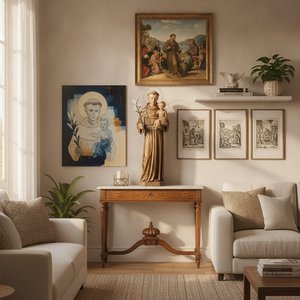
Discover the Divine: Inspiring Saint Anthony Artworks to Elevate Your Home Decor
Transform your home with the profound beauty of Saint Anthony artworks. Explore exquisite Baroque reproductions by Murillo and Zurbarán, hand-painted on 100% cotton canvas to bring divine serenity and timeless elegance to your interior design.

The Dramatic Flourish: Exploring the Baroque Movement's Enduring Legacy in Art History
Explore the dramatic world of Baroque art! Discover iconic artists like Caravaggio & Rubens, defining techniques, and its lasting impact on art history. Expert insights for collectors & enthusiasts at OriginalUniqueArt.
