Passer au format impression
 Lire la suite







































 Pour les œuvres ou reproductions dont un côté mesure plus de 105 cm (environ 41 pouces), le cadre sera expédié sous forme de kit démonté. Cette méthode garantit une livraison sécurisée et prévient tout dommage pendant le transport.


Paul Signac's Sisteron: A Symphony of Light and Color
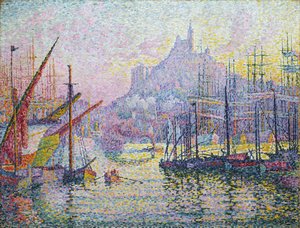
Paul Signac’s 1902 painting, *Sisteron*, is more than just a depiction of a Provençal landscape; it’s a vibrant manifesto of Post-Impressionism, a testament to the artist’s unwavering pursuit of scientific color theory, and an invitation to lose oneself in the shimmering beauty of light. The canvas unfolds with a remarkable serenity – a river gracefully carving its path through a valley embraced by towering mountains, culminating in a picturesque bridge that acts as a visual anchor for the viewer's eye. Scattered figures add a touch of human scale, subtly enhancing the sense of depth and inviting us to imagine ourselves part of this tranquil scene.
- Subject Matter: A quintessential landscape featuring a river valley, mountains, and a bridge – a common motif in plein air painting but rendered with extraordinary technical precision.
- Style: Firmly rooted in Post-Impressionism, Signac’s approach transcends mere representation; he seeks to capture the *impression* of light and color, prioritizing subjective experience over photographic accuracy.
The Pointillist Technique – A Scientific Approach to Beauty
Signac's genius lies in his masterful application of the Pointillist technique, a method he developed alongside Georges Seurat. Rather than blending colors on the palette or directly on the canvas, Signac meticulously applied tiny dots of pure color – predominantly blues, yellows, and greens – side by side. This seemingly simple technique creates an optical illusion; when viewed from a distance, the viewer’s eye blends these individual dots together, resulting in a luminous, vibrant effect that surpasses the limitations of traditional blending. The painting's surface is a textured mosaic, a deliberate demonstration of this scientific approach to color and light.
- Technique: Pointillism – the application of small, distinct dots of pure color to create an optical mixture.
- Color Palette: Dominated by blues, yellows, and greens, reflecting Signac’s interest in capturing the effects of sunlight on water and foliage.
Historical Context and Artistic Influence
*Sisteron* emerged during a period of profound artistic experimentation, building upon the foundations laid by Impressionism while pushing boundaries towards more expressive forms. Signac's work reflects the influence of Claude Monet’s exploration of light and color, as well as Camille Pissarro’s focus on capturing the essence of rural life. However, unlike his predecessors, Signac sought to ground his artistic practice in scientific principles, drawing inspiration from the theories of Eugène Chevreul regarding simultaneous contrast and optical mixing. This intellectual rigor elevated painting beyond mere aesthetics, transforming it into a rigorous investigation of perception.
- Influence: Heavily influenced by Impressionism and the burgeoning field of color theory.
- Movement: A key figure in Neo-Impressionism (Pointillism).
Symbolic Resonance and Emotional Impact
Beyond its technical brilliance, *Sisteron* possesses a profound emotional resonance. The scene evokes a sense of tranquility, peace, and connection with nature – qualities that were increasingly valued during the late 19th and early 20th centuries. The artist’s skillful handling of light and shadow creates a palpable atmosphere, inviting the viewer to step into this idyllic landscape and experience its beauty firsthand. It's a painting that speaks to our innate desire for serenity and reminds us of the restorative power of nature.
Questions et réponses
D'où viennent les visiteurs de «Sisteron» de Paul Signac ?
La page Statistiques de «Sisteron» de Paul Signac présente les statistiques de visites publiques : le nombre de visites mensuelles de cette œuvre, une comparaison avec les œuvres les plus consultées de l'artiste, ainsi que la provenance des visiteurs.
Où puis-je voir un aperçu de « Sisteron » ?
Un aperçu de «Sisteron» de Paul Signac est disponible sur la page Aperçu en situation de l'œuvre.
Quelle atmosphère «Sisteron» de Paul Signac apporte-t-il à un intérieur ?
L'atmosphère Serene de «Sisteron» de Paul Signac s'accorde parfaitement avec l'espace recommandé : un(e) Living Room.
 Aperçu en situation
 Envoyer
 Partager
 Détails de l'œuvre
 Guide
Guide

 Télécharger l'image
 Articles similaires
 Radiographie
 Diaporama
 Questions et réponses
 Statistiques