Passer au format impression
 Lire la suite







































 Pour les œuvres ou reproductions dont un côté mesure plus de 105 cm (environ 41 pouces), le cadre sera expédié sous forme de kit démonté. Cette méthode garantit une livraison sécurisée et prévient tout dommage pendant le transport.


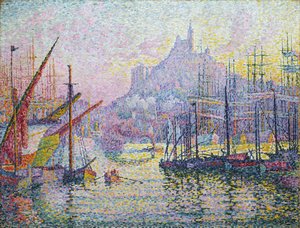
Antibes. Morning: A Symphony of Light and Color by Paul Signac
Paul Signac’s “Antibes. Morning” stands as a cornerstone of Neo-Impressionism, embodying the movement's revolutionary approach to capturing visual experience through scientific observation and meticulous color theory. Painted in 1913–1914 during Signac’s formative years on the French Riviera—a period marked by intense artistic experimentation and collaboration with Georges Seurat—the canvas presents a tranquil seascape infused with vibrant hues that shimmer and dance under the influence of shifting sunlight. More than just a depiction of a picturesque coastal scene, “Antibes. Morning” represents Signac's unwavering commitment to unlocking the secrets of perception itself.The Science Behind Impressionism’s Evolution
Before delving into the artwork’s aesthetic qualities, it’s crucial to understand the intellectual impetus behind Neo-Impressionism. Following the groundbreaking innovations of Monet and Renoir—artists who championed Impressionism's focus on capturing fleeting moments of light—Signac and Seurat sought to transcend mere sensory representation. Inspired by Henri Poincaré’s theories on optics and color perception, they adopted Pointillism – a technique that deliberately eschewed blending brushstrokes altogether. Instead, artists painstakingly applied tiny dots of pure pigment onto the canvas, allowing the viewer's eye to synthesize these individual colors into a unified impression of light and atmosphere. This method wasn’t merely stylistic; it was a deliberate attempt to mimic how the human retina perceives color, grounding painting in scientific principles.A Detailed Examination of Composition and Technique
The painting’s composition is deceptively simple yet remarkably effective. Three sailboats dominate the foreground, positioned strategically against the backdrop of a rocky shoreline and punctuated by the prominent lighthouse beacon. Signac skillfully utilizes perspective to create depth, guiding the viewer's gaze from the boats towards the distant hills bathed in golden light. The artist’s meticulous application of Pointillism is evident throughout—a dense tapestry of minuscule dots meticulously arranged to reproduce the nuances of color and luminosity. Notice how Signac captures the subtle variations in hue as sunlight filters through the clouds, creating an ethereal glow that imbues the scene with a palpable sense of serenity.Symbolic Resonance: Antibes and Artistic Inspiration
Antibes itself holds significance beyond its visual beauty; it served as a crucible for artistic innovation during Signac’s time on the Riviera. The town welcomed artists like Monet and Cézanne, fostering an environment conducive to experimentation and intellectual discourse. Signac's fascination with the interplay of light and color—a preoccupation that permeates “Antibes. Morning”—reflects this broader cultural landscape. Furthermore, the lighthouse symbolizes guidance and vigilance, perhaps mirroring Signac’s own unwavering dedication to his artistic vision.Emotional Impact: Capturing Tranquility and Wonder
Ultimately, “Antibes. Morning” succeeds in conveying a profound sense of tranquility and wonder. The painting invites contemplation—encouraging viewers to immerse themselves in the beauty of nature and appreciate the transformative power of light. Signac’s masterful technique captures not just what he sees but how he feels—translating visual observation into an emotionally resonant experience that speaks to the enduring fascination with capturing sublime landscapes. It remains a testament to Signac's genius and a cornerstone of Neo-Impressionist legacy.Questions et réponses
Comment la palette de «Antibes. Matin» de Paul Signac est-elle décrite ?
Les couleurs de "Antibes. Matin" forment une palette Tons neutres. Cette classification décrit les familles de couleurs dominantes.
Quelle est l'intensité des couleurs de «Antibes. Matin» de Paul Signac ?
«Antibes. Matin» de Paul Signac présente une intensité de couleur Équilibré.
Quelle est la technique utilisée pour "Antibes. Matin" et quelles sont ses dimensions ?
L'œuvre originale «Antibes. Matin» de Paul Signac est une Acrylique sur toile mesurant 120 x 80 cm. La technique et les dimensions correspondent à l'œuvre originale.
 Aperçu en situation
 Envoyer
 Partager
 Détails de l'œuvre
 Guide
Guide

 Télécharger l'image
 Articles similaires
 Radiographie
 Diaporama
 Q&A
Q&A Statistiques