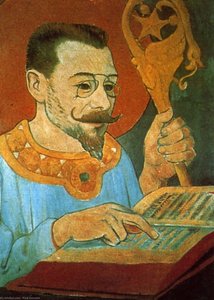
Aperçu en situation
 Partager
 Partager
 Détails
 Guide imprimable

 Télécharger
 Articles similaires
 Radiographie
 Voir le diaporama
 Statistiques
Snake-Eaters
 Oil On Canvas
- WallArt
- Symbolism
 19th Century
 161.0 x 127.0 cm
 Musée National de Varsovie
 Afficher la suite
Reproduction à l'huile faite à la main
Huile sur toile peinte à la main, avec cadre et dimensions personnalisés, réalisée sur commande par nos artistes. ( Passer au format impression Passer au format image numérique)




P118B €10

P118H €10

P118W €10

P438Z €10

P508JH €12

P508YH €12

P805H €10

P805Z €10

P919BZ €10

P919G €10

P919XJ €10

P959ZH €10

P968JZ €12

W106C €8

W218G €10

W218JH €8

W218Y €10

W307PJ €10

W316G €10

W316PJ €8

W316Y €10

W398PJ €8

W4111J €10

W500HY €15

W500JH €15

W692G €12

W849H €8

W940BG €15

W953PJ €8




Choisissez parmi nos formats prédéfinis qui respectent les proportions originales de l’œuvre.

Saisissez la largeur et la hauteur souhaitées, pour s'adapter à votre cadre ou à votre mur. Cette œuvre est peinte à la main ; ainsi, pour un format de forme différente, l'artiste peut peindre un peu plus autour du tableau ou réduire légèrement les bords — c'est vous qui choisissez. Nous vous envoyons une maquette numérique pour approbation avant que la peinture ne commence. L'image présentée sur cette page ne reflète pas le résultat réel — seule la maquette le fait.
Après la commande, l’équipe OriginalUniqueArt.com contactera le client par e-mail pour recueillir ses instructions et lui fournira une maquette d’aperçu
Livraison dans le monde entier () en 3 à 4 semaines au lieu des 5 semaines habituelles. (24 octobre). Aucun compromis sur la qualité.

Livraison express gratuite dans le monde entier

Toile de lin de haute qualité

Assurance transport complète

Garantie de remboursement des droits de douane

Garantie de fidélité des couleurs

Garantie de retour de 100 jours (uniquement en cas de défaut)

Garantie de remboursement à 100%

Tarifs dégressifs sur quantité
 L'option verre n'est disponible que pour les dimensions inférieures à 110 cm.

Snake-Eaters
Technique de reproduction
Format de la reproduction
-


Prix total final
€ 263
A Mystical Encounter in the Breton Woods
In the heart of the dense, dappled forests of Brittany, Paul Sérusier’s “Snake-Eaters” unfolds as a profound invocation of ancient folklore and spiritual mystery. Painted in 1896, this masterpiece transcends mere landscape painting to become a window into the soul of Breton mysticism. The canvas captures four figures caught in the midst of a ritualistic dance, their forms emerging from the shadows of a primordial woodland. There is an undeniable sense of communal connection present in the scene, yet it is draped in an aura of the unknown. As sunlight filters through the thick canopy, it illuminates not just the physical space, but the spiritual weight of the ceremony taking place. For the discerning collector or interior designer, this work offers more than visual beauty; it provides a gateway into a world where the boundaries between the human and the divine are beautifully blurred.
The technique employed by Sérusier is a masterclass in Cloisonnism, a style that would later become a cornerstone of modern abstraction. Rather than relying on the fleeting optical realism of the Impressionists, Sérus and his contemporaries sought a deeper, more permanent truth. He utilizes flat planes of color, bounded by thin, dark contours that resemble the stained glass of a cathedral. This method strips away unnecessary naturalistic detail, allowing the viewer to focus on the rhythmic harmony of the composition. The texture of the foliage and the deliberate arrangement of the figures create a sense of depth that does not rely on traditional perspective, but rather on the emotional weight of color and shape. It is a technique that demands attention, making it a striking focal point for any sophisticated gallery or curated living space.
Symbolism and the Spirit of the Nabis
To understand “Snake-Eaters,” one must look toward the historical currents of the late 19th century. Emerging from the influential Pont-Aven colony under the mentorship of Paul Gauguin, Sérusier was a pioneer of the Nabis movement. This group of artists sought to express inner emotions and spiritual truths through symbolic imagery, rejecting the objective observation of the world in favor of subjective experience. The painting’s palette—a somber yet mesmerizing arrangement of deep browns, earthy reds, and heavy blacks—is meticulously chosen to evoke feelings of reverence, apprehension, and mystery. Every element, from the posture of the dancing figures to the subtle presence of nature around them, serves as a symbol for the unseen forces that shape human existence.
For those looking to integrate art into a refined interior, “Snake-Eaters” offers an unparalleled emotional resonance. It is a piece that invites contemplation and conversation, bringing a sense of historical gravity and avant-garde intellect to a room. Whether displayed as a high-quality reproduction in a study or as a centerpiece in a contemporary lounge, the painting’s ability to evoke the "aura of the unknown" remains potent. It stands as a testament to a period of intense artistic experimentation, offering a timeless connection to the legends and shadows of the past.
Questions et réponses
Quelle est la technique utilisée pour "Snake-Eaters" et quelles sont ses dimensions ?
L'œuvre originale «Snake-Eaters» de Paul Sérusier est une Oil On Canvas mesurant 161 x 127 cm. La technique et les dimensions décrivent l'objet original.
À quel mouvement artistique appartient «Snake-Eaters» de Paul Sérusier ?
« Snake-Eaters » est une œuvre de Symbolism. Ce mouvement indique la tradition artistique à laquelle l'œuvre appartient.
Quelle harmonie de couleurs «Snake-Eaters» de Paul Sérusier présente-t-il ?
L'harmonie colorée de « Snake-Eaters » est décrite comme étant Unified Palette.
Biographie de l'artiste
Premières années et formation
Louis-Paul-Henri Sérusier, plus connu sous le nom de Paul Sérusier, est né à Paris le 9 novembre 1864. Il a étudié à l'Académie Julian dans les années 1880 où il devint moniteur. Cette période marque le début de son parcours artistique qui le mènera à être un pionnier de l’art abstrait et à inspirer le mouvement d'avant-garde des Nabis, du synthétisme et du cloisonnisme.Carrière Artistique
Au cours de l'été 1888, Sérusier se rendit à Pont-Aven où il rejoignit un petit groupe d’artistes autour de Paul Gauguin. Sous la supervision étroite de Gauguin, Sérusier peignit "Le Talisman", un exercice extrême en cloisonnisme qui approchait l'abstraction pure. Cette œuvre mettait en valeur son style innovant et sa volonté d'expérimenter de nouvelles techniques. En tant que peintre post-impressionniste, Sérusier faisait partie du groupe Les Nabis, aux côtés de Pierre Bonnard, Édouard Vuillard et Maurice Denis. Bien qu’il ne soit pas aussi largement reconnu que certains de ses pairs, ses contributions au développement de l'art abstrait sont indéniables.Œuvres Notables et Héritage
Parmi les œuvres notables de Sérusier, on peut citer :- L'Averse (1893), Musée d’Orsay, Paris
- Portrait de Paul Ranson (1890), Musée d’Orsay, Paris
- Mélancolie (1890)
- Les Mangeurs de Serpents (1894), Muzeum Narodowe, Varsovie
Mouvement Artistique et Influence
Le travail de Sérusier a été influencé par le cloisonnisme, un style caractérisé par des formes audacieuses et plates séparées par des contours sombres. Ce mouvement, qui est apparu à la fin du XIXe siècle, a joué un rôle important dans le développement de l'art moderne.- Explorez davantage le cloisonnisme : le mouvement artistique du cloisonnisme
- Découvrez l'œuvre de Sérusier : Paul Sérusier | OriginalUniqueArt.com
- Apprenez à connaître le mouvement des Nabis : le mouvement des Nabis
- Paul Sérusier était un peintre français qui a ouvert la voie à l'art abstrait et inspiré le mouvement des Nabis.
- Il a étudié à l'Académie Julian puis a enseigné à l'Académie Ranson.
- Le travail de Sérusier a été influencé par le cloisonnisme, un style caractérisé par des formes audacieuses et plates.

Paul Sérusier
1864 - 1927 , France
En bref
- Artistes Influents:
- Paul Gauguin
- Émile Bernard
- Date De Décès: 7 octobre 1927
- Date De Naissance: 9 novembre 1864
- Influences Artistiques:
- Cloisonnisme
- Synthetisme
- Lieu De Naissance: Paris, France
- Mouvement Artistique: Post-impressionnisme, Nabi
- Nationalité: Française
- Nom Complet: Paul Sérusier
- Œuvres Notables:
- L'Averse (1893)
- Portrait de Paul Ranson (1890)
- Le Talisman (1888)
Articles connexes

Paul Cézanne : Les 25 Œuvres Maîtresses d'un Génie Révolutionnaire | OriginalUniqueArt
Plongez dans l'univers de Paul Cézanne avec les 25 œuvres incontournables du maître post-impressionniste. Découvrez l'histoire, la technique et l'émotion derrière ses tableaux iconiques comme 'Les Baigneuses' ou 'Mont Sainte-Victoire'. Reproductions d'art haute qualité sur OriginalUniqueArt.com.

Les 10 Chefs-d'œuvre du Paysage Romantique : Artistes et Décor d'Intérieur
Plongez dans l'émotion du Romantisme avec les 10 plus beaux paysages de Friedrich, Turner & Delacroix. Découvrez leur histoire et trouvez l'inspiration déco idéale sur OriginalUniqueArt.com !

Évocations de lieux : Un voyage historique à travers l'art du paysage
Explorez l'histoire fascinante de la peinture de paysage à travers les chefs-d'œuvre du Romantisme. Découvrez Friedrich, Turner et Aivazovski et laissez-vous inspirer par la beauté sauvage et le sublime. Reproduction d'art de qualité chez OriginalUniqueArt.
Paul Sérusier: Pioneering Synthetism & The Nabis’ Symbolic Revolution
Discover Paul Sérusier's pivotal role in the Nabis movement & the birth of Synthetism. Explore 'The Talisman,' his influence on modern art, and a deeper understanding of this symbolic revolution. Expert analysis & insights.

Paul Klee : Les 25 Œuvres Maîtresses d'un Génie de la Couleur | OriginalUniqueArt
Plongez dans l'univers coloré de Paul Klee ! Découvrez les 25 œuvres maîtresses du peintre suisse, figures clés de l'art abstrait et du Bauhaus. Inspirez votre décoration intérieure avec OriginalUniqueArt.com – reproductions de qualité muséale & collection exclusive.