Aperçu en situation
 Partager
 Partager
 Détails
 Guide imprimable

 Télécharger
 Articles similaires
 Radiographie
 Voir le diaporama
 Statistiques
Landscape


 Afficher la suite
Giclées et impressions d'art
Impressions giclées ou sur toile de qualité musée, avec une production rapide et des finitions au choix. ( Acheter la peinture faite à la main Passer au format image numérique)




P118B €10

P118H €10

P118W €10

P438Z €10

P508JH €12

P508YH €12

P805H €10

P805Z €10

P919BZ €10

P919G €10

P919XJ €10

P959ZH €10

P968JZ €12

W106C €8

W218G €10

W218JH €8

W218Y €10

W307PJ €10

W316G €10

W316PJ €8

W316Y €10

W398PJ €8

W4111J €10

W500HY €15

W500JH €15

W692G €12

W849H €8

W940BG €15

W953PJ €8




Choisissez parmi nos formats prédéfinis qui respectent les proportions originales de l’œuvre.

Saisissez la largeur et la hauteur souhaitées pour qu'elles s'adaptent à votre cadre ou à votre mur. Une impression ne peut être que découpée, elle ne peut jamais être agrandie au-delà de l'image originale ; ainsi, un format de forme différente entraînera la perte d'une partie de l'image. Nous vous envoyons une maquette numérique pour approbation avant toute impression. L'image présentée sur cette page ne montre pas le recadrage réel — seule la maquette le permet.
Livraison dans le monde entier () en 2 semaines au lieu des 4/5 semaines habituelles. (22 octobre)

Livraison express gratuite dans le monde entier

Toile de lin de haute qualité

Assurance transport complète

Garantie de remboursement des droits de douane

Garantie de fidélité des couleurs

Garantie de retour de 100 jours (uniquement en cas de défaut)

Garantie de remboursement à 100%

Tarifs dégressifs sur quantité
 L'option verre n'est disponible que pour les dimensions inférieures à 110 cm.

Landscape
Giclées et impressions d'art
Format de la reproduction
-


Prix total final
€ 70
Paul Sérusier’s “Landscape”: A Pioneer of Color and Light
Paul Sérusier's "Landscape," painted in 1912, isn’t merely a depiction of a green field; it’s a pivotal moment in the history of modern art. Born in Paris in 1864, Sérusier was a key figure in the Nabis movement – a group of Symbolist painters who sought to move beyond traditional academic styles and explore the expressive potential of color and form. This particular work embodies the core tenets of that revolutionary approach, representing a radical departure from representational accuracy and a profound embrace of subjective experience.
The painting immediately captivates with its vibrant palette – not a realistic rendering of nature, but an orchestration of pure hues. Deep greens dominate, punctuated by flashes of ochre, cerulean blue, and the warm tones of tree trunks. Sérusier eschewed meticulous detail, opting instead for broad, gestural brushstrokes that suggest movement and atmosphere rather than precise form. The trees themselves are simplified into blocks of color, their outlines blurred and indistinct, contributing to a sense of dreamlike abstraction. This technique, heavily influenced by the theories of Paul Gauguin, who had mentored Sérusier during his time at Pont-Aven in Brittany, was known as “cloisonnism,” where forms were defined by flat planes of color rather than shading or modeling.
The Influence of Breton Symbolism
Sérusier’s journey to this style began with a transformative summer spent in the coastal village of Pont-Aven. There, he encountered a community of artists deeply influenced by Breton folklore and spirituality. The landscape of Brittany, with its rugged coastline, ancient forests, and mystical traditions, provided fertile ground for artistic exploration. Gauguin encouraged Sérusier to “paint what you see, not what you think you should see,” urging him to capture the essence of the scene through color and emotion rather than strict adherence to photographic realism. This instruction proved crucial in shaping Sérusier’s distinctive style – a bold move towards abstraction that would profoundly impact subsequent generations of artists.
The painting's composition subtly evokes Breton legends, with the central tree acting as a focal point, reminiscent of ancient standing stones or sacred groves. The distant figures, barely discernible against the horizon, hint at human presence within this wild and untamed landscape, suggesting a connection between humanity and nature. The cat perched atop one of the trees adds an element of whimsical charm, perhaps symbolizing intuition or a primal connection to the natural world – a recurring motif in Symbolist art.
A Bridge Between Impressionism and Abstraction
"Landscape" stands as a crucial bridge between Impressionism and the nascent movements of abstraction. While rooted in the vibrant color palettes and atmospheric effects of Impressionism, Sérusier’s work transcends mere optical representation. He deliberately simplifies forms, reduces space, and prioritizes emotional expression over objective accuracy – characteristics that would become increasingly prominent in early 20th-century abstract art. It's a testament to his willingness to experiment and push the boundaries of artistic convention.
Emotional Resonance and Artistic Legacy
More than just a beautiful landscape, “Landscape” is an invitation to contemplate the relationship between nature, spirituality, and human perception. The painting’s luminous colors and fluid brushstrokes evoke a sense of tranquility and wonder, inviting the viewer to lose themselves in its dreamlike atmosphere. Sérusier's pioneering work paved the way for artists like Kandinsky and Mondrian, demonstrating that art could be more than just a mirror reflecting reality; it could be a powerful vehicle for expressing inner experience and exploring the depths of human consciousness. Reproductions of this piece offer a captivating glimpse into the heart of early modernism, inviting viewers to appreciate the enduring power of color and form.
Questions et réponses
Puis-je visionner « Landscape » sous forme de diaporama en plein écran ?
Un diaporama est disponible : la page Diaporama de «Landscape» de Paul Sérusier.
Quelle technique et quel style caractérisent «Landscape» de Paul Sérusier ?
«Landscape» de Paul Sérusier allie la technique de Acrylic On Canvas au style Nabis Movement. La technique et le mouvement décrivent respectivement la réalisation et le style de l'œuvre.
Quelle émotion «Landscape» de Paul Sérusier dégage-t-il ?
«Landscape» de Paul Sérusier dégage un sentiment Tranquil au sein d'une atmosphère globalement Calm.
Biographie de l'artiste
Premières années et formation
Louis-Paul-Henri Sérusier, plus connu sous le nom de Paul Sérusier, est né à Paris le 9 novembre 1864. Il a étudié à l'Académie Julian dans les années 1880 où il devint moniteur. Cette période marque le début de son parcours artistique qui le mènera à être un pionnier de l’art abstrait et à inspirer le mouvement d'avant-garde des Nabis, du synthétisme et du cloisonnisme.Carrière Artistique
Au cours de l'été 1888, Sérusier se rendit à Pont-Aven où il rejoignit un petit groupe d’artistes autour de Paul Gauguin. Sous la supervision étroite de Gauguin, Sérusier peignit "Le Talisman", un exercice extrême en cloisonnisme qui approchait l'abstraction pure. Cette œuvre mettait en valeur son style innovant et sa volonté d'expérimenter de nouvelles techniques. En tant que peintre post-impressionniste, Sérusier faisait partie du groupe Les Nabis, aux côtés de Pierre Bonnard, Édouard Vuillard et Maurice Denis. Bien qu’il ne soit pas aussi largement reconnu que certains de ses pairs, ses contributions au développement de l'art abstrait sont indéniables.Œuvres Notables et Héritage
Parmi les œuvres notables de Sérusier, on peut citer :- L'Averse (1893), Musée d’Orsay, Paris
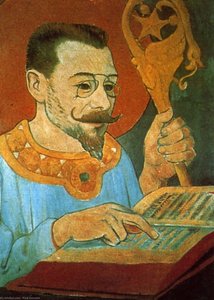
- Portrait de Paul Ranson (1890), Musée d’Orsay, Paris
- Mélancolie (1890)
- Les Mangeurs de Serpents (1894), Muzeum Narodowe, Varsovie
Mouvement Artistique et Influence
Le travail de Sérusier a été influencé par le cloisonnisme, un style caractérisé par des formes audacieuses et plates séparées par des contours sombres. Ce mouvement, qui est apparu à la fin du XIXe siècle, a joué un rôle important dans le développement de l'art moderne.- Explorez davantage le cloisonnisme : le mouvement artistique du cloisonnisme
- Découvrez l'œuvre de Sérusier : Paul Sérusier | OriginalUniqueArt.com
- Apprenez à connaître le mouvement des Nabis : le mouvement des Nabis
- Paul Sérusier était un peintre français qui a ouvert la voie à l'art abstrait et inspiré le mouvement des Nabis.
- Il a étudié à l'Académie Julian puis a enseigné à l'Académie Ranson.
- Le travail de Sérusier a été influencé par le cloisonnisme, un style caractérisé par des formes audacieuses et plates.

Paul Sérusier
1864 - 1927 , France
En bref
- Artistes Influents:
- Paul Gauguin
- Émile Bernard
- Date De Décès: 7 octobre 1927
- Date De Naissance: 9 novembre 1864
- Influences Artistiques:
- Cloisonnisme
- Synthetisme
- Lieu De Naissance: Paris, France
- Mouvement Artistique: Post-impressionnisme, Nabi
- Nationalité: Française
- Nom Complet: Paul Sérusier
- Œuvres Notables:
- L'Averse (1893)
- Portrait de Paul Ranson (1890)
- Le Talisman (1888)
Articles connexes

Paul Klee : Les 25 Œuvres Maîtresses d'un Génie de la Couleur | OriginalUniqueArt
Plongez dans l'univers coloré de Paul Klee ! Découvrez les 25 œuvres maîtresses du peintre suisse, figures clés de l'art abstrait et du Bauhaus. Inspirez votre décoration intérieure avec OriginalUniqueArt.com – reproductions de qualité muséale & collection exclusive.

Les 10 Chefs-d'œuvre Impressionnistes qui ont Révolutionné le Paysage
Plongez dans l'univers vibrant de l'impressionnisme ! Découvrez les 10 chefs-d'œuvre de Monet, Renoir et autres maîtres qui ont révolutionné le paysage. Inspirez votre décoration intérieure avec OriginalUniqueArt.com : reproductions tableaux de qualité muséale.

Paul Cézanne : Les 25 Œuvres Maîtresses d'un Génie Révolutionnaire | OriginalUniqueArt
Plongez dans l'univers de Paul Cézanne avec les 25 œuvres incontournables du maître post-impressionniste. Découvrez l'histoire, la technique et l'émotion derrière ses tableaux iconiques comme 'Les Baigneuses' ou 'Mont Sainte-Victoire'. Reproductions d'art haute qualité sur OriginalUniqueArt.com.
Paul Sérusier: Pioneering Synthetism & The Nabis’ Symbolic Revolution
Discover Paul Sérusier's pivotal role in the Nabis movement & the birth of Synthetism. Explore 'The Talisman,' his influence on modern art, and a deeper understanding of this symbolic revolution. Expert analysis & insights.

Évocations de lieux : Un voyage historique à travers l'art du paysage
Explorez l'histoire fascinante de la peinture de paysage à travers les chefs-d'œuvre du Romantisme. Découvrez Friedrich, Turner et Aivazovski et laissez-vous inspirer par la beauté sauvage et le sublime. Reproduction d'art de qualité chez OriginalUniqueArt.