Passer au format impression
 Lire la suite







































 Pour les œuvres ou reproductions dont un côté mesure plus de 105 cm (environ 41 pouces), le cadre sera expédié sous forme de kit démonté. Cette méthode garantit une livraison sécurisée et prévient tout dommage pendant le transport.


Birth Of The Virgin
The Birth of the Virgin stands as a cornerstone of Early Renaissance art, embodying Paolo Uccello’s groundbreaking approach to perspective and establishing his distinctive visual language. Created in Florence around 1435, this monumental fresco adorning the Cappella Maggiore of Siena Cathedral transcends mere depiction; it's an intellectual triumph—a testament to Uccello’s unwavering dedication to mastering mathematical principles that govern spatial representation.
Introduction to Paolo Uccello and the Early Renaissance Movement
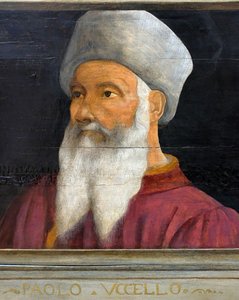
Paolo Uccello (1397-1475), born Paolo di Dono, was more than just a painter; he was a mathematician obsessed with unlocking the secrets of visual perception. His relentless pursuit of the vanishing point—a feat previously unattainable—fueled his artistic endeavors and propelled him to the forefront of the Early Renaissance movement. Influenced by Gothic architecture and sculpture, Uccello sought to elevate painting beyond mere imitation of nature, aiming instead for an illusionistic representation that captured the essence of depth and space.
The Painting's Composition and Style
The fresco’s composition is remarkably complex, utilizing a central perspective system—a technique pioneered by Uccello—that dramatically alters our perception of the scene. Observe how figures appear to recede into the background, creating an immersive experience for the viewer. The vibrant colors employed – predominantly reds, blues and golds – contribute to the painting’s grandeur and convey a sense of solemn reverence. Notably, Uccello's meticulous attention to detail—from the drapery folds to the facial expressions—reflects his mastery of artistic technique.
Historical Context and Artistic Significance
Painted during a period marked by significant cultural transformations in Italy – fueled by burgeoning humanist thought and papal patronage – The Birth of the Virgin exemplifies the spirit of its time. It reflects the ambition to portray biblical narratives with unprecedented realism, aligning with the broader Renaissance fascination for classical ideals and scientific observation. Siena Cathedral itself serves as a repository of artistic treasures from this era, showcasing Uccello’s legacy alongside masterpieces by Giotto and Simone Martini.
Notable Details & Symbolism
The scene depicts Mary receiving the announcement of Jesus's birth from Gabriel. The figures are arranged in a carefully calculated manner to emphasize depth and create an illusion of three-dimensionality. The use of geometric forms—particularly circles and squares—underscores Uccello’s mathematical precision, mirroring his belief that art should be grounded in rational principles. Furthermore, the luminous drapery folds contribute to the painting's ethereal atmosphere, conveying a sense of divine grace.
Where to Find More Information
To delve deeper into Paolo Uccello’s artistic achievements and explore his captivating artworks, visit OriginalUniqueArt.com for high-quality reproductions and scholarly insights.
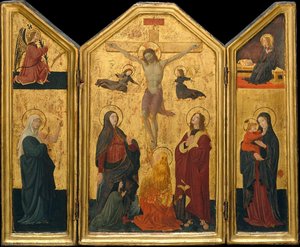
Photo Description: The painting is a depiction of the birth of the Virgin Mary. The scene shows several people gathered around a bed where Mary is lying down. There are at least 12 people in the painting, including both men and women. Some of them are standing close to the bed while others are further away. A few individuals can be seen on the left side of the image, with one person closer to the foreground and another two people slightly farther back. On the right side of the image, there is a group of three people, with one person near the center and the other two people positioned towards the background. The bed occupies a significant portion of the painting, extending from the left edge to almost the entire width of the image. The people in the scene are engaged in various activities, such as looking at Mary or attending to her needs during this special moment.
Size: Unknown
Date: Unknown
Questions et réponses
Quelle tonalité émotionnelle accompagne le style Early Renaissance de « La Naissance de Marie » ?
«La Naissance de Marie» dégage une tonalité émotionnelle Sérénité au sein du mouvement Early Renaissance.
Qui est l'auteur de "La Naissance de Marie" ?
« La Naissance de Marie » a été créé par Paolo Uccello. Les informations présentes sur cette page décrivent l'œuvre originale de Paolo Uccello.
Quelle place occupe «La Naissance de Marie» de Paolo Uccello dans l'histoire de l'art ?
Historiquement, « La Naissance de Marie » est une œuvre Early Renaissance de la grande époque Renaissance.
 Aperçu en situation
 Envoyer
 Partager
 Détails de l'œuvre
 Guide
Guide

 Télécharger l'image
 Articles similaires
 Radiographie
 Diaporama
 Questions et réponses
 Statistiques