
() ·
Une peinture faite pour vous, à la main
Reproduction à l'huile faite à la main
Huile sur toile peinte à la main, avec cadre et dimensions personnalisés, réalisée sur commande par nos artistes. ( Passer au format impression Passer au format numérique)
Biographie de l'artiste
Découvrez Orcagna, peintre et sculpteur italien majeur (v.1308-1368). Maître de Florence, célèbre pour ses mosaïques d'Orvieto. Explorez son héritage !
 Lire la suite
à partir du ·
Chapitre 1
Quelle dimension choisir ?
Faites glisser pour modifier la taille ; l'image de gauche présente le cadre à sa largeur réelle. Les proportions de l'original sont conservées.
Choisissez parmi nos formats prédéfinis qui respectent les proportions originales de l’œuvre.

Saisissez la largeur et la hauteur souhaitées, pour s'adapter à votre cadre ou à votre mur. Cette œuvre est peinte à la main ; ainsi, pour un format de forme différente, l'artiste peut peindre un peu plus autour du tableau ou réduire légèrement les bords — c'est vous qui choisissez. Nous vous envoyons une maquette numérique pour approbation avant que la peinture ne commence. L'image présentée sur cette page ne reflète pas le résultat réel — seule la maquette le fait.
Chapitre 2
Comment souhaitez-vous qu'il vous soit livré ?
Choisissez le type de bordure pour votre toile tendue
Choisissez votre cadre

Bords blancs €1

Bords estompés €1

Bords imprimés €1

P118B €10

P118H €10

P118W €10

P438Z €10

P508JH €12

P508YH €12

P805H €10

P805Z €10

P919BZ €10

P919G €10

P919XJ €10

P959ZH €10

P968JZ €12

W106C €8

W218G €10

W218JH €8

W218Y €10

W307PJ €10

W316G €10

W316PJ €8

W316Y €10

W398PJ €8

W4111J €10

W500HY €15

W500JH €15

W692G €12

W849H €8

W940BG €15

W953PJ €8

H24-GOLD €30

H24-SILVER €30

H36-GOLD €45

H36-SILVER €45
Sous cadre
Baguette : . Dimensions hors tout avec le cadre : .
Chapitre 3
Qui le peint, et y a-t-il des modifications à apporter ?
Après la commande, l'équipe de OriginalUniqueArt.com contactera le client par e-mail pour obtenir ses instructions et lui fournir un aperçu de la maquette
Chapitre 4
Livraison dans le monde entier () en 3 à 4 semaines au lieu des 5 semaines habituelles. (22 novembre). Aucun compromis sur la qualité.
Les dernières touches
Une plaque nominative, comme au musée ?
Détails de la plaque en bronze gravée
This elegant plaque features the artist's name and the title of the artwork, finely engraved for a timeless presentation.
It is made from bronze with a refined, elegant finish. The text is precisely laser-engraved for a sharp and permanent result. Measuring 9x2 cm, the plaque is compact yet easy to read. It's built to be durable and scratch-resistant, offering a professional, museum-quality look. Mounting is simple thanks to the included adhesive backing.
Détails de la plaque en acrylique transparent
The plaque includes essential engraved details such as the artist's name, the title of the artwork, the date it was created, the type of media used-like oil on canvas or watercolor-a brief description of the piece, and a QR code that links to the complete artwork information.
It is crafted from clear acrylic, offering a sleek, modern appearance. The text is UV-engraved in black to ensure strong visual contrast. With a size of 10x15 cm, it ensures optimal readability. It comes equipped with two metal hooks for secure wall mounting. The plaque is designed to be weather-resistant, making it suitable for various environments, and it includes interactive features that work seamlessly with smartphone scanning.
Détails de la plaque en acrylique noir
This elegant plaque includes engraved information such as the artist's name, the title of the artwork, the date it was created, the type of media used (like oil on canvas or watercolor), a short description of the artwork, and a QR code for quick access to more information.
The plaque itself is made from refined black acrylic with a premium finish. The text is laser-engraved in white for high contrast and readability. Its size is 10x15 cm, designed to be easy to read. It comes with two metal hooks for professional mounting. The design is sleek and fits any interior style. It is also weather-resistant and durable, with built-in digital integration for mobile compatibility.
Un vernis protecteur ?
Pour quand en avez-vous besoin ?
Chapitre 5
Votre tableau, tel que vous l'avez commandé

Hell (fragment)
Technique de reproduction
Format de la reproduction
-

Artiste de prestige
Plus de détails, de finesse et un temps de production accru
-

Cadre de reproduction
-
-
Pour les œuvres ou reproductions dont un côté mesure plus de 105 cm (environ 41 pouces), le cadre sera expédié sous forme de kit démonté. Cette méthode garantit une livraison sécurisée et prévient tout dommage pendant le transport.
Assemblage professionnel requis - ce produit n'est pas destiné au bricolage (DIY).
Le kit doit être assemblé et la toile tendue par un encadreur professionnel expérimenté, en utilisant de la colle à bois (non fournie), une pince à tendre la toile et des serre-joints pour maintenir les traverses d'équerre pendant le séchage de la colle. Un assemblage incorrect ou une tension inégale de la toile peut endommager l'œuvre de manière irréversible et n'est pas couvert par notre garantie.
 Pour les œuvres ou reproductions dont un côté mesure plus de 105 cm (environ 41 pouces), le cadre sera expédié sous forme de kit démonté. Cette méthode garantit une livraison sécurisée et prévient tout dommage pendant le transport.
Toutes les baguettes en bois massif sont incluses, découpées avec précision à la taille requise.
À assembler avec les vis fournies, ainsi qu'avec de la colle à bois pour les assemblages d'angles (non fournie), à prévoir par votre encadreur.
L'utilisation d'outils professionnels est requise et non incluse : une pince à tendre la toile (tendeur) et des serre-joints pour maintenir les baguettes bien d'équerre pendant le séchage de la colle.
Important :
L'assemblage des angles nécessite de la colle à bois, les barres doivent être maintenues avec des serre-joints jusqu'au séchage complet de la colle, et le tendage de la toile sur le châssis assemblé nécessite une pince à tendre la toile. Aucun de ces éléments n'est inclus dans le kit. Veuillez consulter un encadreur professionnel expérimenté avant de commander ce format.

Cartel
-
-

Vernis de protection
Vernis brillant (intensifie les couleurs, protège de la lumière et de l'humidité)
-

Personnaliser mon œuvre
Exemples de personnalisation : remplacer le visage par une photo du client ; ajouter un animal de compagnie (par exemple, remplacer un chat par un chien) ; inclure un message caché en arrière-plan ; modifier le paysage ou les éléments d'arrière-plan.
-

Livraison urgente
Livraison dans le monde entier () en 3 à 4 semaines au lieu des 5 semaines habituelles. (22 novembre). Aucune concession sur la qualité.
-
Livraison express
Livraison dans le monde entier () sous 5 semaines. (29 novembre).
Inclus
Prix total
€ 268
L'option verre n'est disponible que pour les dimensions inférieures à 110 cm.
Inclus avec chaque commande
- Livraison express gratuite dans le monde entier
- Toile de lin de qualité supérieure
- Assurance transport complète
- Garantie de remboursement des droits de douane
- Garantie de fidélité des couleurs
- Politique de retour de 100 jours (uniquement en cas de défaut)
- Garantie de remboursement à 100%
- Offre de tarifs dégressifs


 Aperçu en situation
 Envoyer
 Partager
 Détails de l'œuvre
 Guide
Guide

 Télécharger l'image
 Articles similaires
 Radiographie
 Diaporama
 Questions et réponses
 Statistiques
En chiffres
- 1345l'année de création
- 29cadres au choix
- formats standards, dans leurs propres proportions
- 5semaines de travail et de livraison
À propos de l'original


Andrea Orcagna
1315 - 1368, Italie
Informations clés sur Andrea Orcagna
- Artistic Movement Or Style: Gothique-Gothique tardif
- Artists Or Movements Influenced By This Artist:
- Jacopo di Cione
- Nardo di Cione
- Artists Who Influenced This Artist:
- Giotto
- Bernardo Daddi
- Date Of Birth: 1310
- Date Of Death: 1368
- Full Name: Andrea di Cione di Arcangelo
- Nationality: Italienne
- Notable Artworks:
- Triptyque avec la Vierge
- Expulsion du Duc d'Athènes
- Retable Strozzi
- Mosaïques d'Orvieto
- Tabernacle d'Orsanmichele
- Place Of Birth: Florence, Italie
Biographie de l'artiste
Andrea di Cione : L'Architecte de la Vision Florentine
Le nom d'Orcagna — un surnom offert par les artisans locaux — incarne une figure remarquable de l'histoire de l'art italien : Andrea di Cione, peintre, sculpteur, architecte et maître artisan qui domina le paysage artistique de Florence durant la seconde moitié du XIVe siècle. Né vers 1308 au cœur de la cité bourdonnante, la vie d'Orcagna fut inextricablement liée à sa richesse florissante, à ses intrigues politiques et à sa fervente dévotion religieuse — autant d'éléments qui façonnèrent profondément son style distinctif et son héritage durable. Son histoire n'est pas celle d'un génie solitaire, mais plutôt le témoignage d'une maîtrise collaborative, d'une planification méticuleuse et d'un engagement indéfectible envers la virtuosité technique et la puissance expressive.
Les premières années d'Orcagna demeurent enveloppées de mystère, bien que l'on croie qu'il ait fait ses classes auprès du célèbre sculpteur Andrea Pisano. Cette expérience formatrice lui insuffla un profond respect pour les formes classiques et une compréhension sophistiquée de l'espace tridimensionnel — des qualités qui se manifesteraient plus tard dans son monumental tabernacle de marbre pour Orsanmichele. Cependant, la trajectoire artistique d'Orcagna s'écarta rapidement de celle de son maître, développant un style proprement florentin, caractérisé par des figures dramatiques, des couleurs vibrantes et une approche novatrice de la composition. Admis officiellement dans la guilde des peintres en 1343-44, il rejoignit plus tard la guilde des tailleurs de pierre en 1352, démontrant ainsi sa polyvalence et son ambition à travers de multiples disciplines artistiques.
La Grandeur d'Orvieto : Maître de la Mosaïque
La réussite la plus célèbre d'Orcagna réside sans aucun doute dans sa contribution à la magnifique façade de la cathédrale d'Orvieto. Commandé en 1358, ce projet exigea un niveau de compétence technique et une vision artistique qui poussèrent Orcagna aux limites mêmes de ses capacités. Il supervisa la création d'une vaste décoration en mosaïque, incluant une rosace à couper le souffle — un chef-d'œuvre d'inspiration byzantine qui illustre le luxe et l'intensité spirituelle caractéristiques de l'époque. Les mosaïques elles-mêmes se distinguent par leur palette riche, leurs détails complexes et leur puissant impact émotionnel, reflétant la maîtrise d'Orcagna en théorie des couleurs et sa capacité à imprégner les sujets religieux d'un drame palpable.
L'ampleur de cette entreprise était immense, nécessitant une planification et une coordination méticuleuses. Le rôle d'Orcagna dépassait la simple exécution ; il agissait en tant que consultant, guidant le travail de nombreux artisans qualifiés et veillant à ce que chaque élément s'harmonise au sein du dessein global. Les mosaïques d'Orvieto demeurent le témoignage de ses prouesses organisationnelles et de sa capacité à synthétiser divers talents artistiques en un tout cohérent.
Le Triomphe Sculptural : Le Tabernacle d'Orsanmichele
L'héritage le plus durable d'Orcagna réside peut-être dans le monumental tabernacle de marbre qu'il conçut et supervisa pour l'Orsanm'ichele, une ancienne salle de confrérie servant aujourd'hui de galerie d'art publique. Achevé entre 1352 et 1359, cette merveille architecturale est une œuvre complexe et ambitieuse qui expose le talent exceptionnel d'Orcagna en tant qu'architecte et sculpteur. La façade complexe du tabernacle est ornée d'une multitude de figures sculptées — véritable encyclopédie des récits bibliques, des symboles allégoriques et des motifs classiques. Chaque figure est rendue avec un détail remarquable et une force expressive, reflétant la profonde compréhension de l'anatomie humaine par Orcagna et sa capacité à transmettre des émotions complexes par le geste et l'expression.
La conception du tabernacle intègre un système sophistiqué d'arches, de voûtes et de niches, créant un jeu dynamique d'ombre et de lumière. L'utilisation de la couleur — particulièrement les teintes vibrantes du marbre incrusté — renforce davantage son impact visuel. Le travail d'Orcagna sur l'Orsanmichele démontre sa maîtrise tant de la forme architecturale que de la technique sculpturale, consolidant sa réputation parmi les artistes les plus accomplis de Florence.
Un Héritage d'Innovation
L'influence d'Orcagna s'étendit bien au-delà des commandes immédiates qu'il entreprit. Son approche novatrice de la composition — caractérisée par des figures dynamiques, un éclairage dramatique et un sens accru du réalisme — a aidé à façonner le cours de la peinture florentine à la fin du XIVe siècle. Il a jeté un pont entre les traditions gothiques héritées de ses prédécesseurs et l'émergence du style Renaissance, ouvrant la voie aux générations futures d'artistes. Son œuvre servit d'inspiration à nombre de grands peintres florentins, dont son frère Jacopo di Cione, qui poursuivit l'héritage artistique d'Orcagna après sa mort en 1368.
La mort prématurée d'Orcagna à l'âge de soixante ans est un rappel poignant de la fragilité de la vie et de la perte immense subie par le monde de l'art florentin. Malgré une carrière relativement courte, il a laissé derrière lui un corpus d'œuvres remarquable qui continue de captiver les publics aujourd'hui — un témoignage de son talent extraordinaire, de son dévouement inébranlable et de sa vision éternelle.
Articles connexes

Les 25 chefs-d'œuvre de Duccio di Buoninsegna : l'éveil de la Renaissance
Plongez dans l'émotion de Duccio di Buoninsegna. Explorez 25 chefs-d'œuvre de l'école siennoise, entre or byzantin et humanisme. Trouvez l'inspiration pour votre décor avec nos reproductions de qualité musée sur OriginalUniqueArt.com. Découvrez toute la collection en ligne.

Décoder le Voile : Le Symbolisme dans l'Art – Une Exploration Approfondie de la Signification et de l'Interprétation
Explorez le symbolisme caché dans l'art ! Analyse approfondie des allégories, de l'iconographie et des significations profondes des œuvres de Botticelli à El Greco. Découvrez comment interpréter les chefs-d'œuvre avec notre guide expert.

Les 25 chefs-d'œuvre divins de Fra Angelico : l'essence de la Renaissance
Plongez dans les chefs-d'œuvre de Fra Angelico et la Renaissance. Explorez sa collection sacrée sur OriginalUniqueArt.com.
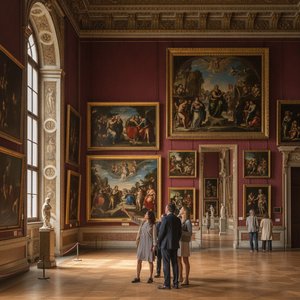
25 chefs-d'œuvre incontournables à la Gallerie dell'Accademia de Venise
Plongez dans l'âme de Venise à travers 25 chefs-d'œuvre de la Gallerie dell'Accademia. De Tintoretto à Bellini, explorez l'éclat de la Renaissance et trouvez l'inspiration pour vos reproductions d'art de luxe. Découvrez tous les chefs-d'œuvre sur OriginalUniqueArt.com.