Early Renaissance · 1461
Triptych (Nicolas Froment, 1461)
Nicolas Froment (1430–1484) a réalisé Triptych. Elle date de 1461. Il appartient au mouvement Early Renaissance. Réalisée en Huile sur panneau. Il est conservé au Galerie des Offices à Florence, Italie. Ses dimensions sont 134 × 175 cm.
- 1461
- Huile sur panneau
- 134 × 175 cm
- Galerie des Offices, Florence

 Aperçu en situation

 Peinture à l'huile faite main
 Envoyer
 Partager
 Fiche pédagogique


 Télécharger l'image
 Articles similaires
 Radiographie
 Diaporama
 Questions et réponses

 Statistiques
Triptych, en bref
- Titre
- Triptych
- Artiste
- Nicolas Froment (1430–1484)
- Lieu de naissance de l'artiste
- Uzès, France
- Date
- 1461
- Technique
- Huile sur panneau
- Dimensions
- 134 × 175 cm
- Où le voir
- Galerie des Offices, Florence, Italie
- Mouvement
- Early Renaissance
- Période
- Renaissance
Que représente Triptych ?
A Divine Narrative in Wood and Pigment
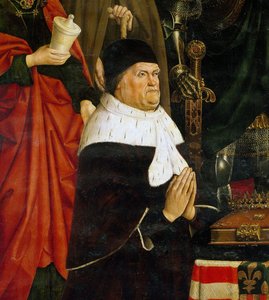
Behold this magnificent triptych, a profound meditation on the life of Jesus Christ, executed by the master hand of Nicolas Froment in 1461. This work is not merely a depiction; it is a devotional journey across three pivotal moments of Christian history—the serene beginnings, the agonizing sacrifice, and the triumphant dawn of resurrection. The sheer narrative scope contained within these panels invites the viewer into an intimate dialogue with sacred storytelling. From the gentle glow surrounding the Nativity scene in the first panel, where Mary cradles the infant Jesus amidst shepherds and angels, to the dramatic tension etched into the crucifixion tableau, and finally to the radiant emergence from the tomb, each segment pulses with untold human drama and divine mystery.
Mastery of the Early Renaissance Style
Nicolas Froment stands at a fascinating crossroads in art history—a painter whose work beautifully bridges the lingering grace of the Gothic tradition with the burgeoning naturalism whispered by Flemish influences. His technique, characteristic of the Second School of Avignon, allows for an astonishing level of detail while maintaining a spiritual resonance. Observe the figures: they are not static icons but breathing participants. The drapery falls with convincing weight, and the faces carry distinct, palpable emotions—a mixture of awe, sorrow, piety, and wonder. This commitment to naturalism, coupled with the vibrant palette achieved through meticulous hand-painting, gives the entire piece an immediate, almost tangible presence that transcends its age.
Symbolism and Emotional Resonance
The symbolism woven throughout this triptych is rich and deeply layered. The progression from birth to death to resurrection encapsulates the core tenets of Christian faith—the cycle of sacrifice leading inevitably to eternal life. Each figure, whether a Roman soldier, a grieving disciple, or an angelic messenger, carries symbolic weight. For the modern collector or decorator, owning such a piece means acquiring more than just art; it is acquiring a focal point for contemplation and spiritual reflection. The vibrant colors are employed not just for beauty, but to heighten the emotional stakes of each scene, drawing the eye through the narrative arc.
A Statement Piece for Any Grand Interior
Measuring 175 x 134 cm, this triptych possesses a commanding presence. It is designed to anchor a significant space—perhaps a grand hall, a library, or a chapel-inspired room. While the original wood paneling speaks of centuries of history, acquiring a high-quality reproduction allows you to integrate this monumental piece of art into your contemporary décor with confidence. The depth and complexity of Froment’s vision ensure that it will remain a captivating centerpiece, drawing admiration for its masterful execution and profound subject matter.
Dans quel musée se trouve Triptych ?
Galerie des Offices
Florence, Italie
L'Histoire et les Origines de la Galerie des Offices Nichée au cœur même de Florence, en Italie, la Galerie des Offices est une institution dont les racines plongent dans l'histoire profonde de la Renaissance. L'édifice fut initialement conçu en 1560 par Giorgio Vasari pour accueillir les magistrats florentins. La construction de cette structure imposante s'est étalée entre 1560 et 1580, période durant laquelle ces bureaux administratifs furent érigés pour centraliser les divers comités et agences du gouvernement de la cité.


Images haute résolution de Triptych

Domaine public : l'artiste est décédé en 1484.
Autres formats, recadrages et citations →Nicolas Froment, Triptych (1461), Galerie des Offices. Domaine public
Questions sur Triptych, réponses
Où peut-on voir «Triptych» de Nicolas Froment actuellement ?
Vous pouvez admirer l'original de « Triptych » au Galerie des Offices, Florence, Italie.
En quelle année «Triptych» de Nicolas Froment a-t-il été créé ?
«Triptych» de Nicolas Froment a été créé en 1461.
Quelle est la technique utilisée pour «Triptych» de Nicolas Froment ?
« Triptych » est réalisé en Huile sur panneau.
Quelles sont les dimensions réelles de «Triptych» de Nicolas Froment ?
Les dimensions enregistrées de «Triptych» de Nicolas Froment sont 175 x 134 cm. Des reproductions peuvent être commandées dans d'autres formats tout en conservant les mêmes proportions.
L'œuvre « Triptych » est-elle dans le domaine public ?
«Triptych» de Nicolas Froment est dans le dans le domaine public - ses droits d'auteur sont tombés dans le domaine public. Ce statut régit les modalités de reproduction de l'image de l'œuvre.
Qui est l'auteur de "Triptych" ?
« Triptych » a été créé par Nicolas Froment. Les informations présentes sur cette page décrivent l'œuvre originale de Nicolas Froment.
À quel mouvement artistique appartient « Triptych » ?
«Triptych» de Nicolas Froment appartient au mouvement Early Renaissance. Ce mouvement apporte le contexte stylistique de l'œuvre.
À quelle période de la carrière de Nicolas Froment se situe « Triptych » ?
«Triptych» appartient à la période Early Renaissance de la carrière de Nicolas Froment. Cette classification relie l'œuvre à l'évolution de l'artiste.
Quel âge avait Nicolas Froment lors de la création de « Triptych » en 1461 ?
Lorsque « Triptych » a été créé en 1461, Nicolas Froment — né(e) en 1430 — était âgé(e) de 31 ans.
À propos de l'artiste, Nicolas Froment
1430–1484, France
Nicolas Froment
Nicolas Froment : Un écho flamand dans la Provence de la première Renaissance Nicolas Froment (v. 1435 – v. 1486) s'impose comme une figure charnière de la deuxième école d'Avignon, marquant un tournant crucial entre la tradition gothique et l'essor du naturalisme flamand dans l'art français du XVe siècle. Né à Uzès, en France, la trajectoire artistique de Froment a coïncidé avec une époque profondément marquée par le patronage papal et l'attrait des idéaux de la Renaissance italienne — une dynamique qui a nourri l'expérimentation stylistique et a finalement consolidé sa place parmi les peintres les plus célébrés de Provence.
À propos de Nicolas Froment Œuvres notables de Nicolas Froment
Autres œuvres de Nicolas Froment
 The Burning Bush (detail)1476
 Matheron Diptych1474
 La Résurrection de Lazare1461
 Le Retable des Pérussis1480

Essais sur Triptych
 Le Mur Signature : Maîtriser l'Art Monumental pour vos Espaces de PrestigeMaîtrisez l'art monumental pour sublimer vos espaces de prestige. Découvrez l'expertise du design architectural par l'échelle et la texture.
 Les 25 chefs-d'œuvre de Rogier van der Weyden : l'art de l'émotionExplorez les 25 chefs-d'œuvre de Rogier van der Weyden et la Renaissance flamande. Découvrez toute la collection sur OriginalUniqueArt.com.
 Les 25 chefs-d'œuvre de Giotto di Bondone : le père de la RenaissancePlongez dans l'univers de Giotto di Bondone, le père de la Renaissance. Explorez 25 chefs-d'œuvre révolutionnaires entre naturalisme et émo…