Aperçu en situation
 Partager
 Partager
 Détails
 Guide imprimable

 Télécharger
 Articles similaires
 Radiographie
 Voir le diaporama
 Statistiques
Donor
 Oil
Oil- WallArt
- Early Netherlandish Renaissance
 1490
1490- Renaissance
 45.0 x 32.0 cm
 Muzeul Național de Artă
 Afficher la suite
Giclées et impressions d'art
Impressions giclées ou sur toile de qualité musée, avec une production rapide et des finitions au choix. ( Acheter la peinture faite à la main Passer au format image numérique)




P118B $10

P118H $10

P118W $10

P438Z $10

P508JH $12

P508YH $12

P805H $10

P805Z $10

P919BZ $10

P919G $10

P919XJ $10

P959ZH $10

P968JZ $12

W106C $8

W218G $10

W218JH $8

W218Y $10

W307PJ $10

W316G $10

W316PJ $8

W316Y $10

W398PJ $8

W4111J $10

W500HY $15

W500JH $15

W692G $12

W849H $8

W940BG $15

W953PJ $8




Choisissez parmi nos formats prédéfinis qui respectent les proportions originales de l’œuvre.

Vous pouvez saisir vos propres dimensions pour vous adapter à un cadre ou à un espace spécifique. Si la taille sélectionnée ne correspond pas aux proportions de l'image originale, nous recadrerons l'œuvre ou étendrons l'image avec une bordure en miroir ou une couleur unie. Une maquette numérique vous sera envoyée pour approbation avant le début de la production.
Veuillez noter que l'aperçu à l'écran ne reflète pas le recadrage ou l'extension réelle. Seule la maquette montrera avec précision la composition finale.
Bien que des tailles personnalisées soient disponibles, nous vous recommandons de choisir une dimension dans la liste prédéfinie afin de préserver les proportions originales.
Livraison dans le monde entier () en 2 semaines au lieu des 4/5 semaines habituelles. (26 septembre)

Livraison express gratuite dans le monde entier

Toile de lin de haute qualité

Assurance transport complète

Garantie de remboursement des droits de douane

Garantie de fidélité des couleurs

Garantie de retour de 100 jours (uniquement en cas de défaut)

Garantie de remboursement à 100%

Tarifs dégressifs sur quantité
 L'option verre n'est disponible que pour les dimensions inférieures à 110 cm.

Donor
Giclées et impressions d'art
Format de la reproduction
-


Prix total final
$ 80
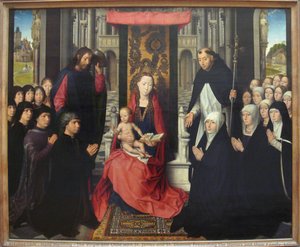
A Window into the Soul: The Devotion of Hans Memling’s Donor
In the quiet, luminous world of the Northern Renaissance, few works capture the intersection of earthly dignity and spiritual yearning as poignantly as Hans Memling’s “Donor.” Created around 1490, this masterpiece serves as more than a mere portrait; it is an intimate encounter with a soul in contemplation. The painting presents a dignified man seated with a profound sense of presence against a muted, atmospheric backdrop. He holds an open book—a gesture that transcends simple literacy to suggest a deep engagement with divine wisdom. Flanked by two figures who lend a sense of communal sanctity to the scene, the composition draws the viewer into a sacred circle, where the boundaries between the observer and the observed begin to dissolve.
The technical brilliance of Memling, often celebrated as the master of Bruges, is on full display through his command of the Early Netherlandish style. This period was defined by an unparalleled realism, achieved through the painstaking application of oil glazes. In “Donor,” one can almost feel the texture of the man’s dark robes and the subtle, shimmering light that dances across the pages of his book. Memling utilized a meticulous process of layering and blending to create surfaces that possess a jewel-like luminosity. This technique does not merely replicate physical likeness; it imbues the subject with an inner radiance, making the skin appear supple and the atmosphere feel heavy with the stillness of prayer.
Symbolism and the Spirit of the Burgundian Renaissance
To gaze upon this work is to read a silent sermon. Every element within the frame is steeped in the symbolic language of the late 15th century. The open book held by the donor is a powerful emblem of divine illumination, representing the humanist pursuit of knowledge intertwined with Christian piety. It suggests an intellect that is open to the light of God, a theme central to the burgeoning Renaissance spirit. The flanking figures act as silent guardians, perhaps representing the intercession of saints or the support of a community of faith, reinforcing the donor's moral virtue and his place within the cosmic order.
Historically, this piece emerged from the cosmopolitan splendor of Bruges, a hub of trade and artistic patronage during the Burgundian Renaissance. This was an era where art served as a bridge between the material wealth of the merchant class and the eternal promises of the Church. For the modern collector or interior designer, bringing a reproduction of “Donor” into a space offers more than just aesthetic beauty; it introduces an aura of serenity, intellectual depth, and timeless reverence. It is a piece that commands attention not through loud colors, but through a quiet, commanding grace that invites long periods of reflection and provides a sophisticated focal point for any curated collection.
Biographie de l'artiste
Hans Memling : Le Maître de Bruges, entre Détail et Mécénat
Hans Memling (v. 1430 – 11 août 1494), né à Seligenstadt en Allemagne, s'impose comme une figure charnière de la peinture flamande primitive — un mouvement défini par un réalisme exquis, une observation méticuleuse de la nature et une profonde contemplation spirituelle. Bien que ses années de formation se soient déroulées principalement au sein du milieu artistique de la Rhénanie, la trajectoire de Memling l'a finalement conduit à Bruges, en Belgique. C'est là qu'il s'est imposé comme l'un des artistes les plus éminents de son époque, développant un atelier prolifique qui a diffusé son style distinctif à travers toute l'Europe.- Jeunesse et Apprentissage : Les détails biographiques précis entourant la naissance de Memling demeurent insaisissables, bien que le consensus des chercheurs suggère qu'il soit issu de Mayence vers 1430. Son éducation artistique débuta sous la tutelle de Rogier van der Weyden, un titan de la peinture flamande dont la maîtrise de la peinture à l'huile et du modelé sculptural a profondément façonné la technique de Memling. Cet apprentissage lui a inculqué un dévouement inébranlable au détail — une marque de fabrique qui allait définir son œuvre entière.
- Bruges et l'Atelier : Dès 1465, Memling obtint la citoyenneté de Bruges, alors centre commercial florissant et épicentre artistique. Reconnaissant le potentiel d'une créativité collaborative, il fonda un atelier composé de nombreux assistants, favorisant un environnement d'innovation et de cohérence stylistique. Cet atelier devint célèbre pour la production de reproductions éblouissantes de chefs-d'œuvre — véritable témoignage du talent de Memling tant en tant qu'artiste que pédagogue.
- Commandes Religieuses : La réputation de Memling s'est envolée grâce à des commandes lucratives provenant de riches mécènes — principalement des membres du clergé et des familles aristocratiques — qui recherchaient des représentations de saints et de récits bibliques faisant écho à la piété et au prestige. Parmi les exemples notables, citons « Le Jugement Dernier » à l'Hôpital Saint-Jean de Bruges, une fresque monumentale illustrant les compétences magistrales de Memling en composition et son usage dramatique de la couleur.
- Le Portrait : Memling excella en tant que portraitiste, capturant la ressemblance de figures éminentes avec une sensibilité et une intuition psychologique remarquables. Ses portraits — tels que le « Portrait d'un homme avec une flèche » — démontrent sa capacité à transmettre le caractère par des gestes subtils et des expressions faciales, une compétence qui a scellé sa place parmi les plus grands artistes de son ère.
Redécouverte et Popularité Éternelle
Les prouesses artistiques de Memling furent largement oubliées jusqu'au XIXe siècle, lorsque des érudits redécouvrirent ses peintures et célébrèrent son génie. Aujourd'hui, les œuvres de Memling — en particulier « Le Jugement Dernier » — continuent de captiver le public mondial, faisant office de symboles durables de l'excellence artistique et de la contemplation spirituelle. Son attention méticuleuse aux détails et sa compréhension profonde de la psychologie humaine demeurent remarquablement pertinentes dans notre appréciation contemporaine de l'histoire de l'art.
Hans Memling
Allemagne
En bref
- Artistic Movement Or Style: Peinture flamande précoce
- Artists Or Movements Influenced By This Artist: ["École d'Anvers"]
- Artists Who Influenced This Artist: ['Rogier van der Weyden']
- Date Of Birth: c. 1430
- Date Of Death: August 11, 1494
- Full Name: Hans Memling
- Nationality: Allemand-Flamand
- Notable Artworks:
- Saint Jean Autel
- Les Jugements Derniers
- Scènes de la Passion
- Place Of Birth: Seligenstadt, Germany
Articles similaires

L'Éclosion du Réalisme : La Peinture de l'Ancienne-Néerlande (XVe-XVIe Siècles) – Un Essai d'Histoire de l'Art
Explorez l'éclosion du réalisme néerlandais (XVe-XVIe siècles) avec notre analyse approfondie des Primitifs Flamands : Van Eyck, Campin et van der Weyden. Découvrez leur technique révolutionnaire et le symbolisme subtil de leurs œuvres.

L'Huile sur Toile : Exploration Historique et Technique d'un Médium Artistique Intemporel
Explorez l'histoire fascinante de la peinture à l'huile, des techniques ancestrales aux maîtres flamands comme Van Eyck. Découvrez les secrets des pigments, liants et glacis pour comprendre cet art intemporel.

The Enduring Legacy of Oil on Canvas: Technique, History & Aesthetic Impact
Explore the rich history & techniques of oil painting – from Renaissance masters to Impressionism. Discover pigments, layering methods, and why this timeless medium endures. Expert insights for artists & art enthusiasts.

Illuminating Realism: A Comprehensive Exploration of the Early Netherlandish Renaissance Movement
Explore the captivating world of Early Netherlandish painting! Discover Jan van Eyck & other Flemish masters, their revolutionary techniques, hidden symbolism, and lasting legacy. A comprehensive guide for art enthusiasts.
L'Éclosion du Réalisme : Innovation et Spiritualité dans la Peinture des Anciens Pays-Bas (XVe-XVIe siècles)
Explorez l'éclosion du réalisme dans la peinture des Anciens Pays-Bas (XVe-XVIe siècles). Découvrez Jan van Eyck, Hans Memling et le symbolisme fascinant de leurs œuvres. Analyse approfondie par des experts.