Aperçu en situation
 Envoyer
 Partager
 Détails de l'œuvre
 Guide
Guide

 Télécharger l'image
 Articles similaires
 Radiographie
 Diaporama
 Q&A
Q&A Statistiques
Crucifixion
 Huile sur toile
- Décoration murale
- Early Netherlandish painting
 Bas Moyen Âge
 56.0 x 63.0 cm
 Musée des Beaux-Arts de Budapest
 Lire la suite
L’œuvre d'art présentée sur cette page est protégée par le droit d'auteur, ce qui signifie que nous ne pouvons légalement créer ou vendre de reproduction identique. Cette protection est appliquée en vertu d'accords internationaux tels que la Convention de Berne et par les lois nationales, notamment celles énoncées par le Loi américaine sur le droit d'auteur - Titre 17.
Cette méthode est pleinement conforme aux réglementations sur le droit d'auteur car elle ne repose pas sur la copie ou la duplication de l'œuvre protégée. Il s'agit plutôt d'une réinterprétation créative — une nouvelle peinture qui s'inspire de l'original sans pour autant lui être identique.
Giclées et impressions d'art
Impressions giclées ou sur toile de qualité musée, avec une production rapide et des finitions au choix. ( Commander la reproduction peinte à la main Passer au format numérique)




P118B €10

P118H €10

P118W €10

P438Z €10

P508JH €12

P508YH €12

P805H €10

P805Z €10

P919BZ €10

P919G €10

P919XJ €10

P959ZH €10

P968JZ €12

W106C €8

W218G €10

W218JH €8

W218Y €10

W307PJ €10

W316G €10

W316PJ €8

W316Y €10

W398PJ €8

W4111J €10

W500HY €15

W500JH €15

W692G €12

W849H €8

W940BG €15

W953PJ €8




Choisissez parmi nos formats prédéfinis qui respectent les proportions originales de l’œuvre.

Saisissez la largeur et la hauteur souhaitées pour qu'elles s'adaptent à votre cadre ou à votre mur. Une impression peut être recadrée, mais jamais agrandie au-delà de l'image originale ; ainsi, un format de forme différente entraînera la perte d'une partie de l'image. Nous vous envoyons une maquette numérique pour approbation avant toute impression. L'image présentée sur cette page ne montre pas le recadrage réel — seule la maquette le permet.
Livraison dans le monde entier () en 2 semaines au lieu des 4/5 semaines habituelles. (29 octobre)

Livraison express gratuite dans le monde entier

Toile de lin de qualité supérieure

Assurance transport complète

Garantie de remboursement des droits de douane

Garantie de fidélité des couleurs

Politique de retour de 100 jours (uniquement en cas de défaut)

Garantie de remboursement à 100%

Offre de tarifs dégressifs
 L'option verre n'est disponible que pour les dimensions inférieures à 110 cm.

Crucifixion
Giclées et impressions d'art
Format de la reproduction
-


Prix total
€ 71
The Profound Drama of Sacrifice
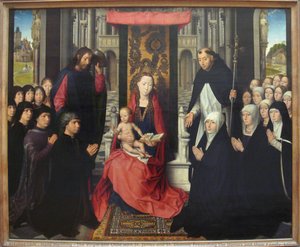
To stand before Hans Memling’s depiction of the Crucifixion is to be enveloped in an atmosphere thick with solemnity and profound human drama. This painting does not merely record a historical event; it captures a moment suspended between agony and ultimate redemption. The central focus, of course, remains upon Christ nailed to the cross, his outstretched arms forming a universal gesture of sacrifice. Yet, Memling’s genius lies in how he frames this monumental tragedy within a richly populated scene. One is immediately drawn into the tableau by the surrounding figures—the onlookers whose varied postures suggest a spectrum of human reaction, from detached curiosity to deep, palpable grief. The inclusion of elements like the horses and the visible knife grounds the divine narrative in tangible, earthly reality, lending an almost immediate immediacy to the viewer’s experience.
Mastery of Early Netherlandish Detail
Hans Memling, the celebrated Bruges Master, was renowned for his exquisite realism and meticulous attention to detail, hallmarks of the Early Netherlandish school. In this work, that mastery shines through in every fold of medieval clothing and every gesture captured by the surrounding crowd. His technique, deeply influenced by the luminous quality of oil paint, allows light to interact with textures—the rough wood of the cross, the drape of a cloak, the sheen on a horse’s coat—with breathtaking verisimilitude. This commitment to observable reality elevates the spiritual subject matter, inviting contemplation through sheer visual perfection. The composition is carefully balanced, guiding the eye across the narrative while ensuring that no single element, from the foreground figures to the background horses, feels extraneous.
Symbolism and Emotional Resonance
Beyond the technical brilliance lies a deep well of symbolism. The Crucifixion itself is the apex of Christian iconography, representing ultimate sacrifice. Memling handles this weighty subject with an almost tender empathy. The presence of multiple witnesses transforms the scene from a singular martyrdom into a universal human experience—a moment where faith, doubt, curiosity, and sorrow converge. For the modern collector or decorator, owning such a piece is acquiring not just art, but a meditation object. It speaks to enduring themes of suffering, devotion, and the enduring power of belief, lending an air of contemplative gravitas to any space it graces.
A Timeless Piece for Contemplative Spaces
The muted tones and rich depth characteristic of Memling’s palette ensure that this artwork possesses a timeless quality. It is a piece designed not merely to be looked at, but to be absorbed. Whether placed in a formal study, a chapel-inspired living area, or an intimate gallery setting, its narrative power remains undiminished. Reproducing the detail and emotional weight of this 56 x 63 cm masterpiece allows one to bring home a segment of profound historical artistry—a visual anchor for moments of reflection and deep thought.
Questions et réponses
L'artiste Hans Memling, créateur de « Crucifixion », est-il connu sous d'autres noms ?
Hans Memling est également connu sous les noms suivants : Memlinc.
Quels sont les droits de reproduction pour « Crucifixion » au Musée des Beaux-Arts de Budapest ?
«Crucifixion» de Hans Memling, conservée au Musée des Beaux-Arts de Budapest, est dans le toujours protégé par le droit d'auteur. Ce statut détermine si des reproductions de l'image peuvent être réalisées.
Quelle émotion «Crucifixion» de Hans Memling dégage-t-il ?
L'atmosphère qui se dégage de «Crucifixion» de Hans Memling est Dramatique, et sa tonalité émotionnelle est Sombre et grave.
Biographie de l'artiste
Hans Memling : Le Maître de Bruges, entre Détail et Mécénat
Hans Memling (v. 1430 – 11 août 1494), né à Seligenstadt en Allemagne, s'impose comme une figure charnière de la peinture flamande primitive — un mouvement défini par un réalisme exquis, une observation méticuleuse de la nature et une profonde contemplation spirituelle. Bien que ses années de formation se soient déroulées principalement au sein du milieu artistique de la Rhénanie, la trajectoire de Memling l'a finalement conduit à Bruges, en Belgique. C'est là qu'il s'est imposé comme l'un des artistes les plus éminents de son époque, développant un atelier prolifique qui a diffusé son style distinctif à travers toute l'Europe.- Jeunesse et Apprentissage : Les détails biographiques précis entourant la naissance de Memling demeurent insaisissables, bien que le consensus des chercheurs suggère qu'il soit issu de Mayence vers 1430. Son éducation artistique débuta sous la tutelle de Rogier van der Weyden, un titan de la peinture flamande dont la maîtrise de la peinture à l'huile et du modelé sculptural a profondément façonné la technique de Memling. Cet apprentissage lui a inculqué un dévouement inébranlable au détail — une marque de fabrique qui allait définir son œuvre entière.
- Bruges et l'Atelier : Dès 1465, Memling obtint la citoyenneté de Bruges, alors centre commercial florissant et épicentre artistique. Reconnaissant le potentiel d'une créativité collaborative, il fonda un atelier composé de nombreux assistants, favorisant un environnement d'innovation et de cohérence stylistique. Cet atelier devint célèbre pour la production de reproductions éblouissantes de chefs-d'œuvre — véritable témoignage du talent de Memling tant en tant qu'artiste que pédagogue.
- Commandes Religieuses : La réputation de Memling s'est envolée grâce à des commandes lucratives provenant de riches mécènes — principalement des membres du clergé et des familles aristocratiques — qui recherchaient des représentations de saints et de récits bibliques faisant écho à la piété et au prestige. Parmi les exemples notables, citons « Le Jugement Dernier » à l'Hôpital Saint-Jean de Bruges, une fresque monumentale illustrant les compétences magistrales de Memling en composition et son usage dramatique de la couleur.
- Le Portrait : Memling excella en tant que portraitiste, capturant la ressemblance de figures éminentes avec une sensibilité et une intuition psychologique remarquables. Ses portraits — tels que le « Portrait d'un homme avec une flèche » — démontrent sa capacité à transmettre le caractère par des gestes subtils et des expressions faciales, une compétence qui a scellé sa place parmi les plus grands artistes de son ère.
Redécouverte et Popularité Éternelle
Les prouesses artistiques de Memling furent largement oubliées jusqu'au XIXe siècle, lorsque des érudits redécouvrirent ses peintures et célébrèrent son génie. Aujourd'hui, les œuvres de Memling — en particulier « Le Jugement Dernier » — continuent de captiver le public mondial, faisant office de symboles durables de l'excellence artistique et de la contemplation spirituelle. Son attention méticuleuse aux détails et sa compréhension profonde de la psychologie humaine demeurent remarquablement pertinentes dans notre appréciation contemporaine de l'histoire de l'art.
Hans Memling
Allemagne
L'essentiel de l'artiste
- Artistic Movement Or Style: Peinture flamande précoce
- Artists Or Movements Influenced By This Artist: ["École d'Anvers"]
- Artists Who Influenced This Artist: ['Rogier van der Weyden']
- Date Of Birth: c. 1430
- Date Of Death: August 11, 1494
- Full Name: Hans Memling
- Nationality: Allemand-Flamand
- Notable Artworks:
- Saint Jean Autel
- Les Jugements Derniers
- Scènes de la Passion
- Place Of Birth: Seligenstadt, Germany
Articles connexes

OriginalUniqueArt.com F.A.Q.: Elevate Your Decor with Premium Textured Giclée Prints
Discover the distinction of OriginalUniqueArt.com premium textured Giclée prints. Expertly crafted with archival 12-color pigments and museum-grade substrates, our prints offer unparalleled vividness for the discerning collector seeking luxury, durability, and timeless elegance.