 Aperçu en situation
 Envoyer
 Partager
 Détails de l'œuvre

 Télécharger
 Articles similaires
 Radiographie
 Diaporama
Samson and Delilah


 Lire la suite
Reproduction à l'huile faite à la main
Huile sur toile peinte à la main, avec cadre et dimensions personnalisés, réalisée sur commande par nos artistes. ( Commander l'impression Télécharger l'image haute résolution)




P118B $10

P118H $10

P118W $10

P438Z $10

P508JH $12

P508YH $12

P805H $10

P805Z $10

P919BZ $10

P919G $10

P919XJ $10

P959ZH $10

P968JZ $12

W106C $8

W218G $10

W218JH $8

W218Y $10

W307PJ $10

W316G $10

W316PJ $8

W316Y $10

W398PJ $8

W4111J $10

W500HY $15

W500JH $15

W692G $12

W849H $8

W940BG $15

W953PJ $8




Choisissez parmi nos formats prédéfinis qui respectent les proportions originales de l’œuvre.

Vous pouvez saisir vos propres dimensions pour l'adapter à un cadre ou à un espace spécifique. Si la taille sélectionnée ne correspond pas aux proportions de l'image d'origine, nous recadrerons l'œuvre ou prolongerons la peinture avec des éléments peints à la main supplémentaires. Une maquette numérique vous sera envoyée pour approbation avant le début de la production.
Veuillez noter que l'aperçu à l'écran ne reflète pas le recadrage ou l'extension réels. Seule la maquette montrera fidèlement la composition finale.
Bien que des tailles personnalisées soient disponibles, nous vous recommandons de sélectionner une dimension dans la liste prédéfinie afin de préserver les proportions d'origine.
Après la commande, l’équipe OriginalUniqueArt.com contactera le client par e-mail pour recueillir ses instructions et lui fournira une maquette d’aperçu
Livraison dans le monde entier () en 3 à 4 semaines au lieu des 5 semaines habituelles. (19 août). Aucun compromis sur la qualité.

Livraison express gratuite dans le monde entier

Toile de lin de qualité supérieure

Assurance transport complète

Garantie de remboursement des droits de douane

Garantie de fidélité des couleurs

Politique de retour de 60 jours (uniquement en cas de défaut)

Garantie de remboursement à 100%

Offre de tarifs dégressifs
 L'option verre n'est disponible que pour les dimensions inférieures à 110 cm.

Samson and Delilah
Technique de reproduction
Format de la reproduction
-


Prix total
$ 300
Description de l'œuvre
The Genesis of a Dramatic Narrative
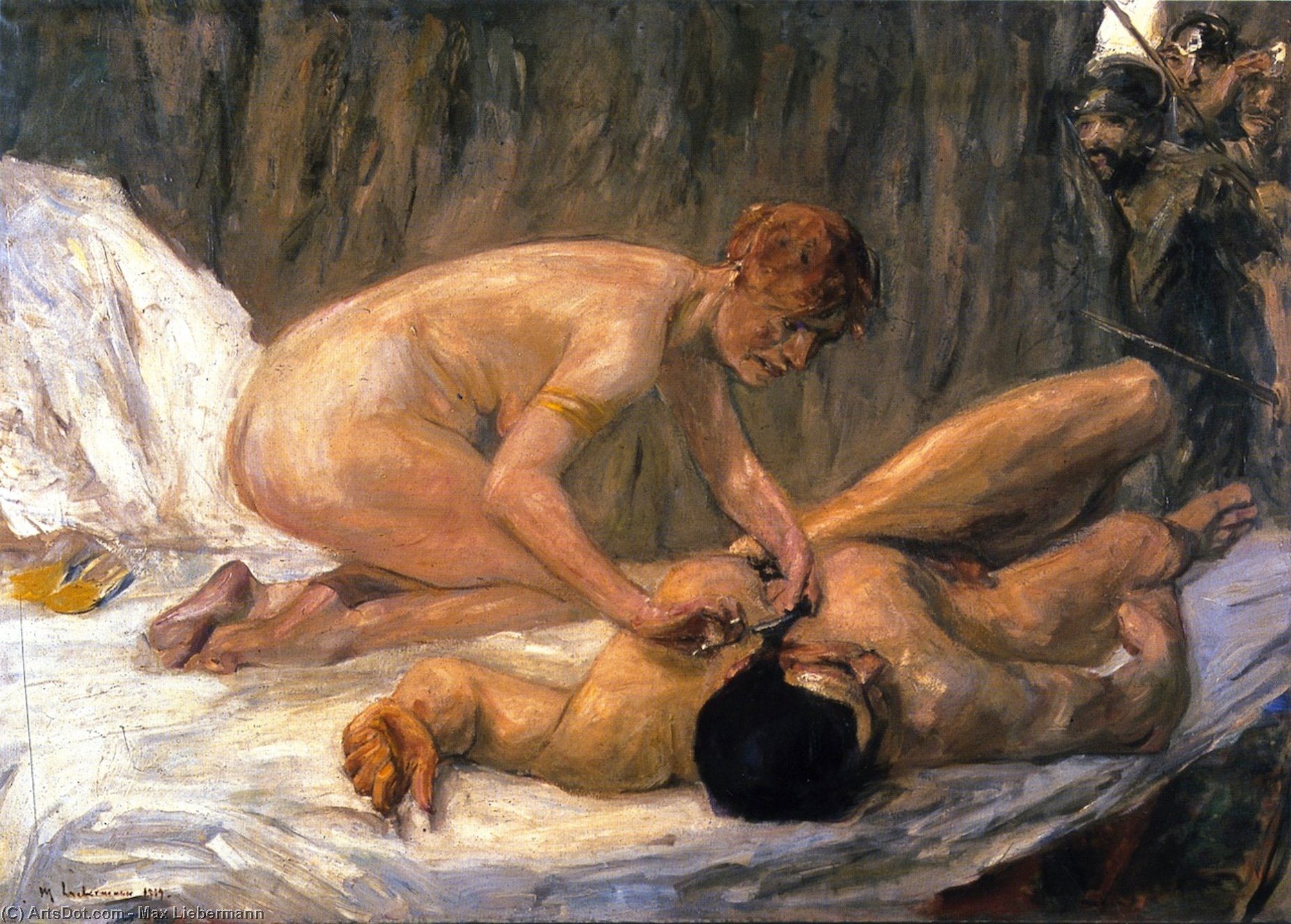
Max Liebermann’s “Samson and Delilah” isn't merely a depiction of a biblical tale; it’s a carefully constructed tableau brimming with psychological tension, a potent exploration of desire, betrayal, and the shifting power dynamics between men and women. Painted in 1910, during a period of significant artistic ferment in Germany, the work stands as a testament to Liebermann's ability to infuse historical narratives with his own distinctive brand of realism and subtle emotionalism. The story itself – the tale of Samson’s downfall at the hands of Delilah, who seduces him to reveal his secret strength – is ripe with symbolism, offering fertile ground for an artist seeking to dissect human nature.
A Study in Light and Shadow: Liebermann's Technique
Liebermann, a key figure within the German Impressionist movement, employed a technique that skillfully blended elements of realism with the fleeting effects of light. “Samson and Delilah” exemplifies this approach. The composition is rendered with a deliberate flatness, reminiscent of early Impressionism, yet imbued with a meticulous attention to detail. Liebermann’s brushstrokes are visible, creating a textured surface that invites close examination. He masterfully utilizes light – predominantly diffused and atmospheric – to sculpt the figures and define their forms. Notice how the shadows subtly emphasize the vulnerability of Samson, while Delilah's presence is marked by a cool, almost predatory luminescence. The color palette is restrained, dominated by earthy tones—ochres, browns, and greys— punctuated by flashes of red in Delilah’s attire, drawing the eye to her central role.
The Figures: A Dance of Power and Deception
The painting's strength lies not just in its technical execution but also in the nuanced portrayal of its two protagonists. Samson, depicted as a powerfully built man, is rendered with a quiet vulnerability—a sense of impending doom etched onto his face. His nakedness isn’t overtly provocative; rather, it underscores his exposed state, both physically and emotionally. Delilah, on the other hand, is presented with a calculated elegance, her gaze direct and alluring. She's not portrayed as a villainess in the traditional sense but as a woman of agency, actively shaping the narrative through her actions. The positioning of the figures—close together yet separated by an unspoken tension—heightens the drama and invites speculation about their motivations.
Contextualizing the Masterpiece: Liebermann's Berlin
To fully appreciate “Samson and Delilah,” it’s crucial to understand the artistic climate of Berlin in 1910. The city was a hub of innovation, with artists pushing boundaries and challenging established conventions. Liebermann himself was part of the Berlin Secession, a group that rejected the conservative traditions of the German art establishment. This period saw a growing interest in portraying modern life—particularly the lives of the bourgeoisie—and exploring themes of social commentary and psychological realism. “Samson and Delilah” reflects this shift, moving beyond purely mythological subjects to engage with more complex human relationships.
Beyond the Narrative: Emotional Resonance
Ultimately, "Samson and Delilah" transcends its biblical origins to become a timeless meditation on power, betrayal, and the seductive allure of deception. The painting’s enduring appeal lies in its ability to evoke a profound sense of unease and intrigue. It's not simply a story of a hero’s downfall but a poignant exploration of the vulnerabilities inherent in human relationships—a reminder that even the strongest among us can be undone by weakness, desire, and the calculated actions of another. It remains a powerful image, prompting viewers to contemplate the complexities of love, trust, and the consequences of our choices.
Biographie de l'artiste
Première Vie et Formation
- Né: Berlin, Allemagne (1847)
- Décédé: 1935
Carrière Artistique et Style
- Impressionnisme: Liebermann est devenu un fervent défenseur de l'impressionnisme en Allemagne, capturant des instants fugaces de la vie moderne avec une attention particulière à la lumière et à la couleur.
- Influences: Son style a été notablement influencé par Édouard Manet, se reflétant dans son esprit et son approche picturale.
- Motifs: Il représentait fréquemment des scènes de la bourgeoisie et des aspects de son jardin près du lac Wannsee.
- Portraitiste: Liebermann a acquis une renommée en tant que portraitiste talentueux, créant plus de 200 portraits commandés, dont ceux d'Albert Einstein et de Paul von Hindenburg.
Œuvres Notables et Réalisations
- "Jésus de douze ans au temple": Une œuvre précoce qui a suscité des débats en raison de sa représentation d'un garçon Jésus sémitique.
- Élection à l’Académie prussienne des arts: Une reconnaissance significative de son mérite artistique et de sa contribution.
- Direction de la Sécession berlinoise (1899-1911): Il a dirigé cette formation d'avant-garde majeure en Allemagne, remettant en question les normes artistiques traditionnelles.
Vie Ulérieure et Importance Historique
- Démission de l’Académie prussienne des arts: En 1933, il a démissionné suite à la décision de l'académie d'exclure les artistes juifs.
- Décès et Héritage: Il est décédé à Berlin en 1935, laissant derrière lui un corpus important d’œuvres qui continuent d’être célébrées pour leur style impressionniste et leur portrait perspicace de la société allemande.

Max Liebermann
1847 - 1935 , Allemagne
L'essentiel de l'artiste
- Artistes Influents: ['Édouard Manet']
- Date De Décès: 8 février 1935
- Date De Naissance: 20 juillet 1847
- Lieu De Naissance: Berlin, Allemagne
- Mouvement Artistique: Impressionnisme
- Mouvements Influencés: ['Sécession berlinoise']
- Nationalité: Allemande
- Nom Complet: Max Liebermann
- Oeuvres Notables:
- Le Jésus de douze ans au temple
- La Meuleuse
- Portrait d'Albert Einstein
Articles connexes

Max Ernst : Les 25 Œuvres Maîtresses d'un Surréalisme Révolutionnaire | OriginalUniqueArt
Plongez dans l'univers surréaliste de Max Ernst ! Découvrez les 25 œuvres les plus emblématiques du maître allemand, entre frottage, collage et rêves éveillés. Inspirez votre décoration intérieure avec OriginalUniqueArt : reproductions de tableaux de qualité muséale et collection d'art unique. Explorez la co

Expressionnisme Allemand : 10 Chefs-d'œuvre Révolutionnaires à Découvrir | OriginalUniqueArt
Plongez au cœur de l'Expressionnisme Allemand avec OriginalUniqueArt. Découvrez 10 chefs-d'œuvre de Kandinsky, Munch et Kirchner. Explorez l'histoire, les couleurs et l'émotion derrière ces tableaux iconiques. Reproductions de qualité muséale disponibles sur OriginalUniqueArt.com
Max Klinger: Symbolism, Science & the Subconscious – A German Master's Legacy
Explore the captivating world of Max Klinger, a pivotal German Symbolist artist. Discover his groundbreaking prints, psychological themes, & influence on modern art movements like Expressionism. Expert analysis and insights.

Anton von Werner: Imperial Painter, Historical Witness & Shifting German Identity
Explore the life & work of Anton von Werner, Imperial Germany's leading painter. Discover his dramatic depictions of war, unification, and court life – a fascinating insight into 19th-century German history & art.
The Northern Awakening: Artistic Innovation & Cultural Transformation in the German Renaissance
Explore the artistic innovation of the German Renaissance! Discover Dürer, the Danube School & Reformation art. Learn about techniques, materials & lasting influence. Find museum-quality reproductions at OriginalUniqueArt.