Lire la suite







































 Pour les œuvres ou reproductions dont un côté mesure plus de 105 cm (environ 41 pouces), le cadre sera expédié sous forme de kit démonté. Cette méthode garantit une livraison sécurisée et prévient tout dommage pendant le transport.


A Fractured Urban Vision
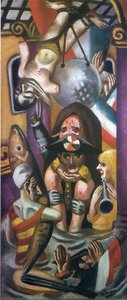
The city breathes with a heavy, unsettling rhythm in Sinagoga. Buildings lean inward, their sharp, angular forms slicing through a sky that feels thick with tension. There is no steady horizon here; instead, the architecture twists and tilts, defying the logic of gravity and space. A central pathway pulls the eye into a depth that feels strangely shallow, as if the world is being compressed into a claustrophobic dream. The warmth of the palette—deep reds, burnt oranges, and earthy browns—does not offer comfort. Instead, it radiates a feverish heat, a sense of simmering anxiety that clings to every surface. A dog occupies the foreground, a silent witness to this distorted landscape, while small, distant figures move through the shadows of the towering structures, appearing insignificant against the weight of the stone and geometry.
The Language of Distortion
The artist employs a visual language that rejects the comfort of realism to reach for a deeper, more subjective truth. The composition is a complex web of intersecting planes and heavy outlines that push the viewer into an uncomfortable proximity with the scene. Through a masterful application of oil paint, the surfaces possess a palpable weight, where thick, gestural strokes meet smoother, blended areas to create a sense of layered history.
- The use of multiple vanishing points creates a disorienting, non-linear perspective.
- Sharp, diagonal lines introduce a constant sense of instability and movement.
- Geometric shapes like rectangles and triangles are rearranged to emphasize a fractured reality.
- A muted, somber quality in the color transitions suggests a mood of profound introspection.
The Weight of Existence
In this work, the urban environment becomes a stage for the human condition. The presence of the Synagogue suggests a landscape shaped by identity and the heavy shadows of social reality. The distortion of the buildings feels less like a stylistic choice and more like a reflection of a fractured world, where the very foundations of society seem to tilt and buckle. This is the essence of Expressionism, where the external world is bent and broken to mirror an internal state of alienation and unease. The scene does not offer a window into a place, but rather a mirror to a feeling of profound displacement, leaving the viewer to navigate a space where nothing is quite as it seems.
Questions et réponses
Est-ce que Sinagoga est peint à la main ou est-ce une impression ?
Peint à la main : un peintre professionnel reproduit Sinagoga à l'huile sur une toile en lin.
Quelle taille choisir pour Sinagoga ?
Les tailles vont de 25.2 x 39.6 cm (€202) à 154.1 x 242.2 cm (€1285) ; le tableau sur cette page présente les principales étapes et leurs prix respectifs.
Quel est le délai de livraison ?
La livraison prend 4 à 5 semaines, avec une expédition express mondiale gratuite ; une option de production urgente est proposée sur cette page. Vous pouvez la retourner sous 100 jours pour un remboursement intégral, sans condition.
Où se trouve l'original de Sinagoga ?
L'original fait partie de la collection du Städel Museum, à Francfort.
Quelle technique Max Beckmann a-t-il utilisée pour Sinagoga ?
Oil On Canvas
 Aperçu en situation

 Envoyer
 Partager
 Détails de l'œuvre
 Guide


 Télécharger l'image
 Articles similaires
 Radiographie
 Diaporama
 Questions et réponses

 Statistiques