Édition à l'huile
 Tout sur Self-portrait







































 Pour les œuvres ou reproductions dont un côté mesure plus de 105 cm (environ 41 pouces), le cadre sera expédié sous forme de kit démonté. Cette méthode garantit une livraison sécurisée et prévient tout dommage pendant le transport.


Identification of the Self-Portrait
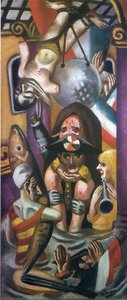
The artwork titled Self-portrait by the artist Max Beckmann presents a stark confrontation with the viewer. Created about 1901, this piece focuses entirely on the artist's own likeness. It is a black and white portrait that strips away the distractions of color to reveal the essential geometry of a face.
The composition offers a close-up view of the artist's face. Every line is a sharp boundary between light and shadow. The subject is positioned with a directness that leaves no room for evasion. It is a study of a man looking back through the grain of the print.
This monochromatic vision captures a moment of quiet intensity. The absence of hue forces the eye to settle on the structural weight of the features. A single gaze remains fixed.
Visual Composition and Style
The frame tightens around the head and shoulders, a close-up that leaves no room for distance. The subject sits slightly off-center, a deliberate asymmetry that disrupts a sense of stillness. Every feature is carved by a stark, graphic quality, stripped of the softness of color. It is a world of black and white tones, where light and shadow exist only through the density of a line.
Lines dominate this space. They are bold and angular, cutting through the composition to define the jaw, the eyes, and the heavy fabric of a jacket. This Expressionistic approach distorts the form to reach for an internal truth. The face is not a mere likeness but a construction of sharp edges and intersecting strokes. Shadows are not washes of grey but clusters of hatching that build depth through sheer repetition. The gaze is heavy, fixed, and unyielding.
The composition relies on the tension between these dark marks and the pale voids of the paper. There is no traditional perspective here, only the immediate, flat presence of the figure. The work rejects the illusion of deep space, choosing instead to push the subject toward the viewer through the weight of its graphic intensity. A quiet, monochromatic gravity remains.
Technique and Artistic Materials
The work emerges from the physical resistance of wood. It is a woodcut print, born from the deliberate act of carving sharp, decisive lines into a solid block, likely linden or boxwood. Each stroke requires a carving tool to bite into the grain, removing material to leave behind a map of light and shadow. This process of subtraction dictates the finality of the image. The artist inking the surface and pressing it onto paper transforms the carved relief into a permanent, graphic presence.
Texture is not found in the brushstroke but in the density of the line. To navigate the transition from light to dark, the artist employs hatching and cross-hatching. These overlapping, angular lines build the varying shades of grey that define the face and the clothing. Where the lines cluster, the shadows deepen; where they part, the paper provides the highlight. The result is a stark, monochromatic world of black and white. It is a quiet struggle between the tool and the wood.
Questions et réponses
Est-ce que Self-portrait est peint à la main ou est-ce une impression ?
Peint à la main : un peintre professionnel reproduit Self-portrait à l'huile sur une toile en lin.
Quelle taille choisir pour Self-portrait ?
Les tailles vont de 37.7 x 26.5 cm (€179) à 240.6 x 169.1 cm (€1358) ; le tableau sur cette page présente les principales étapes et leurs prix respectifs.
Quel est le délai de livraison ?
La livraison prend 4 à 5 semaines, avec une expédition express mondiale gratuite ; une option de production urgente est proposée sur cette page. Vous pouvez la retourner sous 100 jours pour un remboursement intégral, sans condition.
Quelle technique Max Beckmann a-t-il utilisée pour Self-portrait ?
Woodcut
 Aperçu en situation

 Envoyer
 Partager
 Détails de l'œuvre
 Fiche pédagogique


 Télécharger l'image
 Articles similaires
 Radiographie
 Diaporama
 Questions et réponses

 Statistiques