Aperçu en situation
 Envoyer
 Partager
 Détails de l'œuvre
 Guide
Guide

 Télécharger l'image
 Articles similaires
 Radiographie
 Diaporama
 Q&A
Q&A Statistiques
The Fourth Wise Virgin

- 122.0 x 84.0 cm


 Lire la suite
Giclées et impressions d'art
Impressions giclées ou sur toile de qualité musée, avec une production rapide et des finitions au choix. ( Commander la reproduction peinte à la main Passer au format numérique)




P118B €10

P118H €10

P118W €10

P438Z €10

P508JH €12

P508YH €12

P805H €10

P805Z €10

P919BZ €10

P919G €10

P919XJ €10

P959ZH €10

P968JZ €12

W106C €8

W218G €10

W218JH €8

W218Y €10

W307PJ €10

W316G €10

W316PJ €8

W316Y €10

W398PJ €8

W4111J €10

W500HY €15

W500JH €15

W692G €12

W849H €8

W940BG €15

W953PJ €8




Choisissez parmi nos formats prédéfinis qui respectent les proportions originales de l’œuvre.

Saisissez la largeur et la hauteur souhaitées pour qu'elles s'adaptent à votre cadre ou à votre mur. Une impression peut être recadrée, mais jamais agrandie au-delà de l'image originale ; ainsi, un format de forme différente entraînera la perte d'une partie de l'image. Nous vous envoyons une maquette numérique pour approbation avant toute impression. L'image présentée sur cette page ne montre pas le recadrage réel — seule la maquette le permet.
Livraison dans le monde entier () en 2 semaines au lieu des 4/5 semaines habituelles. (2 novembre)

Livraison express gratuite dans le monde entier

Toile de lin de qualité supérieure

Assurance transport complète

Garantie de remboursement des droits de douane

Garantie de fidélité des couleurs

Politique de retour de 100 jours (uniquement en cas de défaut)

Garantie de remboursement à 100%

Offre de tarifs dégressifs
 L'option verre n'est disponible que pour les dimensions inférieures à 110 cm.

The Fourth Wise Virgin
Giclées et impressions d'art
Format de la reproduction
-


Prix total
€ 71
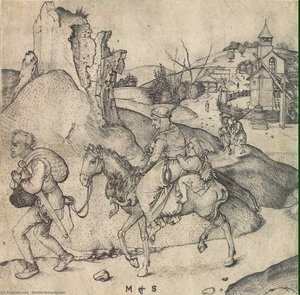
The Fourth Wise Virgin: A Glimpse into Northern Renaissance Mystery
Martin Schongauer’s “The Fourth Wise Virgin,” created around 1490, is more than just an engraving; it's a meticulously crafted window into the spiritual and artistic currents of late medieval Germany. This captivating image, housed within the National Gallery of Art in Washington D.C., draws upon both established iconography – referencing the biblical tale of the Wise Virgins – and Schongauer’s own distinctive style, blending meticulous detail with an almost haunting sense of introspection. The work immediately commands attention not through grand scale or overt drama, but through a profound quietude and a subtle layering of symbolism that invites prolonged contemplation.
Schongauer's artistic lineage is deeply rooted in the traditions of goldsmithing, a craft he likely learned from his father. This background profoundly shaped his approach to engraving – an art demanding unparalleled precision and control over line. The image’s remarkable clarity stems from Schongauer’s mastery of hatching and cross-hatching techniques, creating a sophisticated illusion of form and texture. He doesn't simply depict the figure; he sculpts her presence with carefully placed lines, imbuing the composition with an almost palpable sense of weight and volume. The use of negative space is equally crucial, drawing attention to the central subject while subtly suggesting the vastness of the surrounding world – a world both familiar and potentially perilous.
A Biblical Narrative Illuminated
The scene itself draws upon the well-known parable of the Wise and Foolish Virgins. Ten young women are preparing for the wedding of the king, each carrying a lamp filled with oil. The foolish ones neglect their duty, leaving their lamps unlit, and are subsequently barred from entering the celebration. The Fourth Virgin, depicted here in profile, embodies a serene yet subtly melancholic acceptance of her fate. Her posture is dignified, suggesting not despair but a quiet understanding of divine judgment. The candle she holds – a potent symbol of faith, enlightenment, and guidance – casts a gentle glow upon her face, illuminating her expression with an ethereal light.
Schongauer’s choice to focus on this particular virgin is intriguing. Unlike the more overtly dramatic depictions found in other prints from the series, Schongauer's rendering emphasizes introspection rather than external action. The background is deliberately sparse, devoid of elaborate details or distracting elements. This minimalist approach directs the viewer’s attention entirely onto the figure herself, amplifying her internal state and inviting us to contemplate the moral implications of the story. The composition subtly suggests a sense of isolation – a solitary figure contemplating a universal truth.
Technique and Historical Context
“The Fourth Wise Virgin” is a prime example of Northern Renaissance engraving, characterized by its meticulous detail, refined draftsmanship, and a deep engagement with both religious iconography and contemporary fashion. Schongauer’s work reflects the influence of Early Netherlandish painting, particularly the realism and attention to texture evident in the drapery and facial features. The print's creation coincided with a period of significant artistic innovation, as engravers began to explore new techniques for achieving greater tonal range and simulating the effects of paint. The use of a copper or iron plate, meticulously etched with lines using specialized tools like burins, is itself a testament to Schongauer’s technical skill.
Furthermore, the print's creation occurred during a time of intense religious fervor and social upheaval in Europe. The Reformation was gaining momentum, challenging traditional beliefs and practices. Schongauer’s work can be interpreted as a meditation on themes of faith, judgment, and redemption – timeless concerns that resonated deeply with audiences throughout the Renaissance.
A Timeless Symbol of Reflection
“The Fourth Wise Virgin” endures not merely as a beautiful engraving but as a poignant reflection on human nature. Schongauer’s masterful use of line, light, and shadow creates an image that is both visually arresting and emotionally resonant. It's a work that invites viewers to contemplate their own choices, their own faith, and their place within the larger narrative of life and death. The engraving’s quiet dignity and subtle symbolism continue to captivate audiences centuries after its creation, solidifying Schongauer’s legacy as one of the most important printmakers of the Northern Renaissance.
Questions et réponses
Quelle est l'intensité des couleurs de «The Fourth Wise Virgin» de Martin Schongauer ?
Les couleurs de «The Fourth Wise Virgin» de Martin Schongauer présentent une intensité Monochromatic.
«The Fourth Wise Virgin» de Martin Schongauer est-il une composition en portrait, en paysage ou carrée ?
«The Fourth Wise Virgin» de Martin Schongauer est une composition en Portrait. Il convient de vérifier les proportions avant de choisir un format d'impression.
Quelle technique a été utilisée pour «The Fourth Wise Virgin» de Martin Schongauer ?
« The Fourth Wise Virgin » est réalisé en Engraving.
Biographie de l'artiste
Martin Schongauer : Vie et Héritage
Jeunesse et Formation
Martin Schongauer, né vers 1450 à Colmar, en Alsace (aujourd'hui France), est une figure clé dans le développement de l’estampe pendant la Renaissance du Nord. Il venait d’une famille d’artisans ; son père, Caspar Schongauer, était un orfèvre qui s’était installé à Colmar depuis Augsbourg, en Allemagne, vers 1440. Cet héritage familial a influencé considérablement sa formation artistique précoce, car l'orfèvrerie lui a fourni une base solide en précision et en techniques de travail du métal – des compétences directement transférables à la gravure.
Éducation et Développement Artistique
En 1465, Schongauer a brièvement étudié à l’Université de Leipzig, mais il a rapidement abandonné les études académiques pour se consacrer pleinement à l’art. Il s’est d’abord formé comme peintre auprès de Caspar Isenmann, un maître local influencé par la peinture néerlandaise du Nord, en particulier le travail de Rogier van der Weyden. Cette première exposition à la réalité néerlandaise et à l'attention aux détails deviendrait des caractéristiques propres au style de Schongauer.
Style Artistique et Influences
Le style artistique de Schongauer est caractérisé par une esthétique gothique claire et organisée, combinée aux influences émergentes de la Renaissance du Nord. Il n’a pas eu d’influence directe italienne, mais a puisé son inspiration dans les traditions allemandes et néerlandaises du Nord. Son œuvre démontre un souci du détail, des figures expressives et une compréhension sophistiquée de la composition.
- Caractéristiques Clés : Gravure précise, représentations réalistes, récits dramatiques, structure gothique
- Influences : Rogier van der Weyden, Caspar Isenmann, traditions gothiques allemandes
Réalisations Majeures et Œuvres
Schongauer est surtout connu pour ses 116 gravures, chacune portant sa monogramme. Ces estampes ont été largement diffusées en Europe, influençant considérablement le développement des techniques et des styles d’estampe. Ses gravures représentaient souvent des scènes religieuses, des portraits et des sujets allégoriques.
- La Madone du jardin de roses (1473) : Une peinture significative présentant sa maîtrise de la représentation des détails délicats et de la profondeur émotionnelle.
- Gravures : Incluant *La Tentation d’Antoine*, *L'Adoration des bergers* et de nombreuses autres, démontrant sa maîtrise de la technique de la gravure.
Signification Historique et Héritage
L’impact de Martin Schongauer sur le monde de l’art était considérable. Il a été l'un des premiers artistes allemands à obtenir une reconnaissance internationale en tant que graveur. Ses estampes étaient très recherchées et largement copiées, diffusant son style artistique dans toute l’Europe. Il est même documenté que Michel-Ange lui-même étudiait et copiait l’une de ses gravures – *Le Jugement d'Antoine* – démontrant le respect auquel Schongauer était tenu par les maîtres ultérieurs.
L’œuvre de Schongauer a comblé le fossé entre l’art gothique et la Renaissance, ouvrant la voie à des artistes comme Albrecht Dürer. Son utilisation innovante des techniques de gravure et son engagement envers le détail artistique ont laissé un héritage durable sur l'histoire de l'estampe et de l'art nord-européen.
Décès
Martin Schongauer est décédé à Breisach le 2 février 1491, laissant derrière lui un corps d’œuvre remarquable qui continue d’être célébré pour son mérite artistique et sa signification historique.

Martin Schongauer
1450 - 1491 , Allemagne
L'essentiel de l'artiste
- Artistic Movement Or Style: Renaissance du Nord
- Artists Or Movements Influenced By This Artist: ['Albrecht Dürer']
- Artists Who Influenced This Artist:
- Rogier van der Weyden
- Caspar Isenmann
- Date Of Death: 1491
- Full Name: Martin Schongauer
- Nationality: Allemand
- Notable Artworks:
- La Madone du jardin de roses
- Gravures : La Tentation d’Antoine
- L'Adoration des bergers
- Place Of Birth: Colmar, Allemagne
Articles connexes
Les 10 Chefs-d'œuvre de la Gravure qui ont Révolutionné l'Art | OriginalUniqueArt
Plongez dans l'univers fascinant des 10 chefs-d'œuvre de la gravure qui ont marqué l'histoire de l'art. Découvrez Dürer, Rembrandt, Goya et bien d'autres ! Retrouvez ces estampes célèbres en reproduction haute définition sur OriginalUniqueArt.com.

Hendrick Goltzius: Master Engraver & the Flourishing of Dutch Mannerism
Explore the life & art of Hendrick Goltzius, a master engraver of Dutch Mannerism. Discover his innovative techniques, iconic engravings like 'Jahel', and lasting influence on Baroque art. Learn about collecting Goltzius today.

L’Art de la Taille-Douce : Entre Rigueur du Burin et Émotion de la Gravure en Creux
Explorez la maîtrise technique de la taille-douce, du burin à l'eau-forte. Plongez dans l'excellence de la gravure d'art.

L'Éloge du Sillon : Histoire, Technique et Maîtrise de la Gravure en Taille-douce
Explorez la maîtrise technique de la taille-douce, du burin à l'eau-forte. Plongez dans l'art de la gravure avec nos experts.

Engraving: A Historical Survey of Technique, Artistic Expression & Enduring Legacy
Explore the rich history of engraving with OriginalUniqueArt. Discover techniques, iconic artists like Dürer & Callot, collecting tips, and expert guidance for preserving your art investment. Learn about intaglio printing & more!