

 Envoyer
 Partager
 Détails de l'œuvre

 Télécharger
 Articles similaires
 Diaporama
Dress


 Lire la suite
Giclées et impressions d'art
Impressions giclées ou sur toile de qualité musée, avec une production rapide et des finitions au choix. ( Commander la reproduction peinte à la main Acheter l'image haute résolution)




































Choisissez parmi nos formats prédéfinis qui respectent les proportions originales de l’œuvre.

Vous pouvez saisir vos propres dimensions pour vous adapter à un cadre ou à un espace spécifique. Si la taille sélectionnée ne correspond pas aux proportions de l'image originale, nous recadrerons l'œuvre ou étendrons l'image avec une bordure en miroir ou une couleur unie. Une maquette numérique vous sera envoyée pour approbation avant le début de la production.
Veuillez noter que l'aperçu à l'écran ne reflète pas le recadrage ou l'extension réelle. Seule la maquette montrera avec précision la composition finale.
Bien que des tailles personnalisées soient disponibles, nous vous recommandons de choisir une dimension dans la liste prédéfinie afin de préserver les proportions originales.
Livraison dans le monde entier () en 2 semaines au lieu des 4/5 semaines habituelles. (29 août)

Livraison express gratuite dans le monde entier

Toile de lin de qualité supérieure

Assurance transport complète

Garantie de remboursement des droits de douane

Garantie de fidélité des couleurs

Politique de retour de 60 jours (uniquement en cas de défaut)

Garantie de remboursement à 100%

Offre de tarifs dégressifs
 L'option verre n'est disponible que pour les dimensions inférieures à 110 cm.

Dress
Giclées et impressions d'art
Format de la reproduction
-


Prix total
$ 80
A Glimpse of Parisian Elegance: Mariano Fortuny’s “Dress”
Mariano Fortuny y Marsal's "Dress," a captivating black and white photograph capturing a mannequin adorned in an opulent gown, offers more than just a visual representation; it’s a portal into the innovative world of a Spanish designer who revolutionized theatrical lighting and textile artistry at the turn of the 20th century. The image, dated 1925, presents a study in controlled elegance – a testament to Fortuny's meticulous approach and his ability to evoke a sense of timeless sophistication through carefully orchestrated detail. The mannequin, posed against a simple wall, becomes a stage for the dress itself, highlighting its intricate design and commanding presence.
Fortuny’s genius lay not just in creating beautiful garments but in fundamentally altering how they were presented. Born in 1871 in Granada, Spain, his early life was shaped by the untimely death of his father, a genre painter, which led to a move to Paris and an immersion into the world of textiles – a passion that would define his entire career. He wasn’t merely a fashion designer; he was a visionary inventor, driven by a desire to mimic the soft, diffused light of the East in theatrical productions. This pursuit led him to develop the “fortuny cyclorama,” a revolutionary dome system that utilized reflecting surfaces to create seamless transitions between scenes and bathe performers in an ethereal glow – a technique directly informing his approach to garment design.
The Delphos Dress: A Masterclass in Orientalist Design
“Dress” is intimately connected to Fortuny’s most celebrated creation, the “Delphos” gown. Inspired by the opulence of the Alhambra palace in Granada and drawing heavily on his travels through the Middle East, the Delphos dress embodies a distinctly Orientalist aesthetic. The photograph captures elements of this influence – the flowing lines, the intricate patterns reminiscent of mosaics and textiles, and the overall sense of luxurious comfort. The dress itself is constructed from layers of silk, cording, and delicate beads, creating a textured surface that catches the light beautifully. It’s a garment designed to be worn with grace and confidence, projecting an aura of refined mystery.
Fortuny's meticulous attention to detail extended beyond mere aesthetics; he was obsessed with achieving a specific *feeling* through his designs. He believed in creating garments that told stories – narratives of exotic lands, ancient civilizations, and the beauty of the natural world. The “Dress” photograph subtly hints at this narrative, inviting the viewer to imagine the wearer gliding through grand halls or strolling along sun-drenched streets.
Technique and Innovation: Fortuny’s Legacy
The photograph's stark black and white palette emphasizes the textures and forms of the dress, highlighting Fortuny’s masterful use of fabric manipulation. The layering of silk creates a sense of depth and movement, while the beads add subtle shimmer and sparkle. His innovative approach to lighting, pioneered in his theatrical work, is also evident in the way the photograph captures the play of light on the garment's surface. This wasn’t simply about creating beautiful clothes; it was about controlling and shaping light itself.
Fortuny’s impact extended far beyond fashion. He established a workshop that produced not only clothing but also stage sets, tapestries, and decorative fabrics – all united by his distinctive artistic vision. His work continues to inspire designers today, demonstrating the enduring power of combining artistry, innovation, and a deep appreciation for cultural heritage. The “Dress” photograph serves as a poignant reminder of Fortuny’s legacy—a testament to a singular talent who transformed the world of design in the early 20th century.
Collecting the Spirit of Fortuny
Reproductions of Fortuny's designs, like this "Dress," offer a remarkable opportunity to bring his visionary aesthetic into your home. Whether you’re drawn to the romantic allure of the Delphos gown or simply appreciate the elegance and sophistication of his textile artistry, a Fortuny reproduction is more than just a decorative object; it’s a window into a bygone era—a celebration of creativity, innovation, and timeless beauty.
Biographie de l'artiste
Early Life and Inspiration
Mariano Fortuny y Marsal (1838-1874), painter orientalist spanish, was born in Grenada on May 5, 1838, to a modest family of artists. When Fortuny was three, his father died suddenly — a loss he carried the rest of his life. After his father’s death, his mother moved the family first to Paris, france, where mariano's mother introduced him to various textiles and fabrics that would later influence his creativity.Artistic Talents and Inventions
Mariano Fortuny showcased his artistic talents from a young age, demonstrating skills in painting, photography, sculpting, architecture, etching, and theatrical stage lighting. His inventions, including over twenty patented between 1901 and 1934, revolutionized the world of theater design.- He developed the fortuny cyclorama dome, a quarter dome-shaped structure of plaster or cloth, which used indirect lighting to create a seamless transition between scenes.
- His treatise "eclairage scenique" (1904) described his discovery of reflecting light off different surfaces, changing its color, intensity, and properties.
Notable Contributions and Collaborations
Mariano Fortuny's work gained widespread recognition in the 1920s. He collaborated with notable figures, including:- Richard Wagner, a german composer, whose operas inspired mariano to paint scenes.
- The famous opera house, La Scala of Milan, where he installed his dome, adapting it for the larger theater and inventing a suction fan to maintain its taut structure.
Legacy and Later Life
Mariano Fortuny passed away on May 3, 1949, in venice, italy. His work inspired french novelist Marcel Proust, and his life was depicted in pere gimferrer's novel "fortuny." Mariano’s legacy continues to influence the world of theatrical design.- Explore more about mariano fortuny's inventions and designs at OriginalUniqueArt's collection.
- Discover the impact of his work on theatrical lighting in The Museum Destroyed by Fire (united states), a story of an unfortunate event that shaped american art history, available at OriginalUniqueArt's blog.
Selected Paintings by Mariano Fortuny and Other Artists
- Mariano Fortuny: Teagown (museum of fine arts, boston, united states), available at OriginalUniqueArt's collection.
- Marc Chagall: Study to 'song of songs iv' (naive art / primitivism), available at OriginalUniqueArt.com/@@/8xyhdc-marc-chagall-study-to-song-of-songs-iv
- Pablo Picasso: Clarinet (analytical cubism, oil on canvas), available at OriginalUniqueArt.com/@@/8xz53k-vincent-van-gogh-tree-roots
- Vincent van Gogh: Tree Roots (50 x 100 cm, post-impressionism, oil on canvas), available at OriginalUniqueArt.com/@@/8xz53k-vincent-van-gogh-tree-roots

Mariano Fortuny
1871 - 1949 , Espagne
L'essentiel de l'artiste
- Artistic Movement Or Style: Orientalism art
- Artists Or Movements Influenced By This Artist: ['Marcel Proust']
- Artists Who Influenced This Artist: ['Richard Wagner']
- Date Of Birth: May 11, 1871
- Date Of Death: May 3, 1949
- Full Name: Mariano Fortuny y Marsal
- Nationality: Spanish
- Notable Artworks:
- Teagown
- Portrait of Henriette Fortuny
- Place Of Birth: Granada, Spain
Articles connexes

Mariano Fortuny: A Fusion of Art, Fashion & Design – Exploring a Venetian Innovator's Legacy
Explore the captivating world of Mariano Fortuny – artist, designer & innovator. Discover his revolutionary textiles, iconic Delphos gown, and lasting influence on art, fashion & interiors. A collector's guide to a Venetian master.
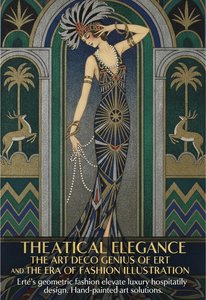
Theatrical Elegance: The Art Deco Genius of Erté and the Era of Fashion Illustration
Explore the theatrical elegance of Erté and the Art Deco era. Discover how his mastery of geometric line and fashion illustration can elevate luxury hospitality design through premium, hand-painted reproductions and bespoke architectural art solutions.
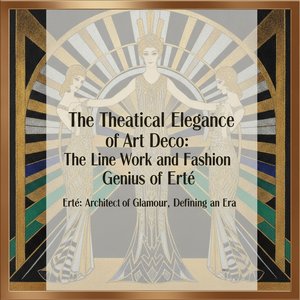
The Theatrical Elegance of Art Deco: The Line Work and Fashion Genius of Erté
Discover the unparalleled elegance of Art Deco through the lens of Erté. Explore a masterclass in linear precision, theatrical costume design, and high-fashion illustration that continues to define modern luxury and sophisticated interior aesthetics.
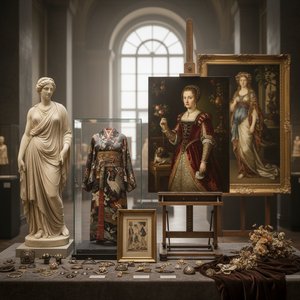
Draped Narratives: Fashion as Symbol & Subject in Historical Art
Explore the fascinating history of fashion as a symbol of power & status in art! Discover masterpieces from Gainsborough to Tissot and learn how clothing shaped societal narratives. Find museum-quality reproductions at OriginalUniqueArt.

L'Âge d'Or Réinventé : Esthétique et Héritage Durable de l'Art Déco
Explorez l'histoire fascinante de l'Art Déco : influences, artistes emblématiques, matériaux luxueux et héritage durable. Découvrez comment ce style révolutionnaire continue d'inspirer le design contemporain.



