

 Aperçu en situation
 Partager
 Partager
 Détails
 Guide imprimable

 Télécharger
 Articles similaires
 Radiographie
 Voir le diaporama
 Statistiques
Trébuchet (Trap)


 Afficher la suite
L’œuvre d'art présentée sur cette page est protégée par le droit d'auteur, ce qui signifie que nous ne pouvons légalement créer ou vendre de reproduction identique. Cette protection est appliquée en vertu d'accords internationaux tels que la Convention de Berne et par les lois nationales, notamment celles énoncées par le Loi américaine sur le droit d'auteur - Titre 17.
Cette méthode est pleinement conforme aux réglementations sur le droit d'auteur car elle ne repose pas sur la copie ou la duplication de l'œuvre protégée. Il s'agit plutôt d'une réinterprétation créative — une nouvelle peinture qui s'inspire de l'original sans pour autant lui être identique.
Giclées et impressions d'art
Impressions giclées ou sur toile de qualité musée, avec une production rapide et des finitions au choix. ( Acheter la peinture faite à la main Passer au format image numérique)




P118B €10

P118H €10

P118W €10

P438Z €10

P508JH €12

P508YH €12

P805H €10

P805Z €10

P919BZ €10

P919G €10

P919XJ €10

P959ZH €10

P968JZ €12

W106C €8

W218G €10

W218JH €8

W218Y €10

W307PJ €10

W316G €10

W316PJ €8

W316Y €10

W398PJ €8

W4111J €10

W500HY €15

W500JH €15

W692G €12

W849H €8

W940BG €15

W953PJ €8




Choisissez parmi nos formats prédéfinis qui respectent les proportions originales de l’œuvre.

Saisissez la largeur et la hauteur souhaitées pour qu'elles s'adaptent à votre cadre ou à votre mur. Une impression ne peut être que découpée, elle ne peut jamais être agrandie au-delà de l'image originale ; ainsi, un format de forme différente entraînera la perte d'une partie de l'image. Nous vous envoyons une maquette numérique pour approbation avant toute impression. L'image présentée sur cette page ne montre pas le recadrage réel — seule la maquette le permet.
Livraison dans le monde entier () en 2 semaines au lieu des 4/5 semaines habituelles. (21 octobre)

Livraison express gratuite dans le monde entier

Toile de lin de haute qualité

Assurance transport complète

Garantie de remboursement des droits de douane

Garantie de fidélité des couleurs

Garantie de retour de 100 jours (uniquement en cas de défaut)

Garantie de remboursement à 100%

Tarifs dégressifs sur quantité
 L'option verre n'est disponible que pour les dimensions inférieures à 110 cm.

Trébuchet (Trap)
Giclées et impressions d'art
Format de la reproduction
-


Prix total final
€ 70
Deconstructing the Everyday: Duchamp’s *Trébuchet (Trap)*
Marcel Duchamp's 1964 work, *Trébuchet (Trap)*, is a deceptively simple composition – a wooden plank supporting four black wrought-iron hooks. Yet, within this apparent banality lies a profound statement about art, perception, and the very definition of an artwork. Far from a traditional painting or sculpture, *Trébuchet* exemplifies Duchamp’s pioneering embrace of “readymades,” challenging conventional artistic boundaries and forcing viewers to reconsider what constitutes aesthetic value.
The Readymade & Conceptual Roots
- A Legacy of Disruption: Duchamp began his exploration of readymades in 1913, selecting mass-produced objects and presenting them as art. This radical approach rejected the emphasis on skillful execution and aesthetic beauty that had long defined artistic practice.
- Challenging Artistic Conventions: *Trébuchet* isn’t merely an object displayed; it's a conceptual gesture. Duchamp elevates a functional, utilitarian item – likely part of a butcher shop or similar setting – to the status of art through the act of selection and presentation.
- Beyond Retinal Art: Duchamp famously dismissed “retinal art” – work intended solely for visual pleasure. He sought instead to engage the intellect, prompting viewers to question their assumptions about art’s purpose and meaning. The title itself, *Trébuchet (Trap)*, adds a layer of intrigue, suggesting a hidden intention or a subtle provocation.
Materiality & Visual Impact
The stark contrast between the rough-hewn wooden plank and the smooth, polished metal hooks creates a compelling visual tension. The natural grain of the wood speaks to its origins, while the manufactured precision of the iron suggests industrialization and standardization. This juxtaposition highlights Duchamp’s interest in the interplay between the organic and the artificial. The composition is deliberately unadorned, focusing attention on the object's inherent qualities rather than any embellishment. The neutral color palette further emphasizes this sense of austerity and objectivity.
Symbolism & Interpretation
- Functionality Questioned: While hooks are inherently designed for holding or suspending objects, *Trébuchet* presents them devoid of their intended purpose. This deliberate removal of function forces us to contemplate the object's form and its relationship to space.
- The Trap Metaphor: The title suggests a sense of deception or entrapment. Is Duchamp trapping the viewer in a conceptual puzzle? Or is he commenting on the traps inherent within the art world itself – the expectations, conventions, and power structures that define artistic value?
- A Reflection of Modernity: Created during a period of rapid technological advancement and social change, *Trébuchet* can be seen as a reflection of modernity’s anxieties and uncertainties. The work embodies a sense of alienation and detachment, mirroring the fragmented experience of modern life.
Ultimately, *Trébuchet (Trap)* is not about what it depicts but rather about what it represents – a radical challenge to artistic norms and an invitation to engage in critical thinking. Its enduring power lies in its ability to provoke dialogue and inspire new perspectives on the nature of art itself.
Questions et réponses
L'œuvre « Trébuchet (Trap) » est-elle libre de droits ?
Le statut des droits d'auteur pour «Trébuchet (Trap)» de Marcel Duchamp : l'œuvre est dans le toujours protégé par le droit d'auteur. Cela détermine si les reproductions de l'image peuvent être réalisées librement.
Où puis-je acheter une image numérique de «Trébuchet (Trap)» de Marcel Duchamp ?
« Trébuchet (Trap) » est disponible en tant que un téléchargement d'image numérique haute résolution, à acheter directement sur sa page Image numérique.
En quelle année et dans quel mouvement "Trébuchet (Trap)" a-t-elle été réalisée ?
« Trébuchet (Trap) » a été créé en 1964, s'inscrivant dans le mouvement Conceptual Art. La date et le mouvement ancrent l'œuvre dans l'histoire de l'art.
Biographie de l'artiste
jeune vie et débuts artistiques
marcel duchamp, peintre, sculpteur, joueur d'échecs et écrivain français-américain, est né le 28 juillet 1887 à Blainville-Crevon, en Normandie, France. Sa famille, connue pour ses inclinations culturelles, a encouragé son intérêt précoce pour l’art. Le parcours artistique de Duchamp a commencé avec des styles post-impressionnistes, expérimentant avec les techniques et les sujets classiques.évolution artistique et œuvres notables
- L'œuvre de marcel duchamp est associée au cubisme, à l’art conceptuel et au dadaïsme, bien qu'il soit prudent quant à son utilisation du terme dada.
- L'une de ses œuvres les plus célèbres, Fountain (1917), un urinoir signé « r. mutt », est un exemple de ses ready-mades, remettant en question la notion de ce qui constitue l’art.
- Portrait de joueurs d'échecs (1911), une œuvre cubiste, met en évidence son intérêt pour le jeu et ses aspects stratégiques.
- To be looked at (from the other side of the glass) with one eye, close to, for almost an hour (1945) est une autre œuvre notable, reflétant ses inclinations dadaïstes.
influence et héritage
L'impact de Duchamp sur l’art du XXe siècle est immense. Il, avec Pablo Picasso et Henri Matisse, a défini les arts plastiques au début du XXe siècle. Son approche conceptuelle de l’art a influencé des générations d’artistes.- Explorez davantage les œuvres de Duchamp sur OriginalUniqueArt : Marcel Duchamp | œuvres
- Découvrez le Musée Ohara d'art, au Japon, qui présente des collections d’art occidental, dont certaines influencées par le style de Duchamp : Musée Ohara d'art, Japon
- Apprenez-en davantage sur le lettrisme, un mouvement influencé par le dadaïsme et le surréalisme, dans lequel Duchamp participait : Mouvement artistique du lettrisme
conclusion
L’approche énigmatique de l’art de Marcel Duchamp, combinant des éléments conceptuels et dadaïstes, a laissé une marque indélébile sur le monde de l’art. Son héritage continue d'inspirer les artistes et d'influencer le développement de l’art moderne et contemporain. Franck Scurti, artiste français connu pour son art conceptuel, suit les traces de cet artiste pionnier.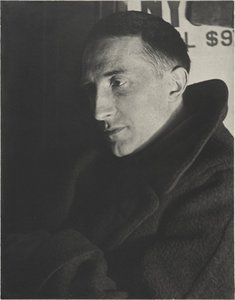
Marcel Duchamp
1887 - 1968 , France
En bref
- Artistes Influencés: ['Franck Scurti']
- Date De Décès: 2 octobre 1968
- Date De Naissance: 28 juillet 1887
- Influence:
- Pablo Picasso
- Henri Matisse
- Lieu De Naissance: Blainville-sur-Mer, France
- Mouvement Artistique:
- Cubisme
- Dadaïsme
- Art conceptuel
- Nationalité: Français-Américain
- Nom Complet: Marcel Duchamp
- Oeuvres Notables:
- Fontaine
- Portrait de joueurs d'échecs
- La Grande Verrière
- Boîte-en-valise
Articles connexes
Marcel Duchamp: Challenging Conventions & Redefining Art in the 20th Century
Explore the revolutionary art of Marcel Duchamp! Discover how his Dadaist readymades challenged artistic conventions & redefined modern art. A deep dive into 'Fountain', conceptual shifts, and his lasting impact.

Les 10 Chefs-d'œuvre en Bronze qui ont Révolutionné l'Art : Collection OriginalUniqueArt
Plongez dans l'univers fascinant des 10 chefs-d'œuvre en bronze qui ont marqué l'histoire de l'art. Découvrez Rodin, Degas et les secrets de ces sculptures iconiques. Reproductions d'art exceptionnelles sur OriginalUniqueArt.com – Explorez la collection !

The Enduring Form: Sculpture Across History, Technique & Emotional Resonance
Explore the rich history of sculpture with OriginalUniqueArt. Discover key techniques, influential artists & investment potential for discerning collectors. Expert insights into valuing and collecting timeless masterpieces.

The Enduring Form: Exploring Themes & Techniques in Sculpture Across Historical Periods
Explore the rich history of sculpture from ancient masterpieces to contemporary innovations. Discover key techniques, influential artists & investment potential for discerning art collectors.

Les 10 Chefs-d'œuvre Bronzes Qui Ont Révolutionné la Sculpture | OriginalUniqueArt
Plongez dans l'univers fascinant des 10 sculptures en bronze les plus emblématiques de l'histoire de l'art. Rodin, Degas et autres maîtres révélés ! Découvrez leur histoire, leurs techniques et trouvez l'œuvre parfaite pour sublimer votre intérieur sur OriginalUniqueArt.com.


