

 Aperçu en situation
 Envoyer
 Partager
 Détails de l'œuvre

 Télécharger
 Articles similaires
 Radiographie
 Diaporama
 Statistiques
Échiquier

 Lire la suite
Reproduction à l'huile faite à la main
Huile sur toile peinte à la main, avec cadre et dimensions personnalisés, réalisée sur commande par nos artistes. ( Passer au format impression Passer à l'image numérique)




P118B $10

P118H $10

P118W $10

P438Z $10

P508JH $12

P508YH $12

P805H $10

P805Z $10

P919BZ $10

P919G $10

P919XJ $10

P959ZH $10

P968JZ $12

W106C $8

W218G $10

W218JH $8

W218Y $10

W307PJ $10

W316G $10

W316PJ $8

W316Y $10

W398PJ $8

W4111J $10

W500HY $15

W500JH $15

W692G $12

W849H $8

W940BG $15

W953PJ $8




Choisissez parmi nos formats prédéfinis qui respectent les proportions originales de l’œuvre.

Vous pouvez saisir vos propres dimensions pour l'adapter à un cadre ou à un espace spécifique. Si la taille sélectionnée ne correspond pas aux proportions de l'image d'origine, nous recadrerons l'œuvre ou prolongerons la peinture avec des éléments peints à la main supplémentaires. Une maquette numérique vous sera envoyée pour approbation avant le début de la production.
Veuillez noter que l'aperçu à l'écran ne reflète pas le recadrage ou l'extension réels. Seule la maquette montrera fidèlement la composition finale.
Bien que des tailles personnalisées soient disponibles, nous vous recommandons de sélectionner une dimension dans la liste prédéfinie afin de préserver les proportions d'origine.
Après la commande, l’équipe OriginalUniqueArt.com contactera le client par e-mail pour recueillir ses instructions et lui fournira une maquette d’aperçu
Livraison dans le monde entier () en 3 à 4 semaines au lieu des 5 semaines habituelles. (8 septembre). Aucun compromis sur la qualité.

Livraison express gratuite dans le monde entier

Toile de lin de qualité supérieure

Assurance transport complète

Garantie de remboursement des droits de douane

Garantie de fidélité des couleurs

Politique de retour de 100 jours (uniquement en cas de défaut)

Garantie de remboursement à 100%

Offre de tarifs dégressifs
 L'option verre n'est disponible que pour les dimensions inférieures à 110 cm.

Échiquier
Technique de reproduction
Format de la reproduction
-


Prix total
$ 300
A Silent Game: Unveiling Marcel Duchamp’s ‘Chessboard (Echiquier)’
Marcel Duchamp, a name synonymous with artistic revolution, consistently challenged the very definition of art throughout his prolific career. While celebrated for audacious “readymades” like *Fountain*, a porcelain urinal presented as sculpture, his explorations extended far beyond shock value. ‘Chessboard (Echiquier)’ from around 1937 offers a quieter, yet equally profound glimpse into Duchamp’s intellectual and artistic preoccupations. This isn't merely a depiction of a game; it is an embodiment of the artist’s lifelong fascination with strategy, intellect, and the dematerialization of art itself. The Allure of Strategy and Intellectual Pursuit Duchamp’s relationship with chess was far from casual. He didn't simply play the game; he immersed himself in it, even contemplating a professional career as a chess master after largely abandoning painting in the early 1920s. This wasn’t a flight *from* art, but rather a redirection of artistic energy into a realm demanding logic, foresight, and abstract thought – qualities Duchamp increasingly valued over purely aesthetic concerns. ‘Chessboard (Echiquier)’ therefore becomes symbolic of this shift. The worn wood, the missing pieces, suggest not a game in progress, but a contemplation *of* the game, a frozen moment representing endless possibilities and strategic calculations. It’s a visual metaphor for the artist's own creative process: a deliberate arrangement of elements, a calculated disruption of expectations. Technique and Conceptual Depth The simplicity of ‘Chessboard (Echiquier)’ is deceptive. Duchamp wasn’t interested in virtuoso painting or sculptural skill; his focus lay elsewhere. The work consists of sixty-four wooden squares nailed and glued onto plywood, a deliberately unrefined construction that emphasizes the object's conceptual nature over its aesthetic qualities. This deliberate lack of traditional artistic flourish aligns with Duchamp’s broader philosophical stance—a rejection of conventional notions of beauty and craftsmanship in favor of ideas and intellectual exploration. The absence of color contributes to this effect, highlighting the geometric precision of the design and reinforcing its symbolic significance as a representation of thought itself. It's an intentional antithesis to the expressive gestures characteristic of Impressionism and Post-Impressionism, demonstrating Duchamp’s commitment to pushing artistic boundaries. Historical Context and Duchamp’s Artistic Vision Created during the height of Dadaism—a movement born from disillusionment with the horrors of World War I—‘Chessboard (Echiquier)’ reflects Duchamp's desire to dismantle accepted artistic conventions and question the role of the artist in society. Like many Dada artworks, it deliberately subverts expectations by presenting a commonplace object—the chessboard—in an unexpected context. This gesture aligns with Dada’s broader critique of bourgeois values and its embrace of chance and absurdity. Duchamp viewed this act as a way to liberate art from the constraints of representation and to engage in a dialogue with the viewer about the nature of creativity and perception. The work stands as testament to Duchamp's conviction that art should provoke thought and challenge established norms—a legacy that continues to inspire artists today. Symbolism Beyond Geometry The chessboard itself carries rich symbolic associations, representing order versus chaos, strategy versus spontaneity, and control versus surrender. However, Duchamp deliberately stripped away any overt visual symbolism, leaving only the geometric form of the squares to convey its meaning. This minimalist approach underscores the artist’s belief that ideas—rather than sensory impressions—are what constitute true artistic value. The missing pieces further amplify this symbolic dimension, suggesting incompleteness and hinting at the infinite possibilities inherent in any given situation. They serve as a reminder that art should not simply depict reality but rather invite contemplation about its complexities and contradictions.- Artist: Marcel Duchamp
- Born Year: 1887
- Death Year: 1968
- Birth City: Blainville-sur-Mer
- Birth Country: France
Additional Research:
Biographie de l'artiste
jeune vie et débuts artistiques
marcel duchamp, peintre, sculpteur, joueur d'échecs et écrivain français-américain, est né le 28 juillet 1887 à Blainville-Crevon, en Normandie, France. Sa famille, connue pour ses inclinations culturelles, a encouragé son intérêt précoce pour l’art. Le parcours artistique de Duchamp a commencé avec des styles post-impressionnistes, expérimentant avec les techniques et les sujets classiques.évolution artistique et œuvres notables
- L'œuvre de marcel duchamp est associée au cubisme, à l’art conceptuel et au dadaïsme, bien qu'il soit prudent quant à son utilisation du terme dada.
- L'une de ses œuvres les plus célèbres, Fountain (1917), un urinoir signé « r. mutt », est un exemple de ses ready-mades, remettant en question la notion de ce qui constitue l’art.
- Portrait de joueurs d'échecs (1911), une œuvre cubiste, met en évidence son intérêt pour le jeu et ses aspects stratégiques.
- To be looked at (from the other side of the glass) with one eye, close to, for almost an hour (1945) est une autre œuvre notable, reflétant ses inclinations dadaïstes.
influence et héritage
L'impact de Duchamp sur l’art du XXe siècle est immense. Il, avec Pablo Picasso et Henri Matisse, a défini les arts plastiques au début du XXe siècle. Son approche conceptuelle de l’art a influencé des générations d’artistes.- Explorez davantage les œuvres de Duchamp sur OriginalUniqueArt : Marcel Duchamp | œuvres
- Découvrez le Musée Ohara d'art, au Japon, qui présente des collections d’art occidental, dont certaines influencées par le style de Duchamp : Musée Ohara d'art, Japon
- Apprenez-en davantage sur le lettrisme, un mouvement influencé par le dadaïsme et le surréalisme, dans lequel Duchamp participait : Mouvement artistique du lettrisme
conclusion
L’approche énigmatique de l’art de Marcel Duchamp, combinant des éléments conceptuels et dadaïstes, a laissé une marque indélébile sur le monde de l’art. Son héritage continue d'inspirer les artistes et d'influencer le développement de l’art moderne et contemporain. Franck Scurti, artiste français connu pour son art conceptuel, suit les traces de cet artiste pionnier.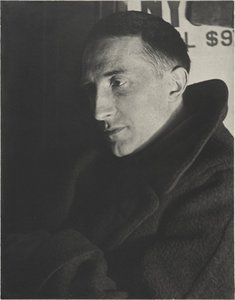
Marcel Duchamp
1887 - 1968 , France
L'essentiel de l'artiste
- Artistes Influencés: ['Franck Scurti']
- Date De Décès: 2 octobre 1968
- Date De Naissance: 28 juillet 1887
- Influence:
- Pablo Picasso
- Henri Matisse
- Lieu De Naissance: Blainville-sur-Mer, France
- Mouvement Artistique:
- Cubisme
- Dadaïsme
- Art conceptuel
- Nationalité: Français-Américain
- Nom Complet: Marcel Duchamp
- Oeuvres Notables:
- Fontaine
- Portrait de joueurs d'échecs
- La Grande Verrière
- Boîte-en-valise
Articles connexes
Marcel Duchamp: Challenging Conventions & Redefining Art in the 20th Century
Explore the revolutionary art of Marcel Duchamp! Discover how his Dadaist readymades challenged artistic conventions & redefined modern art. A deep dive into 'Fountain', conceptual shifts, and his lasting impact.

Abstraction Géométrique : Les 10 Chefs-d'œuvre qui ont Marqué l'Histoire de l'Art
Plongez au cœur de l'abstraction géométrique avec OriginalUniqueArt.com ! Découvrez les 10 œuvres majeures de Mondrian, Malevitch et Kandinsky qui ont révolutionné l'art moderne. Inspirez votre décoration intérieure avec des reproductions de tableaux exceptionnelles. Explorez la collection en ligne !

Expressionnisme Abstrait : Les 10 Chefs-d'Œuvre Incontournables pour Décorer avec Art et Histoire
Plongez au cœur de l'Expressionnisme Abstrait avec ! Découvrez les 10 œuvres majeures de Pollock, Rothko et De Kooning. Histoire, techniques & inspiration déco. Explorez la collection complète en ligne.

Kandinsky : Les 25 Œuvres Maîtresses d'un Pionnier de l'Art Abstrait | OriginalUniqueArt
Plongez dans l'univers vibrant de Kandinsky ! Découvrez les 25 œuvres majeures du pionnier de l'art abstrait. Explorez son expressionnisme, ses couleurs audacieuses et l'histoire fascinante derrière chaque tableau. Reproductions d'exception sur OriginalUniqueArt.com.
Dadaism Explained: The Anti-Art Movement That Redefined Modernity
Explore the radical origins of Dadaism. From the chaos of WWI to Marcel Duchamp's revolutionary readymades, discover how this anti-art movement dismantled tradition and birthed modern conceptual art. An essential guide for students and collectors of fine art history.


